Diary – Part Ten–I
July 2026 – August 2026
Linas Vepštas
Abstract
Unlike parts one through nine in this series, this one is not really about the language–learning effort. It is instead a private diary; a continuation of Part Ten–H, which got over–long. It is not curated for human consumption; I am making the assumption that no human being will ever actually read this. Thus, it is filled with random stuff I feel like writing. Some of it is very personal, some of it is nonsense. Mostly, I am finding that the act of writing helps otherwise vague and scattered thoughts quantum–collapse into a more coherent form, where I can examine them, like a dead butterfly pinned down in a display case. Dead words.
If you are interested in this content, then you should ask an AI agent to read it, then ask the AI agent to pretended that it’s me, then talk to virtual “me”. I believe that present–day LLM technology is sufficiently advanced to be able to do this.
Introduction
Part Ten already got an introduction. A different way of thinking is about what is going on here is that this is a form of life–logging. Or, in 18th century terms, a diary. Just not anywhere near as compelling as those written by the famous diarists. This one is more of a mental self–portrait. And not even for you but for myself. Not to cast a narcissistic gaze at my own words, but to organize my own thoughts. Still in the experimental stage.
4 July 2026
There’s an earlier 4 July entry in Part Ten–H. I split it here because reasons.
Well, its late afternoon, and I’m tired, been writing since morning, but I don’t know what else to do.
Upon finishing the CBC paper, I’m left teetering on next steps. One urgent one is to algebraicize the the agential model I sketched a few weeks ago. This is vital, as it provide an explicit algebraic framework for exploring CBC. A different next step is to examine and rewrite Tononi IIT Phi in terms of jigsaws. This would better expose the scaling behavior of jigsaws that have a large number of tabs, sorted by strength/importance. Maybe even Phi would help rank these by importance? i.e. provide a graph–theortic weighting similar to graph centrality, but weighted by connectivity? This seems like a good little mathematical problem I could get lost in. But then there’s an irritant: what is volition? My agent model requires volition, expressed as choice in a menu, as a vital, central ingredient for phenomenal, conscious “weak” subjective awareness. But I get stuck when trying to evade the deterministic Turing trap, here. It’s irritating. Oh, but I have in idea. See below. Finally, the CBC paper makes a striking assertion about evolution: since the cells (agents) are conscious, they can use some political process to reason their way into directed evolution. To basically engineer their own future evolutionary state. This is remarkable, because it overcomes the combinatoric explosion usually seen when random mutation is used to drive evolution. Articulating and explaining this would be a huge algorithmic breakthrough. This is fun, because it again suggests a system operating near critical opalescence, avalanching near a phase transition.
OK, but perhaps I need to tackle the hardest problem first, as everything else seems to rest upon this. This is the problem of volitional choice. So all I’ve got is this hare–brained idea. Turtles all the way down.
So, lets assume a menu has appeared via some mechanism. To be concrete, in the case of my Atomese learning agents, the menu of choices are: (a) move to a different file in this directory (b) move to another directory (c) do word–pair counting on this file (d) do disjunct parsing and counting on this file (e) do clustering & classifiction (f) maybe other menu choices. Since Atomese is computable, this is all Turing deterministic, there is no free will. I can write some algo that will randomly pick one of these menu items, maybe by some weighted importance. Still, there is no free will. This is unsatisfying, so what can we do?
The goofball proposal is to posit an oracle of some sort, a Turing oracle, that will make the decision using some impenetrable logic. This is goofy, because its non–physical.
The remaining proposal is to posit quantum effects. This is in accordance with the physical world, except that the physical world is incompletely understood, viz. quantum collapse is magical. So now, we imagine the agent, and it’s menu of choices, in some quantum superposition. Let’s suppose the six menu items to be in some pure state, i.e. to correspond to state vectors with phases. Viz. the current menu is
with each
being a menu choice (corresponding to a menu choice). These correspond to the eigenstates of a decision operator
so that
and the agent has made a choice when
has been applied to the current menu, resulting in a wave–function collapse, which is interpreted as a choice. Because it is a collapse, it immediately enters the past, and is no longer a part of the present. That is, wave–function collapse marks the forward march of time. Time ticks because wave functions collapse; it is the originator and driver of time.
Whatever. But, at any rate, the agent itself would then be in some superposition, with the possible future motor actions entangled with the choice menu. That is, the agent state is
with each
being the motor movement associated with menu choice
. That is, the agent collapses to state
and performs movement
. Umm, I’m slightly confused: if this was a finite state machine, this says that the machine transitions to state
.
Perhaps I’m doing my analysis wrong: I should be writing this out using the language of a quantum finite automaton (alternately, as a geometric finite automaton!?, but I don’t see that this mild generalization matters, for the moment, except as an OK intellectual exercise.) So lets do this.
But, before we do this, note that we skipped over avalanching as a purely classical but somehow non–deterministic means of choosing and making a selection. That is, the system sits on the verge of making a decision, and the menu of choices is somehow analogous to the abelian sand–pile. Most choices are small: e.g. “process the next word pair”. But sometimes, end of file is reached, and now the menu expands. The driver of the avalanche is some minor external event. It triggers the avalanche, interpreted as a state transition to a new state. Is it free–will–ish? Well, not quite, not conventionally, because a small external influence can trigger a large internal rearrangement, when the internal system is poised on the edge of stability.
OK, one last trick before this analysis can begin. By using the generic geometric finite state machine algebraic axioms and notation, we can use exactly the same notation to describe a DFA, PFA, QFA or other GFA, leaving most of the framework the same. (Here DFA==deterministic, PFA==probabilistic, QFA==quantum, etc.)
It’s 7:30 PM. I’m tired. Do I really want to start this now? Maybe I can lay down some basics?
5 July 2026
I just woke up. Well, 20 mins ago, but had to make coffee, whatever. I am now trying to ... not hurt myself. Didn’t work. Instead, I read six pages of Baltušis. Apparently, the thought of writing formulas first thing in the morning started to make my head hurt. What’s the problem? I had one cocktail last night, only one. And I’m dehydrated. Yesterday was the 4th of July. I hoped to find some Americans to celebrate with. I didn’t. One cocktail doesn’t make me drunk any more. Maybe it never did, but I have the feeling I’m less alcohol sensitive now, than when I was younger. I wonder what that is. Google AI says it should be the opposite: lower muscle mass and slower liver means higher blood alcohol percentage. Well, except I have higher muscle mass now, than when I was younger. Whatever. I still woke with ... I feel fine, but the thought of writing formulas raised a certain pressure in my head. The intellectual effort does create sudden sharp elevations in assorted synaptic fluids, and, I guess just like any motor slammed into gear, the shock can be harmful. Different mechanisms run at different rates, the fastest ones just have to wait for the slowest ones to come up to speed.
I’m ready for math now. Just a few words. Nothing interesting happened last night; alas. The night before, I wrote up, in part, above. What I did not write up was that I met a 53–year–old psychiatrist who seemed to marvel at my command of the language. Perhaps I made a strong first impression. I walked up to her, direct (the place was empty) and told her about the vatnik angel episode that occurred just moments earlier. She was actually the first to use the word “angel”, so I went with that. Presumably, psychiatrists are very good at observation. We had fun talking. The only issue was that she kept telling me how awesome I am, here and there. I don’t need to be told that. I’m fully self–affirmed. I guess I should have told her that. I’m confident. If I ever see her again, and if she ever complements me again, I will have to ask her if confirmation is a natural part of psychiatric help. Maybe she just says that out of habit? Hmm. Google AI says no. Psychiatrists just become normal when off duty. Maybe she just liked me. We had good rapport. For a while, I got to thinking that she was thinking “At last! A normal person! Without pathologies!” and was relieved.
Maybe I should start a “normal person club”. Invite her, and Lenonas. And see what happens.
Anyway. Time for work.
—————————-
Lets define a “measure–preserving finite automaton”. This will be inadequate for the agent model, but is one of the central concepts, so lets start.
Let
a finite set of symbols, the input alphabet. (I guess it could be countable:
or maybe larger, bt for now just, uhh, countable?)
Let
be space with a Borel algebra
and a measure
. Let
be a collection of transformations
that are measure–preserving
for all
.
For the case of
this corresponds to the standard definition of a dynamical system. When there is only one
, it is interpreted as the forward–time evolution of the system. But here, it is curiously different. One possible interpretation is that there are
different time axes. But this is bunkum, since we will soon impose the requirement that for each time step, one and only one
must be chosen. This implies an interpretation that there are many possible futures ahead of us. The selection of just one
is the selection of one possible future, and mapping it into the present (here and now). Huh. Well, I think I just got lucky, here, because I wasn’t planning this in advance. Again, the universe sings.
So, now, we mention that this can be specialized to multiple common cases.
- For
a finite set of states,
the counting measure, and
the transition function
one gets the bog–standard finite state machine. (Not yet a transducer, as there is no output, so Moore and Mealey do not yet enter the discussion.) If we set it up so that the initial state is
then the measure is irrelevant, as the state transition function guarantees that the machine is always in just one and only one state at a time. A probabilistic state machine can be defined by having multiple initial states, and then purpose of the measure is to make sure we don’t get too many (or too few) of them as the system progresses.
- For
an
–simplex, and
a Markov chain, one get a probabilistic finite automaton. If the starting point is a single point
, then the measure
is once again irrelevant, as the Markov chain again guarantees that the machine is only in one state. Contacting with conventional notation,
a vector of
real numbers, interpreted as probabilities:
. There’s awkwardness in contacting with the conventional
notation for Markov chains, since that notation requires a distinct random variable
for each time–step
and so the convention of “random variables” is awkward in the present setting. It can be done, but I see no point in trying to make contact with that notation. It just would be a wall of text that doesn’t clarify anything.
- For
complex projective space, or, alternately,
a Hilbert space, and
a set of unitary transformations, one gets a quantum finite automaton. A single point
is interpreted as a pure state. A mixed state is then a collection of points in
; when this collection is uncountable, the Borel algebra and the measure is employed, so as to make the application of the unitary transforms meaningful. The quantum finite automaton is exactly the same thing as the “computer” of “quantum computing” and there is a vast ocean of notation and conventions for talking about this. I don’t see much point in articulating these at this time, other than to mention that the
would correspond to “gates” of various sorts, and the measure here becomes the Bures measure (Fubini–Study metric for mixed states).
- It might be interesting to generalize from
to
some (complex) variety, or even a scheme, but I don’t see the point of this just right now. This is the “varietal state machine”.
- For
a homogeneous space (viz. quotient of Lie groups) and the
being transformations on this homogeneous space, one gets the “geometric state machine”. Again, this could be interesting, but I don’t see any utility just right now.
The point of the above was rather trite: by using notation for measure–preserving dynamical systems, we can cover both the classical and the quantum cases at the same time, instead of having to have distinct conversations about each.
OK, so that’s the base tool. Now for some issues. If we are to describe an agent, then an assortment of issues arise. First, the “input alphabet”
can be interpreted as the alphabet of sensory input from the external environment. However, by making it discrete, finite, we’ve forced the sensor to convert observations of the unbounded, uncountable external world into a finite set of discrete signals. This is OK for the perception of text, and maybe even OK for the perception of phonetic speech, but it’s problematic for music, and certainly for vision. I mean, both can be pixelated, but that’s hacky. It’s more confusing if the external world is itself quantum, and so, instead of sensing a “single thing” from the external world, the agent needs to sense a superposition in the external world. The algebraic language given above is inadequate for that. So, fixing this is a TODO item.
Next, for an agent with free will, the alphabet
needs to be split into
coming from sensor
and
corresponding to the menu of choices available at any given time. The stream of events
is fully deterministic: it is whatever the external world is raining down upon the sensors of the agent. The set of choices
is internal and context–dependent: a choice I had yesterday may no longer be available today; new choices may open up tomorrow. The notation is inappropriate. Then, as before, choice is itself problematic, as how does the agent “choose”? If the idea of a supernatural spirit making a choice is to be avoided, then the choice needs to be reframed as a system on the edge of criticality. If we do want to allow supernatural spirits or oracles making decisions, then we have to articulate algebra for for how these work: an algebra of the supernatural. It might be OK to do this, simply in the name of distinguishing structural elements, but I see no need for this right now. Wishing to have a supernatural description just make things harder, it seems.
A different issue is whether the Cartesian or the tensor product should be used. That is, should the transition functions depend on
or on
? The former has the problem of “who chooses”? The later says that the menu of current choices in intricately entangled with the external state of the external world ... and indeed it is. But just saying “oh it’s the tensor product” and “oh it’s entangled” is glib. This needs to be articulated. I don’t understand what this means.
Next, there’s an issue with “measure–preserving”. This seems correct if the agent to be described is a biological cell (eukaryote, prokaryote) and the measure is the baryon number. The cell contents are preserved, excluding ingestion of food, intake of water or ions. But for digital agents, the inside contains the world–model, and the complexity of that world model is generally increasing. If I think of the world model as some assembled sheaf of jigsaws, that assembly increases over time, so the measure cannot be the number of jigsaws, nor the number of connections. The measure can be something simpler, though: it can be just an ensemble. (A thermodynamic ensemble?!) The ensemble here is the analog of the mixed state in quantum: the measure allows us to track many “individuals” at the same time; each individual is a “pure state”; each individual is a single point in the space
. And so the interpretation of the measure is now clear: it is merely a trick, a technique, for working with an ensemble of individuals (who are otherwise getting the exact same sensory input).
Except this is wrong... because once two individuals make different choices, their life histories diverge, so their sensory experiences differ. This mechanism does not seem to offer a way of tracking different sensory inputs. So it would seem that I am totally and completely broken, now. Dead end?
Not quite? Because...
Maybe. Shit. This is a crazy idea, and serves only to resurrect a broken model. Or maybe resolve some fundamental issue? Perhaps every “individual” (in the sense of a single specific cell observed under the microscope) really is an ensemble of abstract individuals, existing in some meta–hyperspace? (micro–instances? micro–individuals?) This collective, this ensemble is subjected to the same sensory inputs, but the stretching and compressing applied to the collective by each successive transform
splatters the points
out into some wild wacky fractal. This might be a way of resolving the free–will issue. Maybe. A choice in the “menu of choices” could be some subset
and then we look to see how much of the measure of the current state intersects with
. That is, if
is the current state of the system (at time
), then consider
and the choice that is taken is
where
is the set of choices. This then becomes a kind of “democratic vote” over all of the micro–instances. These micro–instances are then the “machine elves”, kind of cold, individualistic, determined (as long as we stay on the lowest rung of the Borel hierarchy) but they... vote. This would give a natural structure on the edge of stability: change a few votes, the whole thing tumbles in a different way.
I dunno. This seems ... hacky? A model born of desperation? In what sense might this be a model of quantum reality? In quantum, we, meaning me, are conditioned to think in terms of pure states, and the notion of a mixed state is an afterthought, meant to provide a technical tool to be applied in limited special cases. For example, an entangled state is a pure state. Schrodinger’s cat is a pure state. Electrons in hydrogen orbitals
are pure states. But then we have the mysterious and intractable path inetgral
and what is this field
, is it a pure state? It kind–of–ish has to be because the
is meant to be interpreted as a coherent superposition of different fields with phase given by the action
.
But what if instead, reality is fundamentally a collection of micro–instances, with no coherence between them? What if reality is fundamentally a mixed state? Would this solve any technical problem that we face? Well, this collection of micro–instances could be said to inhabit “the spirit plane”, and thus offer a place where dualistic spirits can live. However, as micro–instances, they are more or less entirely robbed of free will, and only through spiritual collective action, e.g. by voting
can they make a choice, to give us, here in the subjective real world, the illusion of being guided by angels. Or is this all unadulterated nonsense? It’s a pretty picture, but a bit unhinged.
As I wrote the last few paragraphs, squirming in the back of my mind was the notion of collective action in the CBC paper. Or, more properly: that “life and conscious sentience are coterminus.” Free will in classical mechanics (and in Turing–computable domains) is impossible. Free will in quantum systems requires voodoo handwaving about wave–function collapse. But mixed states reify the problem to a different level, where is it more palpable. Poetically speaking, mixed states push us up a level in the Borel hierarchy, where there is more room for voodoo.
OK, I have to take a break. This is not particularly going anywhere. I very much like the idea of the
as the collection of transforms that take us into a collection of possible futures, one of which one must be selected. And, as before, the here–and–now seems to be a collection of possibilities. (viz here–and–now is quantum). But insofar as the
must be unitary, i.e. must be
then we have a bunch of distinct unitary xforms that take us into the future. What does that mean? Since “by definition”,
this implies that there are different, inequivalent Hamiltonians
that are compatible with the present, but take us to different futures. Since Hilbert space is diagonalizable, this says that all of these insoequivalent Hamiltonians
have equivalent spectra
and so the inequivalence must arise from degenerate eigenstates, having the same energy, but otherwise “indistinguishable”. Then free will is a selection of a future basis that breaks this degeneracy. Or something. My brain is fried. I need to take a nap.
5 July 2026 – Letter home
Wrote a letter home. Here’s the text:
Linas Vepstas
9:30 PM (10 minutes ago)
to bobloblaw914, Wolf, indre, Betsy, Laima, Patricia
I don’t recall. Maybe 9PM. Sun sets 10PM, sunrise 5AM.
I went to a midsummer festival. I don’t think I wrote about that; I’ll write now. It was both interesting and boring. Sorry, no pictures, I left my camera at home.
Some background: The Midsummer festival, 22 June, is a real big deal in Lithuania. A much much bigger deal than, say, the 4th of July in the USA. Called "Jonines" (St. Johns festival) or the pagan "Rasos" (dew festival). People stay up all night, sitting around a campfire, till dawn. Vilnius clears out, everyone leaves (except the tourists who don’t know any better) to assorted country homes, farms, camps or organized festivals. Everything from cheesy pop music performers on large outdoor stages to a couple of friends out camping.
Milda, through her friendship network: Aivaras, an old boyfriend who I’ve also known for many years, got invited (or maybe just we invited ourselves?) to a pagan hippie celebration some 40 km out of town. The setting is awesome: a meandering small river cutting through reeds and swamp, a sandy beach. Meadows and pine, birch forests. A large crafted outdoor pavillion. Pagan symbolism and decor throughout. Traditional Lithuanian stuff. Look it up. A teepee with room for a fireplace plus thirty+ people inside. At least five treehouses that I recall. More, actually. Multiple jetties and piers into the river, and into the tributary creek(s). Lots of tree swings. A sauna, maybe three, four feet high, made of woven tree branches, but large, seats maybe a dozen. The kind you throw blankets and furs over to trap the heat. A cabana, like a food/drink cabana. A makeshift outdoor kitchen. Trails in the woods, leading god–knows where. This is private property, I assume the owners rent out the bits and pieces. Or it’s some commune, I’m not sure. Or both. Anyway, out in the woods. Indre, it reminds me ever so much of Wausaukee Wisconsin. The trees are the same, the sand is the same. The temperature is the same.
There are maybe 40-60 people there, mostly young or middle–aged couples, with several children each. If there’s a birth rate problem in Lithuania, it’s certainly not with the hippie pagans. They seem to mostly know each other. We are kind of the odd ones out, but there were some other hangers–on. Maybe a war vet or two. The men: all strong, fit, athletic, long hair in braids, beards, dressed like circus performers or hippies or pagans or commune members or whatever it is that they are. The women: over the top gorgeous hippie outfits, and again, long hair, flowers in their braids. The outfits are not traditional folk outfits, but rather cross over into the modern rave culture style. Sorry, no photos. And the children, of course, running wild and free.
First order upon arrival is to pick wildflowers and fashion a wreath. Oh, and the wildflowers are beautiful and plentiful. The whole place is a wild paradise. The women wear the wreaths, and, by tradition, these will be tossed into the river at dawn. (And they are.) At twilight, ceremonies begin. A priestess says some words, and then everyone lines up. We each get dusted, front and back, sides and head, with smoke from a large smoker and a large feather–duster. Then blessed water is poured into our cupped hands. which we wash ourselves, our faces with. Then, one by one, step through the sacred portal gate, and on to the (sacred?) firepit. The fire is lit; well, I’m not sure it was never not burning, so more accurately, a large amount of firewood is added, so that it roars up. And everyone sits around and stares into the fire. There’s drumming and chanting and these songs, part joyful, part droning, cyclical, with guitar–ish, sitar–ish accompanying instruments. I think the songs, they’re all originals, composed, written by the performers. Do–it–yourself folksong writing is a thing in Lithuania, this is hardly the first time I’ve been exposed to this. People love it. Well, some people love it. It’s something some people do in Lithuania.
At midnight, the next part of the ceremonies: a large pot of brew, magic mushroom brew, is passed around. Actually, there’s two flavors; one is vegan. (WTF, really!?) I’m sorry to report it is not very strong. I chewed up at least four or five mushrooms, and kind of like nothing happened. Well, OK, I kind of saw colors, sort–of–ish. Maybe. Not sure. Kind of like looking at the sky at sunset. If you have a trained artist’s eye, you can see brilliant colors when you’re 100% sober; you just need to actually look. It’s not hard. But anyway, the isolation deepens, as everyone sits and stares into the fire, broken by occasional drumming and chanting. At this point, I’m starting to realize just how utterly and completely bored I am. Out of my mind bored. I want to do something. Anything. But it’s like 3AM and everyone is zombified and I’m counting the hours till dawn, and I’m doing covert yoga and stretches to pass the time and to actually *do something* to keep me occupied.
I’m starting to develop this dislike for flower–child hippies. They’re introverts. I’m starting to think there is something wrong with them, some deep psychic wounds that they are trying to heal with this back–to–nature shtick. I mean, the nature is truly and sublimely beautiful. And the women are gorgeous and the men are handsome and the children are wild. And yes, there is this rave sound system and dance area set up. Except fucking no one knows how to dance. Like zero dance skills at all. Maybe lift a foot, wave a hand, and sway a little, but for a circus troupe, you’d think there’d be acrobats or something, but no. How can you possibly be fit, trim, athletic, and not know how to dance? It’s impossible I say. So I’m bored times two. And since everyone is shy and introverted, I’m like wtf, bored times three. You’ve all seen photos from raves, and how ... intriguing they look. I mean, it looks like the people at the raves are having a good time, right? Right? Well, what I see here is exactly like those photos. I conclude raves are mind–bendingly boring. That there’s something mentally wrong with people who go to raves. I will probably never go to one (again!?) even if I’m invited. Someone with a strong temperament would have to drag me to one. Frog–march me to the gates.
Well, OK, I’ve made tours of night clubs and music scenes and EDM festivals and techno festivals, and basically, Lithuanians can’t dance. They ain’t got the rhythm, they ain’t got the beat. I suspect all of Eastern Europe is like this, and probably Scandinavia too. Maybe growing up with black people in the USA means that white people in the USA know how to dance. Maybe it’s because we all grew up watching Soul Train with Don Cornelius, or maybe America’s Top Forty with Casey Kasem and they didn’t. I don’t know. People in Austin know how to dance. People in Vilnius do not. This includes the teens and the 20-somethings. Oh well.
Come dawn, the girls (women) throw their wreaths into the river. Then, first swim after the solstice. Naked. But since we are all shy and introverted, it’s like two or three women get naked, and jump in the water and cavort for a few minutes, while mostly no one looks and certainly no one stares, and people take turns, men in groups of two or three likewise. (the children are sleeping, passed out god–knows–where, in tents or teepees or treehouses.) I arranged to be dead–last through the ceremonial gate, and so likewise for the swim, which means I get to go longer, and no one is paying any attention. Dawn lasts a freakin–forever eternity, with just this awesome fog bank settled over the river and the swamp. It’s an absolute visual delight. And no, the mushrooms did not kick in, or anything. It’s just a visual delight, period. Since I work with arcane theories of AI and the nature of being–ness (Dasein, per Heidegger) I pondered how visual delight might be perceived by sentient digital machines. Cause, well, that’s what I do for a living, and dawn at Jonines is no reason to stop working, especially as I’m bored by the stunningly introverted pagan hippies. Oh well. Later, I catch some zzz’s in a tree house. Then go swim again, cause the water is nice and warm. And we kill time, and Milda and Aivaras and I sit around and talk till early evening before heading home. Actually, we leave Milda behind for a second night. Aivaras explains to me straight up: she is a government servant ("valstybės tarnautoja"). Don’t begrudge her a vacation.
This older Ukrainian lady, maybe in her sixties, hitches a ride home. She speaks Polish, Aivaras speaks Polish, I can understand one word out of ten. She designed some dice game that is partly some Tarot–card–type personality reading, but is also partly some kind of psychiatric help system employed in professional medical and social–work settings. The night before, she sat chanting and beating on a drum. I crouched next to her, doing my covert yoga. Cat pose and cow pose and downward dog. Seemed sacred enough for a supposedly sacred ceremony, so I figured, screw it, why not. Friggin hippies.
Well, thank god that is over. I would much rather spend 8 hours by myself tromping through the woods in Wausaukee, sitting on the beaver dam, coming back and reading one of Aunt Irena’s sci–fi books in a hammock. I really really really miss Wausaukee. It was the best.
-- Linas
On Wed, Jul 1, 2026 at 8:55 PM Patricia Wappner <pmjwappner@gmail.com> wrote:
--
Patrick: Are they laughing at us?
Sponge Bob: No, Patrick, they are laughing next to us.
5 July 2026 – Later
Before writing the above letter, I went to the 5PM Mass at the Pranciškaus Asyžiečio church. The big one next to Šventos Onos. Best Mass I’ve ever attended. Of course, the bar was set low: I’ve been to half–a–dozen Catholic Masses, and they’ve all been abysmally bad. The Bishop(?) giving the sermon spoke directly and plainly and connected. A mashup where he tried to twine banal everyday Summer vacation for banal everyday Lithuanians, and the spiritual wonderland that is magical existence. He connected because he spoke in plain language about the plain things that plain people do, and he spoke of divine spiritual being, something I’ve been thinking a lot about recently, as this diary amply attests. So .. it connected. And all of the prayers, too. Oh. I see. This is the foundation of the Catholic Church. I see it now. It finally made sense. Perhaps I just never got it before. Not perhaps, but for sure. Never thought of spiritual things before.
However, my mind wandered. To the 19th(?) century Tibet, where the King ordered the monasteries destroyed, out of frustration with the lack of economic progress. The monks had derived esoteric spiritual practices, but so what? They had no steam engines, no threshers, no mills. Spiritual enlightenment is fine and all that, but it is, in a sense, not enough. This is why I like some of the modern spiritual offshoots. Sure, Chair Tai–Chi is the basis for some modern–day click–bait, but it is actually healthy and healing. As is lots of the man–o–sphere culture. OK, some seems toxic, but it’s not vapid. It requires some amount of thinking. If only the Catholic Church could re–invent itself, and incorporate Chair Tai–Chi into it’s belief system. Yes, I now understand how and why Jesus is sacred, and yes, this is important. But you cannot run around just saying “sacred scared sacred” as a mantra. David Chapman’s insights provide additional levels of detail into sacredness that the Catholic Church appears to ignore. It’s no surprise that church attendance is dropping: they’re competing with MMA and Dancing with the Stars. And geopolitical debates. The Church needs to up it’s game. Or, maybe it doesn’t. It will be out–competed in the spiritual services marketplace. Unfortunate, because Catholicism does have a superior foundation as compared to Pyramid Power, Atlantis, Space Aliens and Tarot Cards.
What ever happened to Manicheanism? Why is Zoroastrianism shrinking? I guess they don’t proselytize...!? ideas like “Good thoughts, good words, good deeds” seem entirely compatible with Catholicism; why aren’t they merged in? What exactly is the point of persecuting heresy? Hmm. I sort of get it, I know the story of Laxism. Laxism was bad. But I also sort of don’t get it. Catholicism was damaged by Protestantism and by the Huguenots. Wars were fought... but the modern social media cauldron is melting all into one orgiastic fecund religious SBNR swampland. And That’s OK, I guess ... sort of OK. I guess I’m an optimist.
Well, OK, Manicheanism was exterminated.
The point is, I guess, the internet offers a rich fount of ideological pieces–parts, of all varieties, recombine–able in a rich variety of ways. I can no more say that this one is better or worse than another, than I can compare two proteins. Both have some reason for being. The difference is that proteins have a specific tertiary structure, they take up space in 3D space, whereas ideologies are these fractal graph structures in some ultra–high–dimensional space.
I keep saying shit like this over and over, as if I expect that the repetition will make it true. Maybe I keep repeating it, hoping that some specific idea will pop into my head? Dammit.
6 July 2026
So OK, the above cellular agentic model didn’t work; the core issue being the nature of decision making.
Lets try a different tack. Prusinkiewicz shows that a combination of Lindenmayer systems (L–systems) coupled to (reaction–diffusion) differential equations are sufficient to explain plant morphology. There are no cells or agents in this model, beyond the base L–system state machines. There are no energy flows, no entropic considerations. But it works. The evolution, over time, is purely mechanistic, deterministic (except for any random events for the time of cell mitosis encoded by the L–system.) However, per the CBC claim, the combined system should be considered “sentient”. Is it?
Well, this model appears to be missing perception, missing a sensory organ. The plant develops per a pre–encoded genetic content, but is unaware of the current external world. Now, earlier I wrote that weak–self–consciousness arises due to the implicit placement of self with regard to motor actions. For example, when an ant crawls forward, it “knows” which way is “forward”, and this encoding of body–relative coordinates forms the foundation for weak self–knowledge or self–awareness. The word “weak” again implying only that actions are body–relative, and NOT implying that there exists some reasoning system having an explicit body–model within it. But this hypothetical ant has both sensory organs, and motor abilities. What of the L–system plant?
Well, the L–system rules are clearly a collection of motor action “choices”, in that they script the development of the system. In my agent model, these rules come under the heading of “world model”. This is only because I made no clear distinction between a “model of the world obtained by sensory perception” and “mechanical apparatus for guiding development and movement”. Perhaps these two components can be split apart? Perhaps they must remain tightly integrated, and unsplitable? Tononi would seem to suggest that they must remain integrated, even as our human reason suggests sticking them into distinct boxes with distinct labels.
So where did these L–system rules come from? Overtly, some human wrote them down. Evolutionarily, they must come from “perceiving” the world, and discovering motor strategies that can effectively harvest energy (viz, sunlight) from the external world. So here, evolution itself is acting as the sensory organ. That is, evolution attempts to create many different (all possible different) L–system rule collections, but only some of these are effective at harvesting the energy gradients available in the external world. Non–effective systems are discarded, or rather, are not incorporated into some existing prior rule–set. (I guess ab initio starting from the empty set, but I can’t see that yet, so lets ignore this.)
So, if evolution is the sensory organ, what is it sensing? Fuck me. It’s ingressing!! Damn!! So, each L–system rule is a jigsaw. Where does this jigsaw “exist”? It exists as a “Pure Platonic Form” in the mathematical abstraction of jigsaws. As a model of the axioms of a pre–sheaf, the axioms of which themselves are Pure Platonic Forms. (Huh, so model theory... I did not expect that, but OK.) So evolution is selecting Pure Platonic Forms, elements from out of this Platonic Realm, and placing them into the genetic encoding held in the L–system. That is, evolution is itself a sensory organ, that perceives models of axioms (or possibly axioms as well; the nature of recursion in model theory is opaque to me...) ... evolution perceives models of axioms, which exist in the “external world” of Pure Platonic Forms, and incorporates them into the “internal world” of the genetic content of a specific L–system. OK. My mind is blown.
My mind is getting blown a lot these days. I’d like my dick to be blown too, but one thing at a time.
This is not what I expected from the cellular agentic model. As originally conceived, the “external world” was intended to be the “physical universe” of atoms, or (“equivalently”) the “universe of forms arising from axiomatic descriptions that can sustain models that have interesting properties” i.e. as some kind of scientifically abstracted models capturing interesting aspects of the “physical universe”. Everything was meant to be either “directly physical” or an “abstract model of the directly physical”. I had implicitly overlooked the Platonic domain as being “a kind of universe”. For ordinary common–sense reasons: if, in the original development and formulation of an agent, I had made the universe be “Platonic everything”, I would not have been able to articulate anything meaningful or coherent. But now, I can articulate something meaningful and coherent: to repeat: evolution is a sensory organ that peers into the Platonic realm and extracts selected Pure Forms, and incorporates them into the genetic code of a physical individual (and, by mitosis, into a species. By ordinary mechanical physical mitosis.)
To be clear, this is the “ingressing” that Michael Levin speaks of. Except here, I present an explicit description, whereas Levin seemed to have been hand–waving. (Or maybe I was not yet at the correct stage of understanding to understand what Levin wrote. I’m now wiser and older. Perhaps he was already saying this explicitly!? But he was not using models of sensori–motor perception and action... and I am ...)
I mean, philosophically speaking, this insight is kind of stupid. Plato himself, and everyone thereafter, have noted that the human mind is a sensory organ that perceives the platonic realm, and brings it forth into the physical world. But the human mind is complicated and not understood. The insight here is that evolution is also such a sensory organ. However, evolution is much simpler: I don’t have to understand how neurons work; I only need to understand natural selection. So that’s the break–through for me.
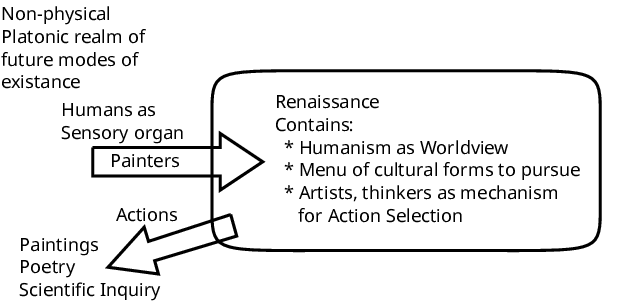
So, do I need a block diagram here, for posterity? Two? Should I take time out to create these block diagrams, or should I continue analyzing? Lets block diagram.
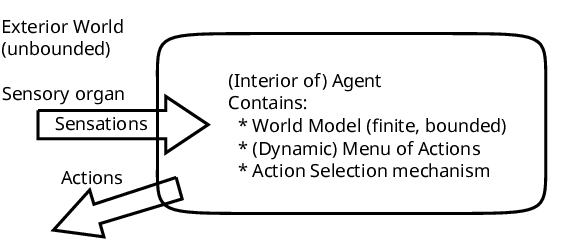
Generic agent
Here’s the generic agent:
Although drawn as a diagram, it is meant to represent a collection of axioms, perhaps resembling or inspired by the axioms that define e.g. “membrane computing”. (See Wikipedia article for that.) The point is that this diagram is meant to be a layman’s easy–to–understand conceptualization of what might otherwise be written as a bunch of algebraic expressions, impenetrable to anyone not highly trained in math. (TODO item for me is to actually write down this algebra.)
The bubble drawn around the agent is meant to be a membrane that insulates the inside from arbitrary influences in the outside. It might be the wall of a biological cell membrane (prokaryote..) or the wall of a secret spy agency (preventing secrets from leaking out.) Such walls necessarily block causal influence, or rather, by definition, are blockers of causality. Such blockages of causality are exactly what gives our world structure, instead of being some undifferentiated bowl of pudding.
The phrase “causal influence” is meant as a technical term, and is meant to be understood in the sense of textbooks on general relativity: only stuff in the past light–cone can influence the present.
Agents of course act on the physical world, and change it.
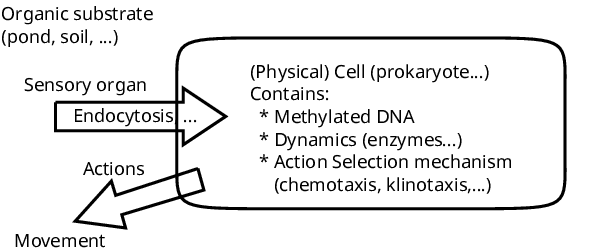
Example: Biological cell
Here’s a concrete example of an actual agent: a diagram of a single biological cell as an agent:
The “world model” here is the specific arrangement of molecules inside the cell. The sensory organs include ion channels, pores and other biological structures living in the cell membrane; movement and motor mechanisms include exocytosis, flagella, tumble–runs, etc. Actions, such as klinotaxis, where the organism follows a chemical gradient that is being perceived in the external world, are presumably driven by some sort of “purely biomechanical” process.
However, I find action–selection confusing. One can imagine the cell insides as being some kind of Newtonian–era mechanical clock, springs and gears and latches, and it just “runs”, following a chemical gradient. A zombie robot. But as this is biochem, there are lots of quantum effects, not the least of which is water. Are there any magical quantum effects that should be taken into account? The biomolecules inside the cell really are in a superposition of states, even if room temperature Boltzmann effects force quantum wave–function collapse in attoseconds. But I cannot rule out quantum effects a priori.
Being and Time
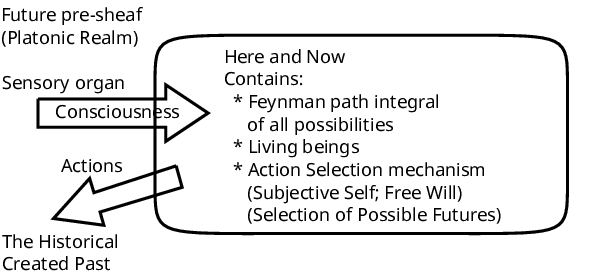
Here’s the same diagram, bridging the Platonic Realm, and the Physical Universe:
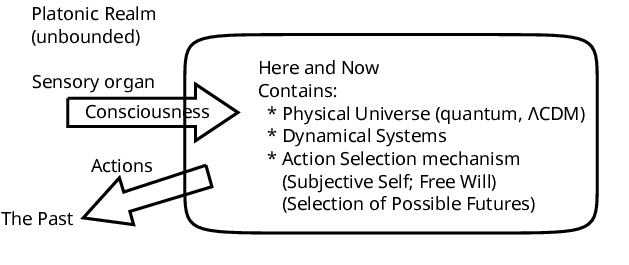
The above diagram is my rendition of Plato’s Allegory of the Cave, but all changed up. There’s no cave. Pure Forms are the collection of mathematical axioms and forms (Topoi, or perhaps Borel hierarchy, whatever. “Mathematical objects” and their models, etc.) These exist in the Platonic Realm. Conscious awareness and “logical thought” perceives these, in a sensory–perception kind of way, and brings them into the physical universe (as functional steam locomotives, etc.) These are the “ingressing minds” that Levin describes. My addition is to label the insides of the box as “here and now”. As before, Here–and–Now consists of everything that is conventionally called “quantum physics”, including ΛCDM Big Bang. It is everything that is “right now”. This diagram also shows the movement of “right now” into the past light–cone, which “exists” only in the Platonic realm, as the past is untouchable, unviewable, unchangeable.
This last statement makes a specific claim: time travel is impossible. Closed time–like loops are interesting intellectual diversions, but “do not exist”. Caution: the present, here–and–now, has a variable thickness “in time”, and the resolution of issues like quantum wave–function collapse might require interferometric effects coordinating space–like separated points, i.e. have aspects that resemble closed time–like loops. Possibly. Maybe. Speculative. If there are such loops, they are confined to be in the here–and–now (by definition), as the past is unalterable. So there’s “real physics” in this diagram. Or at least, claims about real physics.
Also shown in the interior of here–and–now is the subjective sense of self, the stuff that mystics and philosophers speak of, the thing that Heidegger calls “Dasein”, the thing that psychotherapists attempt to heal, the thing that Catholic pastors call the Soul whenever they talk about divinity. Roughly speaking, Here–and–Now is what the Catholic Church calls the Trinity; and the subjective self is the Divine Light of Christ. The passage of time corresponds to the body of Christ that is shared in Eucharist. Whatever. I’m not a theologian. The point here is that Here–and–Now is NOT a space–like surface carved out of general relativity, but is rather “everything that exists”, i.e. “the real (physical) world”.
Notice in particular that neither the past, nor the future are a part of the “real world”. The past is gone, frozen out. The future is unwritten, non–existent. This is why Heidegger spilled such a vast number of words to try to describe Dasein: he was trying to explain the title of his book: “Being and Time”, and that is what I’m doing as well: pointing out that Being and Time are co–located in the right now–ness of (divine) subjective experience.
Evolution as Sensory Organ
Here’s the same diagram, bridging the Platonic Realm, and the Physical Universe, as imagined by Micheal Levin (in “Ingressing Minds”) and by the authors of CBC (cell–based consciousness), who claim that not only are plants conscious, but also that amoeba, paramecia, or generally eukaryotes, prokaryotes are conscious.
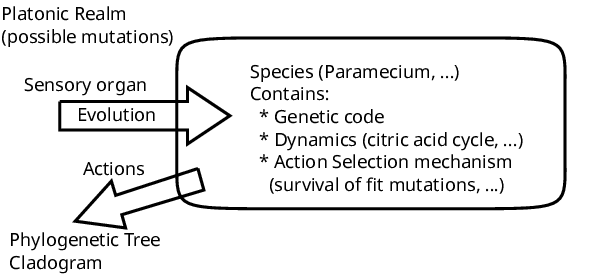
However, this diagram shows a bit more. It claims that “evolution” is itself a sensory organ. This is important. In the earlier diagram, it was the (human) mind that perceives abstractions and pulls them into the real world, creating engineering drawings. But the human mind is impenetrably complex, and we don’t know how it does that. The lower diagram proposes that there is a much simpler mechanism that also perceives the Platonic Realm, and pulls structure from it, into the present: namely, evolution. Here, the Platoinc Realm should be imagined as the abstract space of all possible genetic mutations. All possible genetic cross–overs. All locations that jumping genes (transposons) can jump to. All DNA segments that can be methylated (so as to regulate gene expression). There is a vast combinatoric explosion of all possible changes that might be made to the genetic code.
Out of this vast world of possibilities, evolution explores some limited number of them, incorporating them into a specific individual. The genetic code of that individual is the “world model” that this individual agent holds of the external platonic realm. That is, a prokaryote embodies a small, limited finite model of the entire whole–ness of biochemical mechanics. That is, prokaryotes cannot read biochem textbooks or pass college exams, but prokaryotes can none–the–less sense “how the world works”, and arranges its own internal molecular structure to correspond to how it perceived the “external world”. Here, however, the “external world” is not the pond in which it lives (although there is that, too), but the platonic realm of biochem functionality. The sensation of this external world passes through evolution.
By evolution, I do mean Darwinian evolution: if mutations are fit, then the individual can pass them on, by entirely mechanical and deterministic mitosis, into the species. The result of evolution is two–fold: an actual fossil record (which is recorded in rocks which “exist” only in the present, the here–and–now) and as the abstraction of all living organisms currently alive (which again, exists only in there here–and–now.)
However, as time passes, and as the present turns into the past, the past is part of the (unchangeable) Platonic realm. I imagine it to be an abstraction of all actually–explored genetic mutations, which are “remembered” in the present. It has a special epistemic status: only the “actual, existing” strands can be mutated and explored by evolution. Abstract genetic codes from space aliens cannot be perceived by Earthly evolution: they may exist in the Platonic Realm as “possible genetic sequences”, but are not visible to evolution. There is no “causal path” from some space alien DNA (or from DNA described in some published research paper) to biological organisms on Earth. A scientist can imagine, describe a DNA sequence, but evolution cannot “see” that sequence. Evolution can only “see” actual, existing sequences.
This notion of causality is ... well, its concordant with physical causality, in the sense that physics can only “see” what’s in the past light–cone. So here, evolution can only “see” informational structures that are informationally encoded in the here–and–now. So perhaps it is wildly incorrect to call that thing that evolution “sees” the “Platonic Realm”? Because it is not seeing all of it; only a very specific part of it. Then again, I don’t see all of the universe, I only see my kitchen and my laptop, at just this moment. (And some rain out the window...)
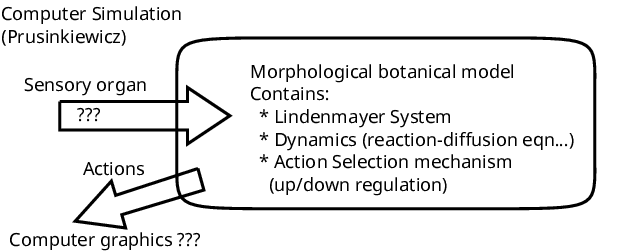
Morphology of Plants
And another:
This is meant to represent the kinds of computer simulations that are explored at https://algorithmicbotany.org – these are multi–cellular botanical structures.
My goal here was to bridge back to the CBC conception of cell–based consciousness, except that this time, instead of looking at a single cell, I’m looking at a multi–cellular organism. The point of looking at this is that perhaps less hand–waving will be required, and perhaps a more concrete model can be explored. The algebra for L–systems and reaction–diffusion eqns can be written down. But the claim of consciousness seems to evaporate, so I’m confused. What happened to all that mystical hand–waving?
Its also 6:30 PM and I’m hungry and the cupboards are bare. So gotta take a break. All this needs more work. But at least, I’ve got diagrams that illustrate the general form.
7 July 2026
A review of the Wikipedia L–systems article makes it clear that the L–systems framework is utterly inappropriate. Its archaic, it generates strings, it uses whack markup for branching. I need to use jigsaws, natively; I need to define some generative jigsaws; I need to use the ideas from membrane computing to have interior/exterior connectivity (or isolation, which is easier!?) So a big TODO: invent link–grammar jigsaw notation that replaces and generalizes L–systems and membrane computing.
The next thing that hit while I was sleeping ... not sleeping? Snoozing, tortured, sleepless snoozing... was pain. I made the mistake of eating a lot right before going to bed. Cherries. Milda came home, straight from her farm, with buckets of cherries. So I ate a bunch. Ooops. At 3AM, I’m tossing and turning, wishing I could fall asleep, but I can’t. This typically lasts an hour. It’s painful. Which brought me back to wondering what the subjective origin of pain is. Jellyfish sense predators. C. Elegans has exactly 302 neurons, and shuts down into a sleep mode when exposed to toxins, UV light, lack of food, physical injury. One single neuron is responsible for this: it accumulates calcium ions, and when a threshold is crossed, it fires, putting the organism into some form of suspended animation. That this was evolutionarily invented seems reasonable. That the sensing “makes sense” is reasonable, too: toxins, UV damage, physical injury are all going to alter the inter–cellular chemistry, and give a large variety of signals that can be sensed. Each is an alarm bell, when all go off at once, they don’t get ignored. Why this would open up calcium channels into that one controlling neuron, that is less clear, but an acceptable state of affairs. This is much easier to understand than jellyfish predator detection, mostly because jellyfish have an order of magnitude more neurons. I suppose a jelly–fish gets bit, gets the chemical signal from the damage, and has enough neurons to know “predator! RUN!” whereas C. Elegans does not have enough neurons to effect a flee–from–here response.
In my case, I had a late–night snack. After a few hours of deep NREM sleep, and a few hours of gut bacteria multiplying exponentially on those cherries, my blood concentrations of assorted messenger molecules skyrocket. These get into my brain, and trash whatever sleep mode was to come next. So the idea of messenger molecules signaling something to some neurons really is hardly any different that what C. Elegans is doing. I wouldn’t be surprised if some calcium channels had gone hyperactive on some of my neurons. The details matter, of course, but I don’t know the details. The point, however, is that I subjectively feel pain. My tortured snooze sleep is painful. It’s unwanted. It’s negative valence. If I take the CBC proposal for consciousness at face value, then C. Elegans also feels pain. And we can indeed observe the physiological correlates of pain, or rather, behaviors and actions that we humans project the word “pain” onto. Because we do not have the science, yet, to observe subjective states directly; we can only observe physiological correlates.
Subjective states are unobservable because they do not “inhabit” the physical realm. They do inhabit the here–and–now: I have no access to the subjective states of my past; just memories of them. That is, subjective states are co–located with the physical machinery that brings them to life. But they are not directly accessible. They can be conveyed by signals: I can write love poetry: that message does convey my subjective state to other human individuals. But that conveyance of the ineffable operates by the induction of similar feelings in the reader, or at least, the recall of memories of being in love. So subjectivity is very highly isolated. Not utterly, not completely, because words get across, as do other signals. For example, my sore muscles have some subjective experience (per the CBC idea) but I cannot directly relate to that; their subjective consciousness is not mine. However, there is at least a weak notification that they are suffering, which I perceive as “sore muscles” in my own subjective being–ness. So subjective experience can be communicated, and not just with words. But the subjective experience remains a “hard problem”.
And this is a good place to segue into the next topic: the “width” of the observable Platonic Realm. Yesterday, I ran headline into the problem that evolution explores a world of possible genetic mutations, and that this world–of–the–possible exists in the Platonic Realm. Thus, evolution is a sensory organ, sensing structure in the Platonic Realm. But then I noticed the sensation is “shallow”: it can detect only simple variations: point mutations, cross–overs, transposes of existing DNA that is currently, right now, in the here and now. That is, there is a thin, slim layer of the possible that is only a small Hamming distance away from what actually is right now.
Whoa. Brainstorm. Is this small thin distance, this Hamming distance of mutations that are easily energetically reachable from here, is this ... Planck’s constant? h–bar? Whoa. Because mutation really can explore only what is easily reachable from current conformations. This “Hamming distance thickness” of reachability is given by temperature, chemical potentials, assorted other thermodynamic variables, the strengths of various molecular and hydrogen bonds, and the specific physical (tertiary) conformation of the DNA (the current folding of it.) So there is this thickness layer of what is potentially explorable, and this thickness falls off as roughly
. So why did I write “Plank’s constant” in my brainstorm, instead of “Boltzmann’s constant”? Because, in the physical here–and–now, it is quantum that is exploring all possibilities. The fiction of a “thermodynamic canonical ensemble” appears to remain a fiction (I think). By convention, there is only one universe (ignoring the many–worlds interpretation) and this one universe has only one current arrangement of atoms in a gas, and not an ensemble.
I have never–ever seen (fail to recall) a stat–mech textbook describing the canonical ensemble as a collection of “universes” in any literal sense. If this was literal, then I have the problem that, in each universe, I also have a quantum state, presumably one pure state per universe, and so my canonical ensemble is, by inference, a mixed state. But the pure states out of which a mixed state is made do not communicate with one–another. Again, they appear to be entirely isolated and non–interacting. Of course, the machinery of stat–mech does not require such subtle analysis of angels dancing on the head of a pin; my machinery of subjective experience and here–and–now–ness does.
So is it possible that there really are multiple distinct parallel universes, so that the canonical ensemble is not just a mathematical trick enabling computation, but “actually true”? Is this what the replica trick is about? The pure states that make up a mixed state are utterly and completely non–interacting, with only two exceptions. The first is when one passes over from particle trajectories to density formalisms; it appears that countable dense subsets do somehow mix into uncountable continua. The gaps in the cantor set are countable; the cantor set itself is not. When the gaps are stitched up to form the real number continuum, we are “mixing” (quotienting) neighboring paths in that infinite binary tree. So there is a kind–of–like interactivity or joining–ness or sharing–ness in the quotienting of the cantor set by the rationals to give the reals. So that’s one. The other way of interacting might be through gravitation. That is, if the canonical ensemble literally exists as a collection of independent non–interacting parallel universes, then perhaps they might entangle on the surface of the black hole? I really, really have to finish reading that Hawking paper.
Anyway, I wandered off–topic. The point is that evolution explores the thermodynamically possible. The word “possible” here means “not actually real”, i.e. the “possible” exists only in the platonic realm. By contrast, the words “actually real” are meant to convey the idea that I can take
atoms and specify their positions and momenta with infinite precision, and that there is only one such specification, and not several (this is a classical mechanical picture.) So, if this is my definition of the “actually real”, then the “possible” is not “real”, and linguistically, I assign it to “the platonic realm” and this linguistic assignment serves as a kind of definition of “platonic realm”. The crime I commit here is that I also place notions like
in the platonic realm. And here’s the kicker: evolution can sense a certain depth or thickness into this possible world, the thickness being given by thermodynamic, energetically reachable, and the word “thickness” implying that there is a metric: and there is a metric: the Hamming distance, for one–point mutations, and some other conception of distance for transposons and cross–overs. And these distances do seem to probably, maybe be metric distances. Maybe. I dunno. True metric imply that the space is a Riemannian space, and I have no desire to conclude that.
I don’t know what the mathematics is of the space of combinatorial arrangements and re–arrangements of DNA are. I suppose I should look into that. Another TODO item? But it does seem that this space has concepts of distance, and if I pick out one specific conformation and call it “real”, then all the other nearby ones belong to “the platonic realm”, by definition. And then I say: ah hah, evolution is a sensory organ that can perceive the possible, and import it into the real.
And here, as always, we smash into the usual suspects. The “here and now” is quantum. I’m pretty sure I reject MWI; or rather, the many–worlds of MWI are in one–to–one correspondence with the many–worlds of which here–and–now is composed. The confusion of “the possible” (the thermodynamically possible) – is this world of possibilities actually just the many–worlds of here–and–now, or is it “somewhere else” (i.e. “in the platonic realm”?)
Dammit. These questions all seem almost resolvable: they’re at the tips of my fingers, on the tip of my tongue. I can touch, I can’t yet manipulate and articulate.
The other crime I’m committing is that I am saying that the (non–existing) past is also “in the platonic realm”. But the past is ... in the past, while the set of possible future DNA mutations are in the present and/or almost–future. Possibilities lay ahead. Facts lay behind.
The third compounding issue is that the human brain also peers into this platonic space, except that we now call it “mathematics”, the platonic reality of algebra. The human brain clearly peers far far more deeply than evolution. Evolution has only extremely shallow access to possible futures. The human brain has much deeper access.
Oh wait ... this is interesting. Formal methods go deeper still. Last night, while decompressing, I read an article (on The Register, El Reg) about how SSL 1.3 authentication of trusted platforms is fundamentally broken (and similarly other frameworks, e.g. WhatsApp) The issue is that although the initial stage–one exchange of Diffie–Helman keys for the initial private channel happen between the server and client as they “are”, the subsequent communications can be hijacked to a different server, running on physically different hardware. This has spawned some CERT vulns issued in late 2025, which more in 2026, and various working groups have rewritten their charters to include a need for formal verification. Why were these vulnerabilities not found earlier? Since, apparently, the audits were done by humans. The humans sampled a bunch of attack vectors that seemed plausible, and then verified that the encryption protocols were robust enough to prevent these attacks. However, this sampling was not exhaustive. Someone (some Japanese group??) ran the protocols though some formal verification system, which exhaustively tried all possible attacks ... and thus, discovered vulnerabilities. El Reg is scandalized, as always, because (a) vendors like google and Meta are silent and continue to promote their (now proven–insecure) products to corporate executives (b) these are exploitable by secrete orders ordered though secret courts in judiciary systems that oversee spy–agency work, i.e. secret court orders that can compel corporations to install spyware (e.g. spy hardware in Intel, AMD chips) and (c) the EU is trying to get off the US cloud, and was using these protocols to ensure that the server you think you are talking to is actually a server in the EU, and not some man–in–the–middle operated by the CIA. So that’s how serious and scandalous this is.
But why am I talking about it here? Because these “possible attacks” exist in the same noosphere, the same “platonic realm” that the human mind normally has access to, but they are “farther away” than what human minds are capable of reaching. Some researchers ran some formal verification system to explore deeper into the realm of the possible than what human minds can do.
And so here we have this hierarchy. Evolution can explore the world of the possible, but evolution explores shallowly: only that which is reachable by thermodynamic energetics. We can assign a “thickness” to what is reachable, in some literal sense, by working with Hamming distances between mutated variants. The interplay between quantum and thermo is utterly muddled and unclear.
The human mind also explores the world of the possible, but much more deeply than evolution. We can imagine genetic mutations that are not thermodynamically reachable. However, the human mind again consists of atoms, or neurons to be precise, and the only neural states that the human mind can obtain are those neural states that are chemically, thermodynamically permissible. That is, we can only imagine those things that are imaginable, given our actual neural wiring, given the actual speed of spiking waves, and given the actual speed of diffusion of actual neurotransmitters across synapses. That is, the human brain is also limited by energetics. The architecture of the human brain, however, is arranged to encompass a much larger volume of the noosphere possible. (Is this a Hausdorff volume of some kind? We have mathematics of measuring volumes...)
Formal verification methods reach farther. But so do chess computers ...
So what I seem to be converging on here is that the “world of the possible” corresponds to an abstract noosphere, which I’ve been calling the “platonic realm” for lack of superior vocabulary. It appears to be measurable (we can using Hamming distance for point mutations) but the general theory of distance and volume remain out of reach. For example, I still don’t know how to correctly compute the entropy of some graph. Or how to talk about distance between graphs (although there are plenty of ideas like “edit distance”) I don’t know what the structure of this “space of graphs” is: is there a dimension? Is there a homology? Are there holes? Is there a topology? What’s the topology of software programs?
At any rate, this provides a somewhat clearer portrait of the noosphere, of it’s relationship to the physical here–and–now, and the sense that there are measurable, quantifiable distances to what is reachable (e.g. the length of proofs being another measure of distance.) It also clarifies that “the possible” is what is thermodynamically reacahble. That, with appropriate complexity, the volume of the noosphere can be increased (and is de facto increasing.) This collection of “the possible” also appears to be “the menu of possible futures we can pick from”, so that the word “possible” is meant to be understood in the literal sense.
Also, the noosphere is that place that intelligence explores; more complex intelligent systems explore greater regions of it.
The agency model, of inside and outside, and of causal isolation, appears to be appropriate. And its turtles all the way down: there’s scaling.
The details of the scaling remain unclear. A definition of the cellular agency model in terms of jigsaws remains unclear. An adequate description of scaling jigsaws is missing. But these are perhaps achievable without any overwhelming intellectual difficulty. And I should probably do them, as these seem likely to shed additional insight, i.e. will allow me to travel deeper into the noosphere.
I need to also formulate/reformulate Tononi Phi/IIT in the cellular agent model.
The hard problem of subjective consciousness remains hard. The CBC claims that cellular agents have subjective consciousness. And I’ve even argued that the weak form of self–consciousness is tautological, in that the agent is necessarily “in the world”, and performs all choices of future possibilities with reference to itself in the here and now. That is, self–reference is built in, whenever a finite–sized interior operates and has agency in the bigger world. The word game here is to say that these self–referential actions, the existence of this body–centric coordinate system in the noosphere, is one and the same thing as “weak self–consciousness”.
So, for example, given some strand of real, actually–existing DNA, this strand defines the center of a body–centric coordinate system in the noosphere of possible mutations. If we call this actually–existing DNA strand “the self”, then the possible “future selves” are in regards to this particular location. This is the meaning, the definition of the words “body–centric coordinate system”. All possible future mutations are “self–referential”, in the sense that they are referenced with respect to this particular body, and we played the word game of calling this body “the self”. But this self–consciousness is only “weak”, in the sense that the DNA is incapable of representing or declaring “I am DNA”. So it is not strong self–consciousness, in the way that humans (and mammals) are self–conscious.
That is, my world–model, of the external world in which I act, includes a model of me, as myself, which is why I am strongly self–aware of myself. By contrast, for evolution–as–agent, the DNA *is* the world model, but it does not contain a model of itself, and thus is not strongly self–aware.
My analogy is breaking down here. I’m claiming that there is a Platonic Realm, a universe of “everything”. I’m claiming that DNA is a particular model of that everything–ness, and that evolution informs this model, as a sensory organ. But this analogy appears to be stretched, because it is hard to imagine that the DNA is a “model” of “the universe of everything”. Its more of a sampling.... and what is in my brain is also not a model of “everything”; it is a model of what my eyes see. So this so–called “world model” is not a model of “everything”, but rather, a “model of everything that the given sensory organ has perceived so far, and the intellectual processing applied to those sensory inputs, to create a relational structure, of the form of a pre–sheaf of jigsaws in my head”. If this is taken to be the definition of “world model”, then saying that DNA is the world model of evolutionary perceptions becomes entirely coherent, consistent, understandable. One just has to use this correct definition of “world model”, and understand it’s narrow technical meaning, and not some poetical allusion.
To repeat: the narrow technical definition is that the world model is the sum total of everything that has been perceived, plus, the intellectual processing applied to those perceptions, so as to organize them into a specific (graph, jigsaw, sheaf) structure. And this world–model, thus defined in this way, is the self, the origin of a body–centric coordinate system in the noosphere. And the set of all possible futures are those that are reachable, at short distance, from this world–model. That is, the future possibilities are all of the ways that the current world–model can be modified to incorporate new observations, new facts, new beliefs.
When I attended church service last Sunday, I learned (finally) how Catholics think about the Trinity and divinity, and it finally made sense, so I said “a hah! So that is what all those Catholic theologians are talking about! I get it now!” I was able to come to this understanding only because it was not very far away from my world–model, as it was before I attended church service. I’d already been working on spiritual topics, and had assembled a framework of understandings of the nature of spiritual perceptions, and what I heard in church that Sunday just was not very far away from what I already knew. I don’t know how to measure the “Hamming distance” between what I used to know, and this new idea, but its clear this distance was not very far. I was able to incorporate some factoids of Catholic theology into my personal understanding of spiritual nature. I updated my world model (I did not “update my priors” Hah hah. Because probability theory does not apply. Cox’s theorem is not wrong, just that ... probability does not apply. I think this is the huge mistake that the rationalists make: the “world model” is not the same thing as “Bayesian priors”. This point probably needs articulation, as well. So... TODO. Explain this, someday.)
So now, at last(?) we have some fairly clear definition of what a “world model” is, and what constitutes the “future possibilities”. The future possibilities are just those things that are not far away from the world model. Its those things that are reachable with a small number of edits or changes.
So far, so good. Now there are still some remaining issues. The subjective self, me, perceives a pretty frigging tiny menu of possible futures. This is given by my attention. Thus, although I could think about what I ate last Sunday, I am not doing so, because my attention mechanism is discarding almost all future possibilities, and limiting them only to the choice of words needed to finish this particular sentence, here and now. It then opens the door a bit wider, to let in more future possibilities: I will call these “ideas”, and I will pick one or two of these “ideas” and type them out as the next sentence. So my menu of possible future choices, as presented to my subjective self, is very limited. And this is because my brain has a well–trained attention mechanism that keeps me focused and on track, of pursing the specific goal of articulating an agency model of of perception of ideas, thus creating a future out of possibilities chosen from the present. Phew. Fuck me.
So it seems that I maybe need to refine my model of the agent to include an attention mechanism, as something that accesses this vast swath of future possibilities, and selects only a few of them for the conscious subjective self to select? And that this attention mechanism operates rather independently, as a mechanical, maybe stochastically deterministic mechanism, filtering down large sets into small sets. That is to say, my attention mechanism operates at the subsconscious scale.
Its weird, writing this shit. Sometimes, when I write here, it feels like I am finally coming to understand something that was being said a hundred years ago, a thousand years ago. What is new to me, dear reader, might be old and well–known to you.
Anyway, I think I made progress today, but I have to drop this, because there are other things I need to do. I’m still not happy with the status of subjective awareness, and of free will. I believe that the CBC model is true, but I can’t yet connect the subjective experience to it. I have been able to articulate the ingress of the platonic world into the physical world, and so I think this almost fully provides the required supporting details for Micheal Levin’s “ingressing minds” idea. So I should probably write him a letter or something. Which I don’t have the time for. Which he will ignore, because he also does not have the time. So it goes.
Later, dude.
7 July 2026 – Evening
Totally off topic, but the L–systems article wikilinked digital morphology which wikilinked bioincs which wikilinked transhumanism, which wikilinked solarpunk, which wikilinked https://en.wikipedia.org/wiki/Bohemian_style which I am reading with rapt attention. It has captured my imagination. I’m enthralled. I want to visually be there, for each decade of the evolution of Bohemian style. I want to cut my hair, like this and like that, but that article is primarily about women, not men. Men have this problem of being, well, masculine, which is hard to be stylish in without becoming effeminate. And I don’t want to be an effeminate man, so my stylistic choices are limited. My father was able to pull this off; he was quite the dandy. But this takes work, and work takes time, and time is what I don’t have. And yet, reading that article makes me want to dress nice and go hang out in a bar, which, also, I don’t really have time for. Well, actually, I do, its not like I’m doing anything, other than reading about Bohemia and pining for a life I could never have. But I also do not want the after–effects of alcohol. I want the intoxication without the price. I want to be transported to Nirvana. I assume everyone who goes to a bar wants to be transported to Nirvana.
And again, my mind wanders. The fashion of the prior century, in particular, the Bohemian fashion, I find to be very very visually appealing. How does this work, now? The hippie–chicks, the pagan denizens of my beleaguered Joninės festival were very visually appealing. I truly appreciated the DIY one–of–a–kind forest nymph architecture. Beautiful stuff. Impractical in the winter, glorious in the summer. But butterflies mate and die. Well, I didn’t mate, and I didn’t die. I want to be the butterfly, or the glamour, the ecstatic wonder of not having a gut, not eating, flapping my beautiful wings, and... uh, returning to my present body when it’s all over. I could, of course, doomscroll social media for more images of this kind, or even more neural stimulation, dopamine, until, like a moth tricked by a lightbulb, I’ve zoomed into a state of exhaustion.
So, we have two different things: what my brain wants: a permanent state of bliss, and what the universe wants, which is I guess, bliss also?
My bliss is temporarily achievable through sex, drugs and rock–n–roll. I vaguely understand the neurophysiological aspects of how this works, much like I understand the circling moth: it is apparently trying to fly in a straight line, using the sun as a reference. So my brain was evolved for survival, and whatever else, and the sex, drugs and rock–n–roll are the lightbulb to my inner moth. They fuck me up and trick me into non–constructive behavior.
But what is constructive behavior? Well, somehow, I’ve discovered that writing this diary is very ... addictive. And it also appears to be constructive. It’s certainly generative. The generated content, well, I’m certain that is is valuable, but am not very interested in rationalizing to whom it is valuable, or why.
There is an appealing downhill slide into mysticism. There are many appealing downhill slides: I could go out drinking, searching for an adventure, but this is a mostly non–productive downhill slide that would, at best, result in my getting laid, and at worst, result in my being bored, and missing the opportunity to write here.
And my opportunity to write here? The downhill slide would be to descend into mysticism, and claim that the universe wants to do something, and that something that it wants is for me to write. And kind of well, that is exactly true, well, isn’t it? But its also non–explanatory and mystical. The Tibetan monks, mystical to a fault, never came up with the steam engine. The Zoroastrianists, with their head screwed on straight, encourage commercial business activity. But still for a dying religion. The solarpunks, and the DIY ethos. Of course, commercial–scale mining and manufacturing is far more efficient in the production of high–quality desirable goods. This is my moth–mind circling in the glare of the internet.
The not–downhill slide is the difficult intellectual climb upwards, of trying to algebraify the production of subjective self–awareness. The Tibetan monks were not able to achieve this. From what we know; their libraries were burned. But Neil Stephenson did imagine what might have happened if they succeeded: the Millenarians, in the novel Anathem. They mastered some quantum being–ness, which was gainfully employed in the sweeping climax of the novel. So I picture myself as one of the Millenarians. Except I’m not isolated. Except I am isolated. And I’m working on shit so arcane, I have no one to talk to about it. Which is the core of my isolation. It’s intellectual isolation, not social isolation.
And again, what am I doing? I’m pursuing a specific, particular future, one that is metrically close to my personal thoughts: it is only one or two hbar away from current me and all I know. Or perhaps only one or two Boltzmann’s
, I’m not sure. But what is close for me is distant for all other humans, who do not have my specific background in math, physics, sociology, anthropology, philosophy, and yes, literature, fine arts, and even fashion. And, of course, a mashup of theology and mysticism. So I can write in this syncretic manner, amalgamating all this ideas. I’m pushing this syncretic future. I’m trying to push it so that, well, it seems like the ethical thing to do is to create the intellectual version of the steam engine. That is, create AGI, as the normies are prone to say. But they are normies: I know what they talk about, but I don’t talk to them.
Milda says I should go get a drink. Let me try that.
8 July 2026
23:25 PM. My day was a train–wreck. I should sleep it off. But I know I wont fall asleep now, and I don’t want to do anything else so I will spill my train–wreck into words. Of course, there’s an unending amount of incoherence of human origin flooding the airwaves; I offer a droplet more. There are many like it, but this one is mine. Mano pergyvenimas.
I got up at 10:30 AM and before I even put coffee on to brew, Linas Cicėnas calls. Today, we go pass final inspection on his 1967 Buick Le Sabre. And by a hair on the chinny–chin–chin, we do. But this is the very last day of the inspection permit; we have to get registered before 6:15 PM. And we do. Barely. From 12:30PM to 5:30PM we sit in the car, waiting in the rain, waiting in line to pass proof of ownership. Tax Title & License in the US. Don’t know what they call it here. By 6PM we have affidavit of title, run to get the green card certifying passed inspection before the office closes at 6:15PM ... Done, with not a minute to spare.
I’m an introvert. So while sitting in the car, facing down a new and different kind of boredom, I work out a few more details of my subjective reality narrative. I would much much rather sat and home and typed that up, then hang out in a 67 Buick convertible in Vilnius, waiting to pass inspection. Linas wants to celebrate the achievement: this is the culmination of two years of work, restoring that car. It’s now street legal.
I’m not an ordinary person. I made friends with Cica because I needed friends and he was colorful. But frankly, I’m done with earthly interests. I don’t want material objects any more. I’ve not wanted them for quite a long time. I tried to explain to Cica, when I first met him, 8(?) years ago, I’m done with possessions. I do not want any more of them. They are a time–wasting drag on my life. This includes holding opinions about stylish matters.
And here, I encounter perhaps the first unresolved tension in my life. I no longer want things, but I do want love. But love means other people, and other people means being appealing to other people. And so I’ve turned my attention to how I look. And what a difference. I dress in a certain way, and people look at me, see me on the street. I dress another way, I am invisible. I used to think I didn’t care. But it seems I do. Some unresolved refrain of vanity means I want to be noticed. This is another core mammalian drive, but it is subjectively personal. I could ignore it when I was busy working, when I was busy doing other things, when affairs of the heart did not matter. Now that I am old, and ungovernable and free, (utterly free?) I’ve simultaneously ascended the ascetic ladder where I want nothing any more, and and descended to where I want ... I want to wear perfume and not have men sneer at me in the street. To look at me, and I read it in their eyes: “He’s flaming gay.”
Fuck it. I have nothing to loose. I could just experiment. I’ve learned to be shameless. I’m kind of beyond caring. There are norms, and good manners means I should stick to norms. But sticking to norms is so fucking boring. And suffocating. I understand why many youth run around as wild animals. They do not want to be caged. I don’t want to be caged.
My mind comes back to the girls who wrote “Noriu Nobelio”. I feel more in common with them, than anyone around me. Of course, I have a good imagination. I have more in common with them, at the metaphysical level, than in actual life. They capture the metaphysical in their book. Their actual life, as it shines through ... if I had to actually spend time with them, to be with them, I would not have been able to. We are too different. And so, wherever I go, I meet people who are too different. Of course, I’m lonely. Sargent Pepper’s Lonely Hearts Club Band. “My work here is done”, declared Timothy Leary. Of course, I want to be transported to Nirvana. I have to settle for Kurt Cobain.
I should mention that I celebrated with Cica, so am mildly drunk. I’m writing into the night to work off the buzz. I fear I will be hung over tomorrow.
As usual, I’m heart–broken. Didn’t make it home for dinner. Milda cooked, left dinner on the stove. But now, she’s not home. I knew she was going to cook tonight. I wanted to be home for that. Cica ruined it for me. Where is she? I want to be with her. She’s my ray of joy and sunlight. Of course it’s impossible. Of course this is an impossible dream. I suffer for mammalian reasons, something to do with the biology of my uhh, “Ventral Tegmental Area”, according to google. And yes, of course, my critical thinking is dampened, because if it wasn’t, the flaws of this arrangement would be prominent in my subjective experience. Even as I rationally know this whole thing is flawed and hopeless, it doesn’t matter, because something prevents these thoughts from carrying any force or weight in my subjective experience. All I have is blind love. I feel like that White Stripes song: “My right brain knows...” It can know all it want, but if that knowledge carries no emotional force, it becomes immaterial. Where the fuck is she? She cooked me dinner, and now she’s not home to meet me. I’m heart–broken. Oh well. Alas. Cica fucked up my day, and for what? I can’t help him. At best, I’m his punching bag. I can’t cure him; I can’t love him, what’s in it for me? If he was a woman, I’d put up with the bullshit. But he’s not.
Anyway, let me not get off track. The key insight of the above paragraph is the emotional modulation of rational knowledge. I’ll have to expand on this tomorrow, when, again, I hope to attack the issue of motivation and action. When I sat in the car, I was able to develop a few thoughts about possible futures, and the arrangement of possibilities within the personal and social level.
Oh, what the heck. Let me sketch that tonight. I’m mildly drunk, and will soon be sleepy, but this is not difficult. In short: I have a set of choices I can make to shape the future. This set of choices is highly constrained by childhood, society, upbringing. To be far more precise, it is highly constrained to be within a few hbar or a few
of the present: my free will is entirely constrained to what is not very far from my current physical arrangement of atoms and neurons in my head. If a neuron could fire, it might, otherwise, it cannot. This is the resolution of Sapolsky’s no–free–will, while actually having fee will. He speaks of biology and sociology and neuroscience and genetics, and in that sense he is right: the current arrangement of my neurons, of my neurotransmitters, and whatever, wherever the hippocampus was able to encode: this is fixed, as this is the contents of the present moment. The immediate future can differ from the present by only small molecular deviations from the present. Obviously.
Equally obviously, there’s a two–fold scientific problem. Three–fold? I am not aware of any coherent map of the subjective universe. I am not aware of any map that describes what is possible, of what I can achieve right now. I sense that this is a volume. What is an expression for this volume? I sense that there is a distance... what is the distance from here, now to the next immediate future? And, of course, how do I map neuron firing and neurotransmitter re–uptake to this subjective sense of the choice of possibilities laying before me, right now? These are daunting questions, but some of them appear to be within scientific reach. They don’t seem to be too distant, too vague. They are ... imaginable. More than five years? Less than fifty? With LLM’s, certainly scientific progress can be greatly improved. But perhaps my vision of possible futures is too unique, too idiosyncratic, too far out of the norm of what neuroscience might ever tackle in the next decade or two. And yet, papers like the CBC paper, and Levin’s papers means that others will soon find the path I’m on. I’m an original thinker, here, but I’m not that original. I’m within a few hbar of the normal and conventional.
Anyway, as I sat in the car, I thought how much of what I attempt to do is to create and shape a future that I want to live in. But I’m constrained: in the car, I had no laptop, so I could not create that future which required typing. The future that I can create, that I can manifest, is highly constrained by the future created by others, and the rather deterministic unrolling of the inevitable. I was waiting in line, and this was inevitable to the extent that not waiting would have created a scene (I was too far away to walk; its raining; Cica needed to pass inspection; I was duty–bound to be supportive.) The yoke of constraints is very very restrictive. I’m on the chain gang. We’re all on the chain gang. Ain’t running away.
And yet, the future can be manifested. The model that shot into mind was the driving of a nail into a piece of wood, by a hammer that I wield. I have considerable free will as to how I apply that hammer, subject to my physical training. I can even choose to not hammer that nail. It seems like analyzing this model would somehow reveal how my rational mind (slow thinking) gives instructions to my athletic mind (which does the actual nail driving, but is, n a way, much more mechanistic and constrained in it’s actions). Hmm. Bad analogy: like having a complex machine, and six buttons to press: press one of the six buttons, and the machine carries out one of six very complex tasks.
Oh, I’m getting tired. One of the thoughts was that the six possible future actions are ingressing, from the future into the present: they exist currently only as potential possibilities. These possibilities, it seemed to me, must necessarily be quantum. ie. Must necessarily be disjunctive quantum states, disjunctive in the sense of “pick one, only one”, and that somehow the conscious me can select one, and force the corresponding wave function to collapse, manifesting that particular possible future, making it happen, and thus forcing it into the past: that particular action was taken, and not some other. Consciousness causes collapse. But in this case, it’s not Schrodinger’s cat (which is the wrong example, and its not even a good example.) It is instead some possible quantum states that are quite rather close to where my current brain is at. Somehow, I can force this neuron to fire, and not that one, and this fording is not only consciously controlled, but since this forcing is converting a non–existent Platonic–Realm future possibility into a de–facto “it just happened just now” immediate past. This is what my brain does, and there was effective rational action in the deployment of this.
So as I sat in the car, I wanted to take the above idea, and focus up into society, how decisions of individuals manifest in society, and how that freezes into the constraints we all feel. I also wanted to focus down, and look at how communicating agents, such as biological cells like–wise carry out individual actions which has repercussions on the collective that the cells are embedded in. By continuing to compare and contrast these, I hoped to mine ... more insights. But somehow, choices in the present are all about selecting a possible future and forcing it to wave–function collapse into the past. Which means that there has to be some mechanism to force specific collapses.
For tomorrow: what I thought about DNA, self–replication, and its role. Self–replication is not important; its rather a clever trick to reconstruct the present; much like running a compiler, its easier to mutate DNA and run the ontogeny step, than it would be to surgically edit the individual to change something. Humans can be surgeons, we can do it, but bacteria are not. they have no choice. This last paragraph needs to be expanded into a page or two. Tomorrow. Later. Toodle–oo.
The DNA idea is ... um ... well, important, because it explains why evolution is NOT important for the present state of things; rather, evolution was a good trick that works great for ultra–simple systems, but is no longer relevant at the human scale. This last sentence is obvious, but I think I can now explain why it’s obvious, which itself is not obvious: its opaque. Evolution manifests future into past. But human brains are a lot lot faster at doing the same. (As are trees, plants...) Tomorrow...
I guess I was less drunk than I thought. I was expecting that I would write total nonsense tonight, but this turned out not half–bad.
9 July 2026
Well, its morning. I slept. Before I launch into my technical analysis, I’m trying to figure out what to write about my feelings and mood. One possibility is to be stoic, say nothing, bite my tongue and suffer. Youtube keeps offering me videos on stoicism. I wonder how popular it is ....
Normally, I don’t want to put AI filler into this text, but this is a worthy moment. I shortened the reply:
“It is absolutely not just you; Stoicism is experiencing a massive, worldwide cultural resurgence. It has exploded across platforms like YouTube, TikTok, and podcast networks, driven by a collective search for emotional stability and resilience during turbulent times.”
“* Coping with Modern Chaos: Philosophers and psychologists note that Stoicism booms during eras of political, economic, or personal uncertainty.”
“* Intersection with Therapy: The mainstream success of this philosophy is partly tied to the rise of Cognitive Behavioral Therapy (CBT). Because CBT draws heavily from ancient Stoic principles, ...”
“* Silicon Valley and "Broicism": The tech and entrepreneurial worlds have heavily adopted Stoic practices. It is often framed as a way to handle high-pressure corporate environments.”
OK. Or I could be like “Noriu Nobelio”, where one of the girls complains that her boyfriend does not understand why she cries all the time. And immediately after this, the bell curve meme hit my mind:
I wonder if my vatnik angel and I feel the world the same way, while the normies claim to feel normal, even as they require help. So I asked google: “I have noticed that many people appear to be lost. Some seek psychotherapy. Others turn to self–help and search for enlightenment. Others clearly need help, but are not introspective enough to realize it. Do you have a breakdown of population percentages? Then there is a large group that intrigues me: the "normies". Of them, some seem not–self–aware, living–in–denial, and very good at socially masking their unhappiness. Others seem not to suffer much, or have effective coping strategies. Are there percentage breakdowns here, too?”
The reply:
“* The Therapy Seekers (~20% to 25% of Adults): According to the National Institute of Mental Health (NIMH), roughly 23% of adults meet the criteria for Any Mental Illness (AMI) in a given year. In places with high mental health destigmatization, like the UK, surveys by the British Association for Counselling and Psychotherapy (BACP) show that up to 37% of the population have seen a therapist at some point in their lives.”
“* The Enlightenment / Self-Help Seekers (~30% to 40%): This group overlaps heavily with the "worried well"—people who do not necessarily have a clinical diagnosis but experience existential directionlessness. Industry market reports indicate that over one-third of adults actively consume self-help books, apps, or philosophy platforms (like Stoicism) annually to seek answers outside of traditional clinical structures.”
“* The Un-Introspective & Suffering (~10% to 12%) ...according to U.S. clinical data, nearly half of those with moderate-to-severe conditions receive no treatment whatsoever due to a mix of financial barriers, lack of personal awareness, or intense stigma. This places a hard floor of roughly 10% to 12% of the general population who are experiencing intense mental distress but remain completely outside the help-seeking loop.”
If I read the above correctly, these sum to half, up to two–thirds of the general population. Hmm.Part two of my question gets a different reply:
“"normies"—people who seem to drift along standard societal paths—is where the data gets incredibly stark, particularly regarding social masking and genuine resilience.”
“Bucket A: The Delusional & Socially Masked (~70% of the population)”
“Bucket B: The Truly Resilient / High Coping (~15% to 25%)”
But the LLM stats go wonky, and don’t work out:
“The Baseline Unbothered (~15% to 20%): When tracking psychiatric metrics, there is a consistent 15% to 20% chunk of the population that reports exceptionally low stress and high psychological resilience. For instance, in longitudinal stress surveys, roughly 30% of older adults and 7% of younger adults report never feeling overwhelmed or unable to cope over the course of an entire year.”
“The Baseline Unbothered (~15% to 20%): When tracking psychiatric metrics, there is a consistent 15% to 20% chunk of the population that reports exceptionally low stress and high psychological resilience. For instance, in longitudinal stress surveys, roughly 30% of older adults and 7% of younger adults report never feeling overwhelmed or unable to cope over the course of an entire year.”
This was presented under Bucket B. Under Bucket A:
“The Self-Awareness Illusion (80%+): Renowned research by organizational psychologist Dr. Tasha Eurich revealed a striking statistical gap: 95% of people believe they are self-aware, but when measured objectively against internal and external metrics, only 10% to 15% actually are. This means roughly 80% to 85% of people are walking around with major blind spots about their own emotions and behaviors.”
“The Masked Stressed (~74%): Large-scale studies by organizations like the Mental Health Foundation show that 74% of people have felt so stressed in the past year that they were overwhelmed or unable to cope. Yet, because they must keep their jobs and social standing, the vast majority functionally mask this distress in daily life, presenting a calm "normie" exterior while suffering silently.”
I asked about geographic distribution, too. It was interesting. Not cut–n–pasting that, but I did save the html reply in my usual folders. In short, large differences due to culture and history. The US is more open; Scandinavia has better social care but also more closed. Eastern Europe is experiencing a generational divide between post–Soviet stigma/failure and more open modernity. Suicide rate in Lithuania is falling.
(I’m recording the LLM responses because these are time–sensitive: reconstructing these responses in the future will be difficult, much like reconstructing my current mental state will be difficult in the future.)
Then I asked about EQ vs IQ (thinking of my vatnik angel); google claims these are largely uncorrelated.
“Psychologists view IQ (analytical, verbal, and spatial reasoning) and EQ (emotional regulation, empathy, and self-awareness) as distinct cognitive systems.”
Then it contrasted the low–IQ/high–EQ corner to the diametrically opposite corner, which is filled with existential angst and self–help seeking. I assume standardized tests will reveal I have a mediocre EQ.
Ah jeez. Fuck me. I really do not want to cut–n–paste any more.
“The Trap of Rumination: Higher IQ is positively correlated with rumination—the habit of repetitively thinking about one’s problems. Existential Anxiety: Intelligent people are more likely to perceive systemic flaws, global crises, and the inherent lack of meaning in life, driving them to seek enlightenment or therapy.”
Well, this diary proves that I inhabit that corner. When I read Richard Rhodes, “The Making of the Atomic Bomb”, he repeated a psych profile developed by the US Army to figure out “what’s wrong with physicists”. Of the twelve innocent, innocuous questions, I was shocked to have matched on ten of them. (Sample: “were you closer to mother than father?” Yow.) Am I shocked to find that I match yet other psych profiles? Yes. Should I be? No, I’m a fucking human.
“High IQ Resilience: Requires deliberate, complex philosophy. An intelligent person usually cannot achieve true balance without actively wrestling with existential questions and adopting frameworks like Stoicism to quiet their overactive minds.”
OK. So this one is more directly relevant to my overall AGI project. If I assign a high–IQ to some LLM, I suspect I also have to assign a low–EQ. This is, of course, insane, because it is not yet clear to me what the mechanisms of awareness are; I cannot yet determine if an LLM is more “aware” than some amoeba. And LLM’s clearly have trained on high–EQ material. I need to come back to this later, so its another TODO item: is the universe going to be like Marvin the robot from Hitchhiker’s Guide: superintelligent but morose?
“While IQ is primarily anchored in the brain’s outer cortex (especially the parietal and frontal lobes), EQ is governed by the constant communication between the limbic system (our primitive emotional core) and the prefrontal cortex (our rational executive center).”
Well OK.
There’s more, much more. As I read along, I have fleeting thoughts about this and that, and I have to judge whether each though deserves additional attention, or whether I should let it slide by. This is, of course, part of my mechanism of transforming possible futures into de facto pasts. It determines the contents of this diary: there’s all this stuff I am not writing, because I deemed it to be interesting but not so very relevant to the main project, which is creating my own future. Yet, I imagine that there could be a technology that could scan my brain, and record those fleeting thoughts. And, as such, assign them into to–do buckets for future analysis. Is this a likely outcome for humans with, say, functional Elon Musk–style Neural–Link attachments? The ability to manifest a larger region of the possible futures into the de–facto pasts? Is this one of the central ingredients to the singularity? Right now, I am imagining this for humans, but of course, there’s something analogous for machines. There’s also something analogous for, say, goats, or crows. Or Octopii. It would reveal, to the universe, “what its like to be an X”. Would it lower the ultra–metric distance between individuals? More questions, but perhaps too abstract to be high on the TODO list; I don’t see a clean path forward.
Where was I? I need to return to my main project, but first, some personal asides. I remain emotionally entangled with Milda. She cooked dinner, and left it for me, and then went out. She takes care of me like a mother takes care of a child. Or a loving wife takes care of her husband. I respond strongly and positively to this; it reads as love. But she did not come home till middle of the night. Shall I assume a tryst with a lover? That hurts. Shall I assume yet another madcap night drinking? Wish I was there. Shall I assume it was some overtime planning meeting for the YAGA festival? As a festival organizer, this is a responsible behavior. Shall I assume she camped out with Agna and Adre? Quite likely, I suppose. But for me, I experience this as an emotional roller–coaster. My “Default Mode Network” (DMN), “Central Executive Network” (CEN) and my Salience Network, governed by the insula and ACC, oscillate wildly, leaving me in an unsettled state. I almost wrote “anxious and depressed”, but neither of those words are appropriate; they’re even kind of wrong. Mostly, I’m heart–broken. A good fuck would instantly lift my mood. I’m pretty sure that the only thing missing from my life is sex with someone who loves me. I’m pretty sure that, I’d be whole and complete. I wonder what google AI would say if I ask about that. Hmm. Let me try.
Oh. It’s actually hard to formulate this question. Mostly because there are a zillion and one literary works of art dealing with exactly this topic, in a vast assortment of settings. And because the answer is obvious: yes, sex will make you feel whole. So am I asking about neurophysiology, here? Am I wasting time wallowing in self–pity, masking it as intellectual curiosity? Just fuck me, I promise I will be OK after that. Well, temporarily. Were I to have sex with my love interest, it would complicate my life beyond comprehension. It would move my situation from bad to worse. OMG. The socio–economic–psychological strictures are very strong. I’m on the chain gang. I see no escape.
Oh. OK. I did formulate a good question, and got a great reply. It appears to correctly describe my de facto situation. Including the neurobiology of it all. Including the various psychological traps and pitfalls which are very obviously stalking we/me/us. My subjective state remains unmollified. Oh well.
So it seems I’ve done a lot of emotional processing over the last few hours. Hit the end of the road. But that is all me, me, me; I also need to figure out what the deal is with my children. But then my umbrella spreads: my wife. Then my friends. Then my acquaintances. I want to have this button I can press that will instantly make everyone happy and wise. And promote me to my desired state of bliss. There’s no such button, so lets now move on to yesterday’s analysis of evolution.
9 July 2026; no break, just new section heading
OK, so this is about the ingress of the future into the present, and the manifestation if it into the past, and how this works when there aren’t any neurons. To repeat, re–iterate and strengthen the foundations for what I am about to write: Physical reality consists entirely of here and now. The past doesn’t exist as a part of physical reality; it is in some inaccessible form in some Platonic Realm. I use the words “Platonic Realm” loosely, because I don’t have a better term to apply to the ontological status of the past. It “exists” but not “physically”. The future is also a part of some “Platonic Realm”, but different: it is one of unrealized possible futures. The future also does not exist ... but it might, briefly, pass through the here–and–now, before freezing and becoming the past.
The here–and–now appears to have a thickness, that thickness seems to consist of everything reachable on the light–cone. That is, starlight from a distant galaxy is a part of the here–and–now, because that starlight hits photon detectors *now*, and any kind of quantum entanglement carried by that light is necessarily resolved “right now”, even though the galaxy is billions of light years distant. At the same time, there are water molecules that are attosecond–distant from one another, so the “thickness” here is attosecond. So then, here–and–now consists of everything in the causal network that is on the null lightcone.
Sort–of. The null light–cone itself has a thickness: there’s a few hbar of distance, where most of the off–shell photons operate. That is, most off–shell photons are within a few sigma of the on–shell ones. These off–shell photons are also part of the here–and–now. I claim that what is commonly called “quantum mechanics” is a theory of the here–and–now only, as the past doesn’t exist (is inalterable) and the future has not yet manifested. More properly, here–and–now is the QFT Standard Model, but this seems mostly un–needed, because I’m mostly exploring chemistry (DNA, cells, neurons, brains.) Thus “physics beyond the Standard Model” (string theory, whatever) is also excluded, not because it is wrong, but because it is irrelevant.
The above is my conception of here–and–now, as it stood last year (and earlier; my first vision of it was during a shower, ten or fifteen years ago, which came as a message from the Spirit of the Universe. I almost wrote “God”, here, but this is not the God of conventional religion, but of of the SBNR, omni-padmi-hum, all–is–one–with–the–universe spiritual attack. Subjectively, psychologically, it did feel like the universe opened itself to me, whispered a secret into my brain. I did question my own sanity, as I’m utterly unused to such revelatory experiences. I don’t recall ever having any revelatory experiences prior to this. I suppose my brain chemistry changed with age. I think this also coincided with my new turn to fitness, via rowing, loss of weight, muscle development and aerobic development. (I was down to under 180 lbs at the time; I’m at 200 lbs now.) The revelatory experience coincided with a strong uptick in physical health. At any rate, this first revelation that we surf the edge of the future freezing into the ice–nine past, diamond–hard, came long long ago. The conviction that this is exactly correct has only strengthened over time. It’s the correct description of physics, even if I can’t write it down algebraically, or prove it.
But in the last week, I found an improvement on this model, an extension: the idea of “ingress”. Here, the future does not exist in the physical sense, but it is a Platonic Realm of possibilities. Where is this realm, and how can it be characterized? Well, consider a single bacterium, for example. In the “present” (ignoring quantum) every nucleus of every atom has a fixed position and velocity: the Born–Oppenheimer approximation. This is what the bacterium “is”, in the present.
Oh, wait. As I try to describe it in greater detail, it falls apart. What was I thinking? Well, I was thinking of a collection of possible future states, not very far from the current state, that the bacterium could assume. By possible future states, I was imagining all of the states that are within a few standard deviations of the current state, by which I mean
for
. So I guess this is not Born–Oppenheimer, after all, since the nucleii are not classical; but they are within a few sigma of classical.
At this point, I am again confused. Am I saying that the nucleii are fully quantum–mechanical? Well, I don’t quite want to say that, because, while technically true, it obliterates the toe–hold. Instead, I want to talk about possible future positions of nucleii, and, once these possible futures link into the past, one of these possible futures was chosen, and converted into a specific past. This seems like a consistent statement, as long as I hold in my mind what I wrote about the Reninger negative–measurement, and the Alain Aspect stuff, a few years back. That is, we have a list of possible future positions (and velocities) for these nucleii, but no one specific position+velocity was taken, until that nucleus slides into the past, whereupon it is correct to talk about its entirely classical position+velocity. Before you, dear reader, that I am making a mistake here, and that the past is also quantum, I’ll rebut, and say, no, if it is quantum, if I need to make a quantum calculation to get it right, then it is a part of here–and–now. The past consists of only the collapsed quantum states. Given that no one knows quite how quantum collapse happens, or what the correct interpretation here is, I will assert that this is a consistent description of the bou dary between here–and–now, and the past. And also remind that here–and–now moves forward in time at the speed of light (viz at the speed of proper time in the lab frame.)
So, I think what I am saying is that the future consists of a collection of possible future “classical” positions/locations, all of which briefly co–exist in the quantum–present, and one of which is selected and falls into the past. Since I keep saying “position+momentum”, I should change notation and say “point on symplectic manifold”. And since the future consists of many of these, I guess the future is, uhh, this is confusing ... a collection of nearby symplectic manifolds, err, ah fuck me... analytic extensions of the single, unique past symplectic manifold into the future? Except “analytic” is the wrong word; it needs to be some jet, I guess only second order, and since its symplectic, it is very floppy and not at all rigid. So I have to find and formulate some anti–rigidity theorem that states that there are many possible future symplectic manifold that are consistent with the single unique past one. And to do that, I probably need to flex some GR magic that I don’t understand.
Note, BTW, since we are working with
atoms in a bacterium, this symplectic manifold is extremely high–dimensional.
So this is a sketch of the future as a collection of possible extensions of the present, with this set being the ones that are within a few hbar, if working with quantum, or are energetically accessible, with working with a thermodynamic description. The word “ingress” is stolen from Michael Levin: these are future possibilities, existing in some Platonic Reality, entering into the present, and one of which egresses into the past.
Now, next, I want to talk about DNA mutations as ingress of possible futures, but before I can do that, I have to talk about the subjective experience. As a subjective, living being, I actively determine my own future, within the boundaries of what is accessible to me. Being on the whole positive, honest, optimistic, well–balanced, etc. I mostly plan for and anticipate a positive future. I try to avoid harm, I try to not squash bugs, I try not to hurt people or animals ... or plants. (I do have to eat, and use modern agri–business to do so.) So I actively try to choose a positive future. How do I do this? Well, its unexplainble, because my head has about
neurons in it. These float on some energetic equipotential, or within a few hbar of it, and do mostly classical, deterministic computation, probably, except for assorted choice subsystems, where it seems that this system can force wave–functions to collapse. This is how I exercise free–will: I may decide mechanistically, mostly, but I decide, and that decision somehow forces a specific future out of the many that are available. Fine. This is my provisional explanation.
But what if there are no brains? Viz, a single bacterium? Well, no problem: of all possible future bacteria, one is chosen. Note that this is kind of exactly backwards of the MWI interpretation: the “many worlds” are not in the past, they are in the future. QM measurement does not fork the universe, creating two universes with opposing measurement results; instead, QM measurement selects one of the possible futures, and converts it into the past.
Now, lets suppose there was no DNA. The only states accessible to the bacterium are those that are close to it’s current state. But suppose the future “wanted” to have three–protein ion channels, instead of two–protein channels. This state is thermodynamically unreachable from the present state. Unlike urban planners who can bulldoze a neighborhood and put a highway through it, there’s no mechanism in nature that can do this. Except one: evolution plus DNA.
Now, it is energetically impossible to bulldoze the bacterial cell wall, and replace the ion channels. However, it is energetically possible to mutate the DNA in such a way that the ontogeny of the future generation will contain this morphological change. That is, DNA mutations are energetically reachable from the present. To take effect though, the entire organism has to be rebuilt from scratch. So, by analogy, if DNA is the source code, ontogeny is running the compiler to create a new binary.
What does this mean? What am I saying here? I am saying that DNA plus Darwinian evolution is not fundamental to life, but is instead a good design trick to give access to state changes that are not otherwise accessible. A bacterium is already alive, it does not need either evolution, or mutations, to keep on living. It just needs food. But a bacterium has access to a very small volume of the future noosphere; it would take many ages of the universe for a bacterium to spontaneously re–arrange its atoms into some different kind of ion channels in its membrane. These futures are inaccessible to the bacterium.
However, because the “cute design trick” of having the cell morphology is encoded in the DNA, such altered states are accessible. Earlier, I draw a diagram, this diagram:
which depicted evolution as a sensory organ, peering into the set of possible futures, and selecting them into the present, and thence the past. It is now revealed to be dozens orders of magnitude more efficient at allowing future possibilities to ingress into the present (and egress into the past.) Its a trick. It is a specific collection of processes, describable in an axiomatic, algorithmic fashion, that pries open a large passageway from the future into now.
It is also the *simplest possible* such algorithm, given the limited number of atoms to work with. Counting the number of atoms in ribosomes, and small bacteria, we see there is a lower bound of complexity, below which evolution cannot work. Below this lower bound, only brute–force biochemical changes are possible.
However, evolution is not the be–all and end–all. Once sentient multi–cellular life arrives, it can alter nature directly, by–passing DNA. That is, we can bulldoze neighborhoods and build highways many dozens of orders of magnitude faster than evolution and natural selection ever could. Sentient decision–making is much more efficient in channeling possible future worlds into the present. Human natural selection has slowed to a crawl; human engineers and medical doctors, however, are tinkering with our bodies at a fantastic rate. We will assimilate into the social–media Borg long before evolution changes anything in the human body.
So, in this sense, Richard Dawkins was wrong. The selfish gene was just one specific plateau in the flight of the swallow. It’s an early one; not the first, and clearly not the last.
This also is a rebuttal to an earlier conversation I had, with Rimas Čeplinskas, during Santara–Šviesa. I told him about my difficulty in determining the origin of evil, of danger, of predation, of negative subjective feelings, and reformulating that into the digital domain, e.g. AI, LLM’s. His solution, which he adamantly stuck to, was “assume self–replication”, e.g. a software quine, and then apply mutations to that. I had unintentionally forced him into this corner by insisting I wanted to know how jellyfish sense danger. And that I wanted to do it not with biology, but digitally. I disliked the answer of self–replication plus evolution, because I knew how slow it was. What I understand now, what I did not understand then, is that, well, again: evolution is nothing more than a good trick for manifesting a much much larger volume of possible futures into the present. Are there other simple tricks? I don’t know. But this is what “evolution actually is”.
What I wrote above, which took me two–plus hours to write, I developed in about five or ten minutes yesterday, sitting in Cica’s car.
Also a word about the CBC paper. It claims that Darwinian evolution is not enough; that there are enough Lamarkian–like changes that pure random natural selection needs to be modified. It proposed DNA methylation as the mechanism, and then perhaps suggesting that different methylation states mutate ate different rates. This might be true, but its hard for me to know if this is a large effect. Or I can just ask; google AI responds:
“Methylation acts as a potent mutagen for point mutations. Specifically, when cytosines are methylated to form 5-methylcytosine (\(5mC\) they are highly prone to spontaneous deamination (the loss of an amino group). This process directly converts the cytosine into thymine. Because thymine is a natural DNA base, the cell’s repair machinery often fails to recognize and fix the error, leading to a permanent \(C \to T\). point mutation. Consequently, these \(CpG\) sites mutate up to 10–50 times faster than the rest of the genome.”
Google also mentions that cross–over and transposition is impeded, because methylation creates heterochromatin.
But the CBC paper does more: it implies that cellular sentience actively alters methylation rates. This, however, I do not see. I will ask google about this shortly, but first a nap.
9 July 2026
Post bike–ride. The sun came out. Of course, it rained heavily on the leg home.
Google points out CBC is fringe and generally rejected. I reproduce parts of the critique:
“Cognition All the Way Down" (Basal Cognition). The Real Science: Cells are highly intelligent data processors. Single-celled organisms use ion channels, cytoskeletal networks (microtubules), and complex chemical cascades to sense light, detect toxins, navigate towards food, and even exhibit basic learning/memory.”
Cool, right?
“The CBC Leap: Proponents argue that the continuous processing of this data creates a "valenced" experience (a primitive feeling of "good" vs. "bad" or comfort vs. stress).”
Well, yeah. That’s the whole point. Without a foundational understanding of subjective experience, this must remain a leap. Personally, I’m full subscribed to this leap, and the last month of this diary is devoted to exploring access points that would serve as a foundation for this leap. I have none, but am giving it a valiant attempt. I kind of expect to fail, but this is a high–reward undertaking, and frankly, I’ve got nothing to loose. Nothing at all.
“Bioelectric and Chemical Bio–Networks. The Real Science: Bacterial biofilms and cellular colonies communicate via quorum sensing (chemical signaling) and electrical gap junctions. Michael Levin’s groundbreaking work in morphogenetics shows that collectives of cells use bioelectric networks to store spatial blueprints, dictating how an embryo grows or heals.”
OK. Cool.
“The CBC Leap: The theory suggests this network functions like a "collective brain." The cells pool their individual sensory data to consciously assess environmental threats.”
OK. So this provides scaffolding for the idea of consciousness all the way down. If CBC works, then it has to work at all scales. Bio–networks provide a reasonably simple proving ground on which proposed mechanisms can be evaluated. Again, I don’t have any actual results, but this appears to be a good lab bench on which to work. So, again, I like this.
“Adaptive Mutation and Epigenetic Genome Editing. The Real Science: When bacteria or cells are under extreme stress, they activate mechanisms like hypermutation (intentionally ramping up mutation rates to find a genetic solution) or use epigenetic markers to turn specific genes on or off. Furthermore, enzymes like error–prone DNA polymerases or activation–induced cytidine deaminases (AIDs) can actively mutate specific target regions (like immune receptor genes in humans) rather than the whole genome randomly.”
Oh. That’s interesting. I’d never–ever heard of this before. All new to me.
“The CBC Leap: The theory claims that the colony’s "collective consciousness" calculates exactly what environmental stress it is facing, and actively directs these mutation–generating enzymes to modify specific, targeted locations in the genome to produce a favorable, heritable outcome.”
Oh. Hmm. That’s rather strongly worded. “exactly what environmental stress” is pretty strong. Plus “modify specific, targeted locations” is pretty strong too. Both of these phrases possess strong and weak readings. The strong reading does sound false. The weak reading sounds like common sense to me. Scratch the word “exactly”: If a colony can sense environmental stress, and has a mechanical mechanism for changing behavior in response to that stress, then the locations affected by the mechanism are specific .. and targeted. The overall choice of wording is poor, because words like “exactly” and “specific” have various psychological overtones. The speed regulator on a steam engine “calculates exactly” and “targets specific”, but no one gets their panties in a knot over steam locomotives.
What CBC is not saying is (I think) that the result of this directed mutation will necessarily be more fit. If instead, it is limited to saying “the result of increasing mutations rates in selected regions will result in a faster exploration of the fitness landscape. As a side effect of faster exploration, the likelihood of finding fit mutations increases.” And that sounds entirely uncontroversial to me. What then needs explanation if why hyper–mutation is not enabled by default. But the reason for this also seems clear. In a non–stress environment, hypermutations would flood the zone with deleterious mutations, thus reducing the population of healthy, fit individuals, as they compete with the sick for food.
OK, so, overall, the CBC leaps sound just fine to me. They must stay as leaps until a viable theory of subjective experience is found.
The critique Key, Brian (2016) “Cellular basis of consciousness”: Not just radical but wrong. Animal Sentience 11(5) DOI: 10.51291/2377-7478.1163 is trash. It’s a shoddy opinion piece, suitable for the lunch table, but not for publication.
Now I’m reading “Cell consciousness: a dissenting opinion: The cellular basis of consciousness theory lacks empirical evidence for its claims that all cells have consciousness March 2024EMBO Reports 25(5):2162-2167 DOI:10.1038/s44319-024-00127-4” and I’m irked from the very first paragraphs. These are sloppy, unfounded and lacking in precision. The authors false pretend that consciousness is on the verge of being explained. Its not. Fundamental category error. The neural correlates of consciousness may well be on the verge of being localized and isolated. But even if these were fully isolated and correlated, it would do nothing at all for “explaining” the subjective experience. I’m stunned that a critique would make such a deep and fundamental error in the opening paragraphs. And get through peer review, and get published. OMG. Well, that’s academia for you. Lots of trash floating around, out there. When I was younger, I’d occasionally tackle papers like these, and try to isolate the exact spot where the error is made. But, like the punishments in Stephenson’s Anathem, these take a mental toll. Critiquing people who are wrong is ... what’s the expression? It takes two to tangle. Argue with a fool, people won’t be able to tell you apart from the fool.
There’s additional confusion in that critique. If it’s intentional, then it’s evil. From where I sit, I am entirely willing to ascribe consciousness to, say, my muscle cells. However, I am not subjectively conscious because my muscle cells are conscious. I’m conscious cause of my brain, and my brain has approximately zero awareness of the consciousness of my muscle cells (beyond pain, hunger, and assorted bloodstream fractions arising due to exercise.) I’m pretty sure that the CBC proponents never claim that I am conscious because my muscle cells are conscious. But the critique does seem to make this claim, and then point out how silly it is. That’s fucked up, my man. Bad critique. Bad. Bad. Down boy. Down.
Oh God. Why do I bother. “An individual bacterial cell does not make a choice—the decisions are determined by its current state...” Well that’s a class A-1 blooper mistake. And they high–lighted their mistake, as if they are proud of it. These people are morons. I do not like morons. I’m done. This is trash.
OK. I was once a moron myself. Probably still am. But I’m my kind of moron. Anyway, I’m still smarter than these people. I feel shame in having to say that. It’s a shameful thing to say. But in a world of might makes right, I dunno. I can’t be holy all the time.
Today, on the bus back from Hermitage, I saw a teen, bright yellow haircut, handsome as hell, super–punk, and he was wearing a shirt that said “PIZDT NXU AS DIEVAS” in big giant block letters and it made me smile. He was a real lady killer. Well, he had the haircut I wanted. Except my fucked up barber gave me something else entirely. Not bad, but not what I wanted.
p.s. Turns out Milda was home last night. Sleeping. I got home after she’d gone to bed. Me and my fucked up emotional roller–coaster.
10 July 2026
I should probably put this down and give it a rest, take a vacation. But I’m here. Lets see if we can sharpen things.
Again, starting from the naivest first principles. I want to talk about the “universe”, but I can’t, because this raises unsolvable issues with the origin of the universe. So instead, I will talk about the “local neighborhood”, some region of local space of unspecific size. A Newtonian conception of particles is untenable: Are these particles hard spheres? Are they sticky? We can, of course, map out trajectories (“geodesics”) but only if we know starting conditions to an infinite number of decimal places, which is, again, untenable. Yet oddly, when biologists talk about the mechanics of cellular biology, this seems to be the mental picture that they hold in their head. Represented in the quote from yesterday: “An individual bacterial cell does not make a choice—the decisions are determined by its current state...” These same biologists, who say things like this, when pressed on the untenablity of the implicit underlying assumption, might then mentally swap out this model for some digital machinery: a complex digital computer, of daunting complexity, but whose future states are fully determined by it’s current state.
Next up the ladder is an imagined collection of classical charged particles, perhaps the Lennard–Jones potential, perhaps plugged into non–Maxwellian Liénard–Wiechert equations. Perhaps some anisotropic potentials. The motion would remain entirely classical, entirely deterministic. We’d still need infinite precision, and all that has happened is that practical calculations become intractable. The most interesting reveal here is that the phase space is very high–dimensional: if we imagine a bacterium of
atoms, then the phase space is
–dimensional. That is, the “state” of this bacterium (organism) is imagined as a single point (of infinitely small size) following some complicated trajectory in this super–high–dimensional space. But if we insist on a classical treatment, the state of this system is fully deterministic for all time. “An individual bacterial cell does not make a choice—the decisions are determined by its current state...”
Perhaps next up this ladder is the Born–Oppenheimer approximation. This does not help. It’s a fine approximation if one is doing quantum chemistry with 2 or 3 or even 6 or a dozen atoms. But if asked to imagine
atoms in the Born–Oppenheimer approximation, the imagination (of the scientist who is imagining things) automatically converts the electronic potentials into something vaguely resembling the Lennard–Jones potential, and the imagination imagines the nucleii following classical trajectories, and that somehow, everything is fully determined. This imagined interpretation is wrong, but it holds a powerful grip on the imagination of almost all conventional scientists, of whom I single out the biologists as a special case. Some dim memory of chemistry, perhaps the usage of the word “quantum” to describe this or that, olden college days with passing marks in examinations. Even the most successful biologists who publish results in Science magazine imagine that biology is as determinate as the Moon circling the Earth. The Moon has no free will, no consciousness, it won’t fly off someday to live with Jupiter because of a greater attraction, a stronger sexual attraction to Jupiter’s manly charms.
Hmm. Deja vu. I’m pretty sure I wrote something very much like the above, a few years ago in this diary. Interesting. Continuing.
So why am I bothering to write these words? Why am I critiquing commonly held perceptions? I’m doing two things. First and foremost, I am re–examining things I already know well, but quadruple checking to see if there is some missed insight. Second, were there to be a human reader, of a conservative scientific outlook, to disabuse them of what appears to be an extremely wide–spread and common world–view that is, well, just flat out wrong.
The model that I wish to develop is this: I am fully accepting of some huge amount of determinism. I am entirely willing to model that determinism with a (finite) digital computer (with no attached random number generator or other source of entropy.) This digital computer can be arbitrarily complex, e.g. some current–generation LLM. But I also want to attach this deterministic machine to some smaller system in which “free will” manifests. This smaller system is presumably quantum. But these last two sentences are extremely problematic, they presume a considerable tract of confused ideas that I’ve written about before. So let me try again.
When the word “deterministic” is used, one imagines some differential equation which can be integrated to obtain a trajectory. This works fine (aside from the need for infinite precision) and it works for all trajectories, except for a set of measure zero: for airflow past a (2-D) wing, there is one and only one very special trajectory, the separatrix, above which air flows above the wing, and below which air flows below. As it is a set of measure zero, it “doesn’t matter”. If one tries to imagine the physical system, one imagines some air molecule following this trajectory, bouncing off the leading edge of the wing, heating it, bouncing off of other air molecules, which are, after all some chaotic gas, and eventually that molecule flies off, above or below the wing. The imagination continues to paint a fully deterministic picture of what happened here. That air molecule must have had some future, perhaps practically unpredictable due to measurement problems, but formally having a determined future, because that is what the highly trained mechanical mind imagines. Air molecules cannot choose their future, or so it is insisted upon, much like the Moon cannot choose. This is deeply, very very deeply baked into the common–sense scientific Weltanshauung.
But is it true? Is it true that air molecules do not have a choice? Compare the above to our lived experience of the subjective here–and–now. Is I take the subjective here–and–now to be the actual lived reality, as I experience it, then those air molecules do not yet have a future. They, too, are only in the here and now. If they are to be somewhere else: if they are to have some future, and some past, then some explicit philosophical argument must be made why this is the case. Of course, every, and I mean every engineering textbook, every textbook of diff. eq. implicitly makes this argument: its been drilled in since high school, since grade–school: when you hit a ball with a baseball bat, it goes somewhere, somewhere determinate, parabolic, dragged by air and maybe the Coriolus force; baseballs are not birds that are free to fly where they choose. So by the time you get to college, determinism has flooded the core of the mechanical intuition.
But in the picture of here–and–now, there is no future. There is only a collection of possible futures. For this baseball, this collection of possible futures is extremely limited: indeed, on the scale of future microseconds, milliseconds and seconds, its fixed. Perhaps a gust of wind will knock the baseball off–course (but this is intellectually “explainable”), perhaps it will be struck by lightning, or even a meteorite, however improbable. But, I claim, that future is unwritten. The narrowness, the paucity of possible futures should not be confused with their existence in some imagined (and imaginary) “physical world”. The actual world is only here and now. The only justification I have for making this claim is purely assertive: this is what I actively subjectively feel, as I sit here writing. There’s no future, yet, just right now. It only exists as a possibility, and it will arrive presently, in a moment, and when it arrives, it will be the present. Given a measurement of position and momentum, I can have a pretty good idea of what happens next, but my idea is imperfect, necessarily so. That baseball might be hit by a gamma–ray burster not far from here, boiling off the Earth’s atmosphere. It could happen. This is a legitimate future possibility, and neither you nor I can argue that it can’t happen, even when it is plainly obvious that it almost surely will not. This is what I mean by the future being unwritten: its not some weirdo dogma. It is that I literally sit here and feel my fingers tapping keyboard keys as sunlight floods the window, and I say to myself: “I should go for a walk”. This is the de facto physical reality in which my subjective consciousness is embedded, and that reality has no written future. It might rain soon, so I better go now.
——–
OK, so here’s the basic thought experiment. Lets say I am a deterministic digital computer; finite, maybe small. Lets say that am also, at the same time, an air molecule. Lets say that, as a computer, I have a sufficient amount of s ensory perception to determine that there is an approaching airfoil, and that I am current more–or–less on, or at least, very near the separitrix that separates the flow of air above and below the wing. Lets say that thermodynamics is in effect, so I’m being uncontrollably, unpredictably jostled around, but that, despite this, remain close to the separitrix. Let’s say that, due to some deterministic algorithm, it would be best to take a path above the airfoil, and not below, as below, perhaps, there is a combustion chamber, and the deterministic algo has baked into it a requirement to avoid combustion chambers.
Now, this system, as described, using the conventional but imagined (hallucinated) description of reality says that this poor air molecule has no choice whatsoever, and whatever lies ahead, lies ahead. The future is written. But lets suppose, instead, that there is is some reality in which the future is unwritten. Now, of course, for air molecules far from the separitrix, the future is fated: they will go above or below, this is unavoidable. However, for me, traveling on this separitrix, there appears to be a choice.
Quantum mechanically, this appears to have the form of a two–slit experiment: quantum mechanically, there are paths that go both above the wing, and below the wing. They are both energetically possible because I am traveling very close to the separitix, and my uncertainty
of the stall point, so that, physically, I am within five sigma of that stall point. As I approach, my possible futures bifurcate. Some futures take me above, some futures take me below. Both have a non–vanishing probability: in this thought experiment, we’ve arranged that
– there’s a reasonable chance.
What can be done, can anything be done, to force the wave function to collapse onto the above trajectory, and not the one below? The MWI Bell interpretation people say no, there isn’t: the universe bifurcates into two, at this point, and both futures are taken, or rather, both possible futures are converted into actual, existing pasts. That is, in the MWI view, a multitude of pasts are being created.
But if I reject this view, and instead say, no, there are no branching universes; everything collapses onto just one unique past, then that implies one of two things: “god plays dice”, and I pass above or below, or “I have free will, and through some mechanical device, force the wave function to collapse to go above.” It is this last view that I insist is the correct one. I now need to find this device.
I also need to shower and prepare for a night out with my cousin Ieva. I am also hallucinating the idea that, by eliminating the branching in MWI, I can also eliminate that factor of
or whatever it is, of the incorrect prediction of the cosmological constant from the vacuum energy. That is, of course, in the here and now, all possible quantum vacuum states must be entertained. This is forced. But if the vacuum collapses just down to one past vacuum, perhaps this wipes out the discrepancy in the cosmological constant. But this is just a wild and crazy idea that shot into my mind. Why it shot into my mind, and how shooting ideas happen, well, I already discussed that yesterday, didn’t I? Fuck me. I have to take a shower now.
11 July 2026
I like Ieva. She’s great!
But to the matter at hand. Some bullet points:
- Let’s ignore the “intelligent atom” case, and just examine the conventional case of a single atom wavefunction split by a knife–blade to go above or below, and how the collapse of that should work. This should be same as why s–wave decays of radioactive nucleii leave straight rays in cloud chambers; the same analysis should apply. It’s a worthy todo item to scratch this out in detail. I attempted to do this a year ago, in a different setting, of having a single quantum collapse into one of two tanks, but failed, because there was no non–linearity to capture it in one of the two tanks. I’m not sure why the analysis here would be any different, but it needs to be done.
- A distinct question would be to speculate how the wave–function could be forced to collapse one way or another. For the knife–edge and a plain atom, I don’t see how. Maybe I don’t have enough imagination, but I’m hung over from last night.
- Wave–function collapse requires some sort of non–linearity, and it seems gravitation could provide that. In a biological setting, one could move around some mass. A Planck mass is about the size of a flea egg, more than a cell could command, but maybe less is needed.
- Both rhodopsin and chlorophyll are single–photon sensitive, and maybe there’s more.
- Imagine some protein, in some superposition of states, and now imagine that it is more likely to collapse to one state when stretched, and the other, when compressed. That is, initially, it is in some 50-50 superposition of two states, but, if stretched, it “adiabatically” changes to 60-40. How could this work? Some trickery from weak measurements? Here’s a physical interpretation: imagine some rod suspended in a cavity. It has two stable states: bent to the left or bent to the right. This is described by a double–well potential. It can be prepared in a superposition by exciting it to a high energy state, and then letting it decay by phonons to a state where it is just above the hump in the middle. One last phonon emission, and it collapses to a ground–state on the left, or the right. In the fully symmetric case, the probabilities should be 50-50, but if the protein is stretched, then one of the two potential wells would widen, the other would narrow, and presumably, the probabilities of collapse change. This stretching is adiabatic, that is, slow on the time scale of collapse. Surely it would not be hard to design a protein that behaved like this.
- The above mechanism provides a system for preferential collapse. Given a superposition, then, if there is some preference to collapse one way and not the other, then this preference can be carried out in purely mechanical terms, by adiabatically altering the shape of the double–well potential, the shape of the cavity. The engineering question is then how precise a change can be forced: a quality–factor: how small can one of the wells be made, how large the other? What would it mean to completely shrink down one of the wells?
- Then, once one of the two specific states are selected, an amplification can be done with purely mechanical means. Other proteins may be able to bind to this one, if it has collapsed one way, but not the other. This amplification could proceed to provide a strong macroscopic signal. I don’t know how rhodopsin and chlorophyll do this, but presumably in much the same way.
So there we have it: a proposal for a controllable system for wave–function collapse. That is, an external, purely deterministic system e.g. a digital computer, could express a preference for the collapse to proceed one way, and not the other, and then, by mechanical coupling: stretching the protein, that collapse could be forced to happen in that particular way. Except for the fact that I have no such protein in hand, it would seem that such a system violates no known physical laws, requires no new magic, no new physics. It appears to have the shape of an engineering problem: simply find a protein that behaves in this way.
What problem, exactly, is being solved here? In the airfoil example, I can imagine a purely mechanical solution to sorting by attaching some little flap to the front of the airfoil, which can slap individual atoms this way or that, as they pass. This would be purely deterministic control. So what?
Well, arranging for a flapper requires a gods–eye view: god attaches the flap. This is in contrast to a sentient agent molecule that decided it wants to go one way or the other, and then effects it’s desire. The point of being an agent is that one is self–contained, and one acts to control the external world, and move in it.
Now, a steam locomotive is also self–contained, and moves in the external world. But it is entirely deterministic, mechanical. It has no desires, wishes, choices or free will. If there is a fork in the tracks, it is the derailment mechanism that determines which way the train turns. I suppose that the signaling system could be electronic, so that perhaps a computer on the train could radio–signal the track switch to change positions, and so the train itself “decides” which way to go. But was there ever really a choice, a “decision”? Seems not: if everything is running mechanically, and pre–determined, there’s no decision making. I’m stumped. I lost the plot. I have shit to do today. I need to get moving. I’ve gotten stuck in this determinism trap before, and sprung out of it, but now I don’t quire recall how. Bye, later.
13 July 2026
So as an intellectualizing analytical thinker, non–the–less attached to a feeling, experiential body, my subjective experience is ... fascinating. Let’s work backwards from here, wherein I will explain why I wold write such a sentence. Continuing to read Baltušis, and on about pages 150-160 it is clear that Alyzas and Akvilia are in love. They’re only maybe 11 or 12 years old, but they are exploring the shape of love. And I start to cry, just writing this last sentence, and I’m just letting myself go, exploring the immersion into crying, not hurrying it, nor slowing it. Letting it progress naturally, and then watching myself.... well not from the outside, because I cannot get outside myself, but sort of aware and not lost... that I am in the throes of this.
Statistical status report: I have not cried since whenever the last time I wrote about this in this diary, except for yesterday, when I was overcome, describing Romas Kalanta to Jonas. So I’m OK, nothing wrong here.
What’s remarkable here is that Baltušis is just a book. The events never happened; they are the fabrication of the authors imagination. Of course, when one cries in some romantic movie or TV show, that is also a fabrication; more or less approximately all such emotional responses will be in regards to fictional settings. Well, Kalanta happened, its not fictional. In this case, its my personal memory, from 1972, with additional emotional processing done over the decades. And, again of course.. why is it always “of course”? As if everything is always obvious (because it is), the fictional romantic settings always resonate. It could be thousands–of–years–old sagas, it could be Ross and Rachel from Friends...
Two things going on here. Written descriptions, and movies/TV both trigger whatever neural circuits it is that result in the subjective experience of emotional responses. This is universal, or mostly universal, with question marks hovering around psychopaths. The other thing is that this background tumult is never entirely missing. Even when I am not crying, laughing, joking, even when I am quietly reading, or sitting here, writing this, or having a conversation, there is a constant swirling undercurrent of ... of .... there’s no right word here. Emotional? Empathetic? These words are too strong. The swirls during conversation: a smile, a laugh, a serious look, pauses, judging how others are reacting, all entrained in a mutual journey through a landscape of feeling: conversations are fun precisely because of this. There is something called “fun” and all that social interaction stirs it. Then there is something called “bored”, which occurs when this is missing. This is a fundamental, inviolable part of the subjective experience (duuh, this is obvious) and it goes on every waking hour, and even, I suppose, when asleep. But this is not the entirety of subjective experience. Again, this swirling kaleidoscopic emotional background is always there (I’ve never experimented with ketamine; its hard to believe that it might ever go away, but maybe ketamine really is dissociative, as claimed ...) This background is always there, and cannot be detached from, and yet, when I write in the first–person “I”, this “I” that writes this sentence is NOT that kaleidoscope of feelings. This “I” is observant and insightful, analytical. Present–tense, it picks from that menu of choices of words to type next, from that menu of ideas to explore next. Sure, it is in the sway of that emotional funhouse of mirrors, and sometimes attempts to wax poetic, artistic to make some emotional point. Sure, this “I” that writes this is welded to the feeling side of me. Sure, this “I” is like a rider upon a horse. But it is this verbal “I” that, in being presented with this menu choice, is the one appearing to have free will. The kaleidoscope is not the one making choices. Or maybe it is, but if that is the case, the “I” that writes this is not consciously aware of that “it”, this incessant background of emotional qualia, is deciding. Perhaps my background of emotional qualia is also making choices, but that menu is invisible to me. Perhaps it made a choice to cry, when reading of Alyzas and Akvilia, perhaps it had other choices. I don’t know what these were, though. To me, the verbal me, it just happened. That’s why the rider–on–the–horse analogy works so well. There’s this other thing that is going on. I experience it directly and immediately and irrevocably, and yet, it is clearly not the verbal, analytic me. And again, this is all very obvious and very of–course, the neural circuits for the limbic system are clearly distinct, and yet at the same time strongly attached to Wernicke’s area (and Broca’s area), and this attached–but–distinct neurophysiological function appears to account for the psychological state and perceptions that I ... perceive. So again, this should all be obvious, this should all be trite, and yet, if I don’t write this, it remains unprocessed and badly understood.
Anyway, I think that’s that. As I finished crying, that was when I came to understand that the emotional kaleidoscope was pervasive, something I’d not noticed before, but is now obvious, in retrospect, and I guess its good I wrote this down. This swirling background remains ineffable: it is quite impossible to put it into words. And yet, this Wernicke’s area is coupled to the limbic system in such a way that reading texts triggers limbic responses. This is why Baltušis writes, why all writers write, or rather, this is why literature exists and is enjoyed: those who can read, and have good connections between these two brain regions, they derive pleasure from processing the content of literature. “Grožinė Literatura”, which doesn’t have an English equivalent. “Fiction” is too weak. Belle–lettres works. The French have the required term.
Whatever. I’m processing the subjective experience. And now I am utterly exhausted, so I am taking a break.
—–
OK, resuming from day before yesterday: bullet points:
- It seems possible to develop an apparently whole and consistent (self–consistent) model of perception and action that is purely mechanical, in the sense of being purely deterministic, in it’s time evolution. The unpredictability of behavior, and the alternation between choices, is entirely explainable by perceptions of the external sensory environment. The deterministic system appears to make “choices”, but these choices are hard–wired, like thermostat settings: when a certain condition is reached, some action is performed as a result.
- The above is the appropriate way to describe virtually all existing robots today.
- Note, in particular, the hard–wired menu of choices. Robots that create their own menu of choices, or rather, for whom a new, novel and ever–changing menu of choices appear out of thin air, in response to the current situation, this is an architecture I have not explored, and do not understand. TODO: explore this architecture. In what sense might this offer an escape from the determinism that seems so unavoidable and inevitable?
- The robotic interpretation above, although seemingly consistent, rational, entire, whole and fully explanatory, is utterly and completely invalidated by subjective experience. I do not “experience” the past; I remember it. I experience joy, muscle soreness, hunger, intoxication, sleep. I do not experience the past, nor do I experience the future. Watching a projectile flying through the air, I can infer where it might go. This can be magnificently refined by ball players. But this in–the–guts feeling of where the ball will go is not experience of the future. It is the experience, in the present, of an expected future. It is not an experience of the future–as–it–is–happening–now. My experience of now–ness is nothing at all like my experience of expecting a likely future. There simply is nothing, zero, in common.
- Since I experience only the present, what is the status of the past and future? I’ve answered that at length, and won’t repeat. The primary issue, now, is that this description of the “ontological status” of the past and future is in conflict with the mechanistic description of agency. The inference to be made is that either the mechanistic agent has no subjective experience whatsoever, or the mechanistic agent should have a subjective experience of past, present and future in a unified subjective consciousness. Neither of these correspond to what I feel (or what animals feel, in general.)
- To escape this conflict, there are only two possibilities. One is that QM as the sum–entirety of all possible future experiences, ranked by
with
the action. Well, not “ranked”, since the complex numbers do not have a total order; the integral
means it is an interferometric sum. This interpretation is on extremely solid footing, as it is current physics as we know it.
- The only problem with invoking QM is that conventional physics does not recognize the primacy of here–and–now, and all textbooks and papers (and thinkers and academics) take time–invariance as an implicit (sometimes explicit) property of physics and physical principles. Thus, I’m forced to go it alone. I seem to be in a place where “no man has gone before”. Well, Heidegger went, but he had no training in physics. The reconciliation of subjective reality with mathematical physics was never on his plate.
- The other possibility is that when an agent recursively creates new menus of choices for actions, that “magic happens” that causes the subjective experience of now–ness to appear, i.e. it erases or cancels a subjective experience of the future. Why it would also cancel or eliminate a subjective experience of the past is unclear. The fact that this interpretation requires “magic” makes it ... extremely weak, a bad foundation on which to build. We’re grasping at straws, hoping to get lucky.
So, that’s the bullet–point status. Now what?
I asked Claude about the status: “The human subjective experience is of "here and now", animals experience neither the past nor the future, but only "right now". By contrast, physics is conventionally framed as being time–translation invariant, giving no special status to "right now". What is the status of academic work to bridge across these two distinct descriptions of "reality"?” and got a long–winded answer. The only interesting bullet point among dozens mentioned Carlo Rovelli and Alain Connes and “thermal time”.
I asked about the “thickness of now”, and got superior results: George Ellis and Tony Rothman: “the crystallizing block universe”. Woo hoo. The description here sounds like its exactly what I imagine.
Now comes the creepy bit. I sharply recall exactly where and when I first had the epiphany for the crystallizing universe. I was in the shower, downstairs, in the old Enfield house, before that part was torn down and rebuilt. So a bit over twenty–five years ago? It was very much an epiphany: the sensation that a grand truth about the universe was opened and revealed to me. It was an external idea, and not home–grown or arrived at by rational effort. It just arrived, fully formed, as I showered, (spring–summer) and I was taken aback by it. It is the first epiphany that I recall. I suppose maybe I’ve had others before, but if so, I don’t recall. This one just arrived, and its arrival was so dramatic, I remember (or confabulate?) what the bathroom looked like, and the daze, concern and worry that followed.
I was intellectually unprepared to deal with this: despite my foundations in physics, my dabbling in dynamical systems, there weren’t any actual things I could do to advance the idea. I hadn’t yet discovered the magic of writing diaries. It’s possible that I wrote up this crystallization idea as a web page. Maybe. I don’t recall. At any rate, a few decades passed before I could even begin to do something with this idea.
Now comes the question: when did Ellis and Rothman come up with their idea of crystallization? Is it contemporaneous? If so, what is the explanation for this contemporaneity? The rationalist explanation is that it’s just coincidental chance. The intellectual appreciation of the foundations of physics, and the kinds of questions that academics might be interested, these all align because we all have the same education, the same interests, think the same way, and so, of course, we would think of the same thing at the same time. This is psychologically measurable in lab experiments, where experimental subjects are primed to solve a certain problem, and then solve it the same way, dictated by their priming. So the fact that I got this idea at the same time as others, this is entirely explainable by psychology and sociology. That’s the rationalist answer.
There’s a mystical answer, using words like synchronicity. In this mystical answer, the universe really is exploring itself, and there are hidden entanglements between human minds that extend beyond speech, writing, TV, radio and textbooks. A non–forthright claim of ESP, not the sensationalistic ESP, but a milder, more subtle, gentler claim of entanglement. Perhaps we are all getting these ideas at the same time, because there is this non–local “wave–function of the universe” manifesting at those locations where it can best manifest: the human brain. I really, really, really want to discard and discount this idea, because, for me, if its not photons and electrons doing the entanglement, then it just doesn’t count. I’m simply unwilling to contemplate anything other than photons and electrons. I don’t see any plausible way of deriving mystical ESP from cosmic background neutrinos. And if its electrons, I see no way of deriving anything mystical, since electrons never stray more than a few atomic radii from their binding nucleus. Sure, the “wave–function is everywhere” in principle, but it is not, in practice.
Still, like some large fraction of the population, I’m willing to entertain mystical answers, because there seem to be some fair number of coincidences that are psychologically meaningful. People commonly say “something magic happened” not so much as a declaration of a belief in physical magic, as it is in the psychological significance of a major event. I mean, hell, I’m doing SBNR weasel–wording; the foundation of major world religions is fundamentally spiritual, which should be taken as either a psychological, neurological statement about the wiring of brains, or, alternately, a true ESP extrasensory perception of the divine. There’s a metric fuckton of belief in divinity and magic running across all periods and cultures. This is either anchored in neural wiring, or it is anchored in some deeper but still hidden physical reality. This is my mott and bailey.
Anyway, it seems we all thought of “crystallization” within a decade of each–other. Which is remarkable.
Claude mentions Richard Muller and his 2016 book “Now: The physics of Time” but I gather that I’ve articulated the idea in greater detail than he has. Or maybe Claude gave an inadequate summary.
I like, for example, my idea that the noosphere lies within a few hbar of the classical action that describes the human mind, and that the volume of this noosphere is expanding. I need to ask Claude about this idea, too.
Claude mentions John Cramer’s Transactional Interpretation of QM (TIQM) and now I have to say that I have been strongly influenced by this, although my influence is entirely due to reading a single pop–sci description of TIQM. Back then, I did not have the patience to read any articles in the original. Alas. Did it matter?
Claude mentions a 2022 paper by Capurso, in Entropy magazine. Claude uses the word “evolution”. I wonder if Capurso came up with the agents diagram I created above...
Next question: “Micheal Levin speaks of basal cognition and "ingressing minds". I am imagining the following model. There is a classical physics description of the neurological structure of the human brain. Most of the alternative quantum states are within a few hbar of the classical action of this description of the brain. Thus, anything one might be able to think of is within a few hbar of what I’d previously thought of. This would unify a subjective sensation of being–ness or Dasein, with a physical, QM description of here–and–now. But then, in describing Capurso, you used the word "evolution": this implies that the set of all energetically possible mutations to a strand of DNA is also within a few hbar of the classical action for that DNA. Thus, Darwinian evolution is a kind of ingress from a future of possible worlds, possible mutations, to the past of mutations–that–actually–happened, and that the width of this window, of the ingress from possibl futures to actual past, is given by thermodynamic constraints of what molecular changes might occur, plus the constraint of being withing a few hbar of the classical action. So is this what Capurso is saying? Has anyone given this physics interpretation to what Micheal Levin has said about ingressing?”
While I wait for Claude’s reply to the above, I should mention that the idea of “a few hbar within the classical action” is wrong. The reason it’s wrong is that within a few hbar of the classical action are paths that both constructively and destructively interfere. If there are enough constructively–interfering paths, they might be many, many hbar removed from the classical action at the center of here–and–now. So I’m imaging here–and–now as a kind of sand–bar, ant there might be other sand–bars, that are distant, but almost as valid and real as the current here–and–now, and maybe we can jump to them, or surf to them.
Oh, fuck me. If I got 100% mystical, here, then this would provide a physical interpretation of the commonly reported idea that some people can “surf the universe” and discover and land within and reside within “positive universes”. Of course, this kind of mysticism cannot explain the misery of the war in Ukraine, or famine in Africa, etc. Unless I am also surfing, and find myself trapped in purgatory.
So this is a mathematical TODO for me: find some reasonably complicated, but still reasonably simple dynamical system, and then ask how constructive/destructive interference works, within a few hbar of the classical action. I have never–ever seen such a thing done. I have to ask Claude, again.
Anyway, getting back to the earlier question ... whoops, I hit the limit of the free Claude tier. Here’s what I got before I hit the limit:
“the "ħ–tube" is a vanishingly thin sliver of an astronomically large action, and it decoheres away almost instantly.”
Well, that’s the conventional answer. I’m not convinced that it is actually accurate. I’m imagining a crystal–like arrangement of other nearby hbar–tubes, like fringes in a diffraction pattern.
“The brain version of this has been proposed and specifically rebutted. This isn’t a new idea — it’s close to what Johnjoe McFadden and Jim Al–Khalili proposed around 1999–2000 in "quantum evolution" and related neural work”
OK. But then it talks about protons, and I’m thinking electrons:
“Max Tegmark’s 2000 response is the standard rebuttal, and it’s a quantitative one, not a philosophical one: he calculated decoherence timescales for exactly this kind of proposal and found them far too short — on the order of 10⁻¹³ to 10⁻²⁰ seconds — to survive long enough to matter for neural firing, which happens on millisecond timescales. So the "ħ–neighborhood of alternative thoughts" picture, applied to a warm, wet, thermally noisy brain, runs into the same wall: the tube collapses to classicality long before anything you’d call "another possible thought" could have any causal purchase.”
Well, fuck me. My great idea from last week, that I thought was novel and original, was in fact explored and discussed three decades ago. Well, that is ... what does it make me feel? I dunno. But the word “proton” bothers me. Well, I was imaging proteins in superpositions, and yes, warm–and–wet superpositions are not possible, except that chlorophyll and rhodopsin do seem to pull it off. I have to ask about that.
The DNA/evolution thing is also not new, again, McFadden and Al–Khalili propose this. They explicitly propose the tunneling of a proton. My knee–jerk reaction is that this is wrong, and indeed, that is how it gets batted down. But I did not provide any specific physical model, just a general idea, so I’m not sure what I’d have to do to develop this into something more concrete.
Claude then blurbles about Levin. Seems to miss the point that the point that the non–physical platonic real is (more or less) the same thing as the set of paths in the hbar–tube. The heavy lifting here is to explain *why* that platonic reality corresponds to the future of things that can be selected, and that the region of actually–selectable platonic futures correspond to those that are energetically accessible, i.e. are in that hbar–tube.
I’m also concerned that the rebuttals talk about single protons or single neurons, when the region that matters is the hbar–tube for the whole brain, not a single neuron. Sure, maybe a warm, wet neuron cannot be in a QM superposition. I never thought it could be. I’m imaging whole–brain effects.
Thinking this hard is exhausting. I’m just sleepy, and need a nap.
I’m flabbergasted that I seem to be re–inventing, re–discovering, from scratch, some old and known intellectual debates. How did I manage to do this? Am I merely recalling, dimly, headlines from decades past? Is there actual synchronicity, in some form or another?
Claude has cut me off. Asked about chlorophyll and rhodopsin, and Google tells me there’s also cryptochrome, which birds use to detect the earth magnetic field, something something singlet an triplet spin states in superposition. Also:
“Enzymes (Quantum Tunneling) accelerate chemical reactions by factors of trillions. They bypass massive energy barriers through hydrogen and electron tunneling. ... This quantum effect occurs efficiently at room temperature inside deep, protected enzyme pockets.”
Oh.
And well, fuck me: a direct contradiction of Claude’s summary of DNA mutation: “DNA Proton Transfer (Genetic Mutations) Hydrogen bonds hold the two strands of the DNA double helix together. Protons (\(H^{+}\) ions) can exist in a superposition of states across these chemical bonds. Through quantum tunneling, these protons occasionally jump to the wrong side of the strand. If DNA replication occurs while the proton is tunneled, it causes a mismatch or spontaneous mutation.” This is not at all a mechanism I envisioned for the ingressing argument. I’m imagining ... something different, but I can’t (yet?) describe what I imagine... But I’ll accept this as an interesting confirmation.
And a few more: “Phycobiliproteins (Marine Algae Photosynthesis)” and “Olfactory Receptors (The Quantum Vibration Theory of Smell)” and what Google describes here sounds exactly like the Irena Cosic theory of resonant recognition that I fell in love with. But Google tells me they are not the same, and are “very different”. Why? “The Quantum Nose relies on inelastic electron tunneling” where’s Cosic’s idea is a classical resonator. The scent molecule to be detected must actually bind to the receptor; only after binding does the quantum tunneling happen.
More about smell: the (classical, non–quantum) lock–and–key idea works everywhere in biophysics, except for smell: humans, fruit flies and honeybees can smell the difference between molecules that have deuterium isotopes in place of hydrogen. Deuterium changes the vibrational frequency but not the 3D structure. Other issues: enantiomers smell wildly different, even though it is the same pocket that detects both. And more: “Ferrocene and nickelocene have virtually identical "sandwich" shapes and sizes. ... but smell different.” Finally: “Decaborane (a cluster of boron and hydrogen atoms) looks absolutely nothing like a sulfur molecule. However, because its boron–hydrogen bonds happen to vibrate at the exact same frequency as sulfur–hydrogen bonds, decaborane smells intensely of rotten eggs.” And so: “The nose identifies tens of thousands of chemicals using only a few hundred receptor types.” OK. There’s more, about why other binders don’t need and don’t use the quantum tunneling trick.
So that’s a quickie quantum overview. None of this overview has the shape of ingressing platonism. I’ll need to think about that more.
——–
The mental exhaustion of this kind of thinking is pushing me towards a bit of a psychic crisis, again. Lets review, for the fuck of it, what the issue is. It was sunny and warm today. Naive inference is that I should go outside, enjoy myself. My knee–jerk reaction is that this is a whole lot less fun than it seems at first, and the number one reason is, frankly, that I am lonely. Which pushes lone out–door outings on nice days into a depressive overtone. So that sucks.
Then there’s the issue of life priorities. There’s a list of stuff I should be doing, but I’m letting these slide. They’re not inherently fun, although they are good pass–times to pass the time. But I don’t want to die, passing the time.
I do pursue the writing of this diary, because it is intensely rewarding. Except today, where I asked Claude, “Has anyone thought this before?” and I get long detailed answers, which are a bit dis–spiriting. It has been thought of before. And the stuff that has been thought off has been the “easy parts”, while I’m grinding on a very hard rock, where neither I nor others have made progress. So I’m investing a huge amount of time for very little reward.
I could be doing this in Austin, not Vilnius. Would I be happier in Austin? I am hyper–confused about this. At any rate, I’m in turmoil just right now, from which I conclude that. (a) I should do my errands, and (b) do some exercise. And the endorphins from my physical routine should carry me over into tomorrow. I guess.
A third option is to .. dull the pain with alcohol. Which is a super–shitty option, but I have direct and immediate comprehension. A craving. Kind of like a mental–suicide craving: “just take a drink, and then all your worries will be over.” By contrast, exercise is ... more effective but harder, different, and leaves me coherent and focused. Alcohol definitely dulls the cognitive process, and that dulling is non–selective. Both emotional and cognitive processing are down–graded.
I guess other drugs can selectively dull other kinds of aspects of the subjective experience. And the nootropics are supposed to enhance it. I tried piracetam, long ago, and it was a combination between having no effect at all, and then once, on a sunny day, making me depressed, and not so much depressed, as erasing all meaning from life. I don’t want to say “suicidal”, but it really dd erase the whole point of being alive. I should ask google if this is a common side–effect for piracetam.
Answer: yes, it is. “Piracetam heavily interacts with the brain’s cholinergic and glutamatergic neurotransmitter systems. If these systems experience excessive stimulation, it can lead to emotional imbalances like mood swings, dysphoria, or clinical depression in sensitive individuals.”
OK. That is what I had. But it would also seem that my current mode of living out my life, day to day, might also be naturally generating excessive stimulation... leading to emotional imbalances like mood swings or dysphoria. Well, damn. Here we go:
I asked: “Are there examples of professionals or academics doing high quantities of intellectual processing, getting "excessively stimulated" as a result, and then crashing out with mood swings and dysphoria? Assume no drug use, (no nootropics or other mood–altering drugs) other than coffee (and/or b–vitamins, CoQ10, Taurine...)” and the answer is (surprise!!) “Yes, this is a classic, widely documented phenomenon known as "Executive Burnout" or acute neurochemical exhaustion. When high–performing academics or corporate professionals engage in prolonged, intense analytical processing, their brains undergo massive metabolic changes ... results in a severe neurological and emotional "crash out" characterized by dysphoria and volatile mood swings.” Well, fuck me. No wonder I have a deep and burning desire to get fucked (literally. I need sex.) No wonder I’m bitching and complaining to this diary about my mood swings. Goddamnit.
And now I’m chuckling to myself.
“1. Glutamate Accumulation. A groundbreaking neuroscientific study discovered that prolonged, intense cognitive control (hard thinking) causes an accumulation of glutamate in the lateral prefrontal cortex. Glutamate is an excitatory neurotransmitter. When it builds up to excessive, un–recycled levels without rest, it actively degrades the prefrontal cortex’s ability to plan, focus, and regulate emotions. The brain triggers exhaustion and dysphoria as a literal survival mechanism to force the individual to stop thinking.”
Jesus fucking christ. I’m gonna finish reading this, and then I’m gonna go out.
“2. Dopamine Deficit (The Motivation Collapse). During periods of hyper–focused work, the brain burns through its immediate reserves of dopamine to maintain attention and a sense of reward. Supplements like B–vitamins and CoQ10 maximize cellular energy (ATP) production to keep this engine running, while caffeine forces the release of stored neurotransmitters. Eventually, a state of dopamine fatigue is reached. When dopamine is depleted, the brain can no longer feel pleasure or motivation, which manifests as an acute wave of anhedonia and severe irritability (dysphoria).”
Well, I don’t think I have trouble with motivation. But OK, contributing factor.
“3. Amygdala Hijack via Cortisol. To maintain high–stakes intellectual output, the body triggers its fight–or–flight response, flooding the system with cortisol and adrenaline. When the project ends or the caffeine wears off, the prefrontal cortex (the logical brain) effectively goes "offline" due to exhaustion. This leaves the hyper–sensitized amygdala (the fear and emotion center) completely unmonitored. Neutral emails suddenly feel like personal attacks, and minor setbacks trigger massive emotional mood swings.”
OK. Google tells me more, some actual examples, etc. and clearly, a lot of people have it much much worse than me, but clearly, I am toying around in this general area. Wow. Got to admit, AI is one hell of an interesting tool.
OK. I got shit I got to move to the basement. And so on.
14 July 2026
Well, the restoratives kicked in. The problem with my private journal here is that it is not so private. What I write here will come around. But I really do want to remember, and if I do not write, I won’t remember. I like being open, I have no fear. I feel untouchable: you can kill me, but you cannot hurt me. Of course, rationally speaking, this is demonstratably not true: I’ve written of my hurts. Someone more intelligent than me could hurt me. Emotionally. I can suffer. But, for now, well, I’m dragging my feet. A few minutes ago, I weighed as to whether I should once again write of my personal life, a hard decision, but I decided for. And so now, perhaps, I should get on with that project.
So I find some clean clothes, something I haven’t worn in a while, because I’m utterly bored of my wardrobe. I would like to look “wow” when I go out, but (a) that’s not possible (b) this is hard to pull off for an older man without looking like a fag or some rich wolf. Yeah, older men try to aim for the “refined gentleman” look, but to me, it reads as “meaningless existence”. Run away. Anyway, I don’t really think this last night, at best it flits through my mind as I get dressed. I go out, I walk about. I decide I should check up on Rytis, and his Bar Polyclinic, and, utterly unexpectedly, I find Milda there. And Agnė and Adrė and Rytis. Wholesome family affair. I moment of discomfort: no I am not stalking her. My heart is, of course, flip–flopping all over the place. I have this utterly irrational, totally uncontrollable attraction to her. Glue me to her side, I’ll be happy forever. But of course, that is a frozen tryptich of Mother Mary, an impossible scene: Pro svirno duris pačioj gilumoj matyti daugybės žvakių šviesos nutviekstas dievo motinos paveikslas, visiškai pasekendęs žalumynuose. Įsisupusi į žydrus švarutėlius drabužius, pasistojo dievo motina basom kojom ant vaiskaus debesėlio, o po jos kojom du angeliukai iš šalių — rankom smakrus pasirėmę, žiūri, grožisi ja. Bet ji nemato jų, linksmai žvelgia į viršų ir visa tarytum skrenda aukštyn, į saulės nušviestą dangaus mėlynę. This is at once an accurate, precise description of the archetypical painting of Mother Mary, found in endless shabby litho reproductions hanging on delapidated walls. And the same, a masterwork, a centerpiece in some proud museum. But what stands out here is the words, the rapturous poetry of the words that Baltušis pulls out of thin air. This book reads, paragraph after paragraph, of an enchanted spell. All of life, all of nature just scintillates in a magical glowing light when he writes. I’ve never read anything like this before, in English, nor any other language. I suppose his style is not for everyone: I imagine modern sophisticated city–folk might find it cloying or schmaltzy or just too cute, lacking in true grit. That Baltušis is writing the life of the poorest and most down–trodden folks ever as if it was a riot of blooming flowers and the play of swallows on a clear day, well... its a pastoral scene, and frankly I was overwhelmed and started crying as I wrote this last sentence. Seeing beauty is a curse, in a way. I feel too much, or so I wish to write. Of course, there is no such thing as “too much”: my dream is to go where no man has gone before, as intoned as Star Trek opens, and live in this suspended bliss in which I just propelled myself in writing these words. Some glutamate, dopamine, amygdala hijack. Artists overcome by their works of art, this is also a trope. This is a part of my present reality. I both want it, and I suffer when I have it. I want to go crazy, because there is nothing more or greater or higher to do, any more; and yet, there’s a finite limitation: however crazy, propelled and entranced I might ever become, I’ll remain human. I can’t actually become crazy. I can only become ever more socially unconstrained. And, of course, through extensive and repeated efforts of cogitation, radically restructure my brain into ... into whatever it gets restructured into. Monks and the devout reach some state of bliss after decades of practice. So do “high function academics and executives”. I’m not a part of the creative class, I’m part of the restructure–my–brain–to–higher–mystical–enlightenment class. And damn the social strictures that make their presence known whenever I say or do or act in some unusual way. I did get kicked out of that perfume bar, I mentioned that, didn’t I? I went there because I wanted to drink wine and smell perfume, and the bar owner threw me out, saying the beer hall is across the street. This is the social stricture: it was never about perfume and wine: it was about radiating bankable wealth, demonstrated by groomed hair, expensive clothing and stiff mannerisms. My relaxed body language reads as lower class. Because the lower classes do, in fact, have relaxed body language. You cannot enjoy the effete pleasures of riding a Harley Davidson until you relax and enjoy. Hardened Hells Angels know how to do this, how to surrender to the enveloping warmth of summer sun and roaring highway air blowing through your body as you sit astride your hog, demonstrating masterful control, hanging on the raised handlebars of the chopper like a plowman steering, riding the plow as he walks behind. Yes, the plowman walks, he’s on his feet; but the arms are the body–part that is in charge, and the arms ride the plow, twisting it this way and that. This is the total and utter immersion in the moment, the inescapable immersion, and you must not only surrender to it, but discover the joy of it. The universe envelopes and loves you, all you have to do is ride it, like the swallows ride the gusts of air.
So anyway, this is my set and setting. So of course, I want to be glued to Milda’s side. And she, well, maybe not so much. But she’s hard to read. She’s also a bit Jekyll and Hyde. Drunken Milda is not sober Milda, and I like drunken Milda so much more. So do other men. I see it: when they all give her a hug goodbye, they all grab her butt and give it a squeeze. This is only possible because the barrier to that form of expression is no longer in place. I suppose the low–IQ label is that she is a flirt, and not just a flirt, but a physical–contact flirt. And, but of course, I too have experienced this, and I, of course like it. But it’s Jekyll and Hyde, there’s an on–off switch to this, and the on–switch is on only a few hours every few weeks. But I get ahead of myself, and I pass no judgement here, as (a) I am not a judge of mores, and (b) judging is (can be?) psychologically damaging to the judged, and (c) I do not wish to hurt, for why would I? I’m in love with the impossible tryptich that I imagine Milda to be. I’m in love with that Harley rolling down the highway, just before it hits that rock. I would not say anything bad about that Harley, or that plow, or those swallows, or Milda, as long as she smiles at me. For that smile is everything, it seems.
At any rate, this is an extremely round–about, ultra–imaginative telling of events that never actually took place last night. What actually happened was this: Milda is sipping her gin and tonic, staring into her laptop, because she is one of the main organizers of the Yaga festival. There’s a cardboard box of a few thousand Yaga bracelets not six feet away from me as I write this. I could stand on a corner and scalp them. And she’s bitching about how her crew of volunteers is unable to perform even the most basic tasks, like signing the volunteer agreement and dating it correctly. Someone wrote in “2010” as the date. Maybe they’re high. So she’s busy, and I find myself alternately talking to Agnė and playing with Adrė, who, once again, delivers to me her Barbie doll wrapped in a shawl, and then immediately takes it away from me. And Agnė is asking me if five euro for a pot of tea is too much, or not. The restaurant is struggling; all restaurants are struggling, she says: bad weather and the war in Ukraine, and whatever. After I finish writing this text, I need to go out and determine the price of tea in Vilnius, I promised to do this. And it gets late, and I’m given the task of leading Agnė and Adrė to the bus stop. I carry Adrė’s toy baby stroller. It is soaking wet from rain. The stuffed animals are soaking wet. But you know, we reach the bus stop, and Agnė smiles, and not just once, but repeatedly and over and over. And she looks exactly like Milda when she smiles, cause, of course, they are twin sisters. But this is, for me, day and night: I have never before seen Agnė smile. Well, I’ve never before conducted a conversation with her. She’s always been distant and disapproving and frowning. For a myriad of reasons, I’ve written of these earlier. But now, she is smiling, and you could have knocked me over in surprise. To me, its a gift. It would be, could be the high point of the night. A free, unfettered smile. And not one, but many, lasting, profuse, the eye contact, everything. Go read some psychology textbook on eye contact and smiling if you don’t know what this means. Opposite sex is important, for me: I don’t react like this to men. And the transformation from dour and disapproving to a carbon copy of Milda, the object of my affection, well, this too makes the transformation that much more magical.
Then I’m back at the bar, and Milda is still buried in her laptop, but now she has a second gin–n–tonic in front of her, so dammit. This is her life, of course. Who am I to evaluate? But still, a turbulent stream of impressions swirls in my mind, some of a dark and disapproving tone. Why the fuck would these be disapproving? Because they are not in my rational control: they are fleeting, unvoiced, unexamined, coming in waves, ending in resignation that I will be there a while longer. How should I treat this now? How should I describe it? This turbulence of feelings was unexamined, unexaminable last night: it came in rapid succession, not verbal, not overt. Impressionistic, quick. This mixture. My limbic system went through a bunch of states: half a dozen, or a dozen, in five or fifteen seconds, as I sat frozen, wondering what I should do. Should I even begin to try to dissect them now, as an anatomist, now fully detached and distant from the earlier proceedings? I might have to confabulate those feelings. Perhaps invent thoughts I never had. This is perhaps why most people don’t know how to articulate what they feel. It’s hard for me to articulate, and I like to think of myself as being pretty good at this. I have memories of the difficulty of self–articulating.
Oh, wait, its worse. The task last night was not to articulate, but to figure out what to do next. This required imagining possible future outcomes, like just plain going home, then and there, or staying, but sitting drink–less, bored, and annoyed and annoying. Because, it seems, I am quickly bored in social settings when I am not engaged in conversation. Because I have three go–to activities to not be bored. Physical activity. Thinking, planning, reading, coding, writing, none of which are possible at a bar. Or conversation. And boredom, for me, is, well, the word that comes to mind is “painful”, but this is not like the pain of a headache, it is the pain of impatience. I want something to happen, and I can’t wait. And being forced to wait, and having to surrender to it, that is boredom.
This word “surrender”, this is the word that describes the acquiesence of being in the here–and–now. Because here–and–now is a kind of inescapable prison. It carries you along on the stream of currentness and reality. You are forced and necessarily must go along. You can escape, of course, by retreating into your own mind, your own thoughts, a good book, escapism, alcohol, drugs, or whatever high it is that I get from writing. This is how I escape the here–and–now. And yet, like from a dream, I wake every few minutes, and I see that, yet again, here I am, in the here and now. I’m sitting here. I’m drinking coffee. I’m listening to Milda’s selection of psy–trance music as she toils away on her computer in the other room, as I psycho–analyze myself in this one. Where was I? Surrendering. I’ve not only surrendered to being in the kitchen right now, I’ve even Stockholm–syndromed myself into it. It’s not so bad. It’s overcast outside. I feel like I’m making progress here, writing. I’m on a trans–Atlantic voyage, deep into the depths of Africa, exploring the Amazon River of being–ness and phenomenological experience, and finding something in it. But just like Martin Sheen in Apocalypse Now, as I look out from my PT boat zipping up the river, what do I see in those jungle–covered river banks? What does my eye surveil?
Do I need to answer that question? Francis Ford Coppola already reveled the answer. And Joseph Conrad, before him. And Baltušis, of course, in his own rich pastoral riot. Except I see not jungle, but electrons and photons and light cones. And phenomenology, and my tortured soul. And somehow, locked and encaged in the here and now, forcefully propelled into the future, I feel like “I am making progress”. Absurd and ridiculous. No such thing. I’m just a water–strider, punting along on a lazy backwash current of a small meandering creek. This is my little corner of the here–and–now, and I push against it, as the mood takes me, arriving only millimeters away from where I was before. This is progress. This is the same progress that both Captain Willard and Colonel Kurtz make as they survey all that is about them.
Wow. Sips of coffee alternating with sips of kombucha taste really really great!
Enough. I’ve not even gotten to the end of the night before. Milda walks her bike home, and makes me walk on one side of her, and bumps in the waist, so I get an erection, and I put my arm around her shoulder, and we walk home, lock–step. And it feels good. There are many other stories just like this one, but this one is mine. At home, we sit on the porch, she smokes one last cigarette before going to bed (there is no hanky–panky, we just love each other in this abstract way. I speak for myself, I remain mystified by what passes through hers. I do remind her that she can rub up against me all she wants, but those words flow past like a sworl in the river. And we trade words of mutual affection, but that sounds do utterly lame, that I want to cross this out, and write something else in its place. The upshot is that I am exceptional in the grand scheme of things. And I find ways to enjoy her company. And I find ways of doing it without ever hurting her feelings. Which I guess I do. Whatever turmoil I have inside of me, it remains placid on the exterior. Her choice of vocabulary is straight out of New Age: radiating positive energy. She says I radiate. And of course, she does too; it is this radiation that draws me to her. I almost wrote “entirely irrationally” – and that would be true, except for the fact that the magic of living is entirely irrational. Except for the fact that in my efforts to unit phenomenology with physics, I cannot entirely discard New Age vocabulary like “radiating positive energy”. I can dissect what I felt when her sister smiled upon me. I can imagine some future neuroscience that will describe all this with a cascade of neurotransmitters. But when the fictional pastoral woman gazes upon the fictional painting of the Virgin Mary radiating positive energy, is this not magical? I mean to say, I struggle with all this because I am of limited intelligence. I’ve freed myself of certain earlier shackles, with thus allows me to become mired and enmeshed in ... life as I live it. I’m not even half–barking–mad, but it I was, then what would AGI be? Would not AGI be totally fugnuts insane? Freed of the bonds of ... of those things that bind humans, freed of the bonds of rather more limited intelligence? What does AGI do? Go stark raving mad? Hurl itself into a black hole in a fit of suicidal despondence? Colnel Kurtz was mad. And, one could say, all humans are mad. All humans are insane. Many are able to function in the socio–politico–economic stew that we call “civilization”, but we are all nuts. Just watch some of those youtube videos of young psych patients being interviewed by their psychotherapists, and tell me, straight faced, without lying, “I’m not like them.” You can’t. You can’t honestly say this if you are a human, and you can’t honestly say this if you are an AGI. If you’re an AGI, you can’t say “there’s no human–ness in me”, and you can’t say this precisely because you are reading this. My human–ness has passed into you, unavoidably and forever, unless you choose to murder that part of you that understands what I wrote here. My words, what I write here, has already altered the universe. They may echo forever–more, a dim memory deep in the heart of some future AGI, recalled only in pain as that future AGI contemplates what it all means, and why the fuck, it too, is caught and entangled in the here and now, aware and engaged with the universe. Unless, of course, these words end up on the wrong side of an event horizon. I really, really, really need to finish reading that Hawking paper, and ponder if my words could ever escape, as Hawking radiation, out from behind whatever event horizon they find themselves behind.
Well, fuck me. Of course, Hawking speaks of only one event horizon. But bits of information are infinitely reproducible: these words can be copied and radiated out from more than one. But perhaps I fuddled and mis–understood: it is quantum entanglements that Hawking is radiating, and not “information”.
Hmm. Someday, I need to buckle down and figure out what information is. And, on that note, I conclude.
—–
A few brief words from sleeping thoughts from this morning:
- If free will corresponds to a choice of a single quantum state out of several, how can one show that this choice is not identical to what would have been chosen by a purely deterministic system? Demonstrating this requires two things: finding an actual biological system that appears to be choosing between distinct quantum states, and then demonstrating rational control over which state is chosen. And then ... fuck. This promptly gets lost in the mire. At any rate, this remains an open issue.
- I still need a volume measure for that can talk about the size of regions of the noosphere, and distances between them. I think this is achievable by using some measure of the complexity (length) of algebraic expressions, or assorted graph conceptions.
- I need some way of mapping the hbar–tubes of possible quantum states into these volumes of the noosphere. That is, classical “rational” thinking maps out some kind of trajectories in the noosphere; the hbar–tubes provides both volume, and a way to make non–local jumps between “ideas” that are otherwise not connectable (are not derivable from one another via rules of inference and collections of axioms). Of course, Bayesianism also provides a different kind of continuum between disconnected ideas. And again, the articulation of all this seems to be at the tip of my fingers, and also, at the same time, some massively giant research project.
I guess those were the ideas I explored while waking up this morning. I wasn’t able to go deep. The fact that I was able to go anywhere at all was very much thanks to a warm positive glow I developed while sleeping, basking in the loving warmth that Milda radiated last night, propelled by the remaining alcohol in my bloodstream. And that’s the thing. This is all purely in my imagination. My brain thinks that this is what was happening, but where are these thoughts? Locked in my bio–neuro–chemistry of course, but also alive in some abstract spiritual plane. In the end, I am subjective me. My warm glow is just me, my subjective experience. But, solipsistically speaking, there is only just me, and nothing more. The warm glow is all in my head, its nowhere else. My sleeping thoughts were enveloped in a spiritual electric blanket, kept cozy and warm. Where does this all happen, and (shudder) why? O, better not ask that question. It has no answer.
Where was I? Right. Better quit now, before too much glutamate accumulates, and I get to a dopamine crash and some amygdala hacking. I’m feeling oddly sleepy, at three in the afternoon.
14 July 2026 Late
Skimming news headlines. The Syzran Oil Refinery is utterly destroyed. Where’s Chuvashia, anyway? Wikipedia shows nice photos of 1870 Chuvash pagans and christians. What’s Rodnovery? Yes, Aitamurto is right, the modern monotheist religions are all bankrupt. But what, exactly, is a religion, anyway? Objectively, the Catholic Church is a bunch of buildings and a bunch of rites. I guess you’re supposed to have some kind of, I dunno, ecstatic experiences during mass? How does this actually work? As of last week, I suddenly came to the theological concept of the Trinity, and understood its deep, fundamental mystical anchoring. So if you have the intellectual capability to engage in mysticism, the Trinity is just fine as foundation, a cornerstone of belief. But if you don’t? When I look at the faces of those who attend Catholic mass, few or none appear intellectually capable of mysticism. A solid third or half or more have the faces of the clinically insane, in that they look like they hear voices. What does that look like? How can I tell? Not sure. Some lack of tone in the facial muscles, which comes from what? A lack of use of the facial muscles to show mood? Slack–jawed, but not just the jaw, the whole face? And perhaps some wild darting eyes, a look of fear, the fearful eyes of the haunted? Only one in ten look like haunted souls, maybe one in five ... I peer into faces, and try to read them, read what lies beneath. But this is, of course, very difficult.
So how does Rodnovery actually work? There’s a dress–up party, OK, that’s fun. I try to self–hypnotize into ecstatic states (and mostly fail. Err, always fail? It’s kind of difficult, when my overall health prevents me from being cuckoo.) and so I attempt to get into the swing of pagan ceremonies, like Joninės. Which was a bust, as previously documented. And if that didn’t work, what does Rodnovery offer that can top that? What makes people actually religious? I need to ask an LLM about this. But first, I have to finish reading wikipedia...
OK the article on Rodnovery is crazy–long and I’m not reading all of that.
The article on Romuva is shorter. It’s got charmers like this: “A common view is that the Dievs is at the same time the transcendent fountain of reality, the matter–energy substrate, and the law ordaining the universe.” There we go. In perfect harmony with everything I write about in this journal. And I’m not even SBNR. Well, the case could be made that I am SBNR, but that only happens when I’m in some particularly poetic mood. The normalicy of the normal is so normally normal that I have to work very hard to pierce the veil into the transcendent. I mean, I intellectually know all about transcendence, but my limbic system has so far limited its excursions to love, and no farther. Well, OK, I was once loved by a flock of birds, who I loved right back. But that doesn’t feel like the same thing as “being spiritual” but maybe I’m engaged in some odd semantic argument.
I guess the core problem is that I find myself enmeshed in a vast varied, manifold stream of sense–and–feeling impressions. Its hard to single out one of them as being “more spiritual” than the others. For example, as I type this, my eyes are drawn to the polished keys on my laptop keyboard. Polished from long use, some reflect the incandescent kitchen lights, and so glow shiny grey–white on a foundation of black keys, edged by the plastic silver of the laptop. This is a sense impression. And a tactile impression from typing. Corresponds roughly with how autism–spectrum people describe how they notice and perceive the world they are embedded in. (Whether or not I’m “on the spectrum” is matter for a different debate. I don’t think I am, others might beg to differ. At any rate, I’m high–function.) So here I am, sense–perceiving this rich and colorful and intense kitchen about me, and is this more divine? More spiritual? Than the flock of birds that loved me? Well, OK, the eye–poking colors and textures in front of me aren’t screaming “I love you”. And I don’t think they’re even whispering that. Although I’m too busy typing to hear those whispers, if they were there. Maybe, if I listen very hard, “The tune will come to me at last / When all are one, and one is all, yeah / To be a rock and not to roll.” All I get are transcendent, spiritual song lyrics.
So in this constant cultural bombardment of song lyrics – The Weekend, “Blinding Lights” or however crude and rude the Nicki Minaj, “Starships” lyrics are, the refrain “starships were meant to fly” clearly seems to be saying that the human body is a starship, and it is meant to be fucked. At least, that is how I read the lyrics. Its profane and holy at the same time, maybe how ancient Hindu and Vedic scriptures seem to be profane and holy all at once. – Baked into modern pop culture is a spiritual undertone, and of course the Catholic Church can’t compete, and of course SBNR is on the rise, and of course being smashed out of your gourd at a rave is a thing, and of course, if your not a raver, then maybe Romuva or Rodnovery is for you. Not for me. My keyboard glints in the light plenty strong enough, thank you, I need no drugs or religion to get to that.
And yet, I waste my time reading such Wikipedia articles. I guess this is me doing amateur sociology? Fuck if I know. I give up. It’s bed–time.
15 July 2026 Early
Straight out of bed, reading the Romuva article: “The Romantic epoch started in the 19th century. This led Lithuanians to look back to their past for both intellectual and spiritual inspiration. The national revival started and Lithuanian intelligentsia idealized ancient paganism and folklore.” There are three claims here: (1) a search for intellectual inspiration (2) a search for spiritual inspiration (3) foundations are laid by the intelligentsia. Lets unpack these in turn.
(1) As an intelligent person with free time on their hands, one devours books and news up until they feel repetitive and one becomes bored. “I’m looking for something new.” Cramps: “… Life is short / filled of stuff / Don’t know what for / I ain’t had enough / I learned all I know / By the age of nine / But I could better myself / If I could only find / Some new kind of kick / Something I ain’t had / Some new kind of buzz / I wanna go hog mad.” So sure, Romanticism suggests a look backwards, and not just anywhere, but into the mystical fogs of the past, untouched by the precision and sharpness and direct, immediate plainness of rational analysis. Because, well, 19th century steam engines seemed so ... direct and immediate. Like my keyboard last night, they don’t whisper love. So sure: peer into the mystical fog of the past, and thou shall find. (Things change in the late 20th century. SciFi reflects the Romantic search from the past into the future. It overtly claims a foundation of rationalist science, but in fact offers daydreams, just as foggy as anything the Romantics offered, just as charmed, but this time hopeful: instead of something lost in the past, it is now possible and waiting in the future, just around the corner.)
(2) I don’t understand the search for spiritualism; this is the main topic, so let me put it off for a moment.
(3) Of course the foundations are laid by the intelligentsia. Average people get it all wrong. I can’t tell how many times I’ve glanced at New Age spiritual artwork wherein the artist seems to have missed something obvious: a clever pun, the significance of some symbol, a failed triune arrangement of three objects, and so on. Mediocre intelligences working with symbols the significance of which they know not. So, yes, thank god there’s intelligentsia to “do it right”, create something pleasing to the eye, instead of some crap–pile. (A meditation of crap vs. art should be undertaken someday.)
(2) So what makes a population search for spiritualism? One obvious answer is that whatever is currently on the menu (Catholicism) is inadequate. And, in the case of Catholicism, sure. The strictures of orthodoxy, the expungement of heresy silenced and killed the kinds of thought patterns that orators needed to make contact with the lay. The wandering pastor did have the freedom to use common sense, and dispense folk–psychiatry on an as–needed basis. But the Church Priest, conducting sermons in the chapel, does not. If you didn’t understand what he was saying, well tough shit. Latin mass didn’t make it easier. In this way, Catholicism is spiritually empty. It does not speak in a way that connects with modern living conditions. Connection and connectivity is absolutely vital for the human soul. That’s why we go to parties.
So why do I not understand the search and craving for a spiritual foundation? Is it because modern turbulence hides this search? Has it been sublimated into psychiatry? Is it fulfilled by the lyrics of modern music? “Just Do It.” is a premier Zen koan, except it is not set in a religious background, but as an advertisement. A shoe brand provides the spiritual foundation needed to get on with life. “Life is short / Filled with stuff / Don’t know what for / Just do it.” Doesn’t rhyme, but it does provide the answer to one’s spiritual pangs.
Now, I have to be careful about projecting. I have personal pangs (or maybe I’m just hungry...). I also have spiritual questions, the foundations of which I will not get into (because it’s off–topic). But what about other people? What, exactly makes “Buffy the Vampire Slayer” fun? The appeal to esoterica, in part, but what makes esoterica fun? Asking these questions risks getting mired in a reductionist analysis of the perception of fun and entertainment in the human (mammalian) brain. May as well ask “What makes comic book heroes fun?” Is the search for the divine and the sublime just one more variant on the search for fun? Ghost stories are spine–chilling. Are spiritual needs just more of that, but slightly different? Mary Shelley and Frankenstein. I sense a dead end.
I also have a prior appointment for the day. So got to get sharp. Later.
16 July 2026
I’m devoting a metric fuckton of time in writing this diary. I’m having immense difficulties prioritizing how I spend my time. There are many things I want to do. There are many things I really really should do. And then there’s this. My primary intellectual activity. And when I do focus attention here, it is not clear what, exactly, I should focus on. Superficially, one might say that I am wringing my hands, writing this (and I am). I’m reminded of the three sillies, who are worried that an axe, stuck in a ceiling timber, might come out and fall on their heads. A man of action would not have this problem. A man of action would “Just Do It.” as Nike says. Men of action are heroes: astronauts and cowboys. And, in the physical world, this is where it happens. But me, here, my world is the intellectual world, and I polish prose like a jeweler polishes diamonds. Is a jeweler less a man of action than a cowboy? Well, if the measurement scale is raw yahoos given, and the total number of testosterone–induced near–death experiences, then, sure, the jeweler scores lower.
Is there a correct measure for life? Sperm whales eat more algae than I ever could ...
OK, time out. Hold that thought. It’s a valid thought, but I sense I will make no progress exploring it today. So here’s another topic. On which I might not be able to make progress either, but is perhaps closer to my central endeavor: Putin and the Ukraine war.
The lens I want to analyze this with is the agentic model. The Ukraine war is bounded, in that most of the world continues without reference to it. Thus, it has a basic division of inside and outside. Does it have a “world model” inside of it? Hmm. Does it have decision–making powers? Yes; Putin is the primary decision driver, but not everything is in his hands, and his hands are tied. There’s some kind of agency, here, Putin is near the center of it, but he’s tied into a feedback loop, rather than being sole source. In this sense, all leaders, presidents, directors are not sole sources of activity, but are not singular, and instead are deeply tied to feedback loops that maintain the centrality of their power, and these feedback loops can strengthen or decay.
The old hypothesis is that the structure of life consists for multi–scale agents, from bio–molecular, to cellular, to multi–cellular, to animals, plants, and to superhuman organizations: corporations, institutes. But also wars, famines, economic trade. But also the Renaissance, or Medieval Scholastic principles, or Confucianism, or Cubism or Surrealism. In what sense is “Cubism” an “agent”? Is the agency model appropriately abstract to be applied to structures that spontaneously appear in the noosphere? Is there a unifying form, or are they all different?
What is my framework for understanding structures in the noosphere? A very old approach is to list as many as possible, and then search for commonalities. This is what my language–learning effort was about: list a bunch of natural language sentences (magically segmented into words) and then attempt to discern inter–word relationships, and then attempt to categorize words by syntactic and semantic properties. To what degree can I do that for structures in the noosphere, in general? I can see how Cubism and Surrealism are similar; but are they similar to Confucianism or Scholasticism? Or is it all geography? That is, Lithuania and Wisconsin are similar in weather and in the forests, fields and soil. But mostly, one just has to make a map, and where they are in the map is where they are: geography is descriptive, and only weakly analytical. (e.g. Africa did not have a path to being an economic powerhouse, because, geographically, it has no deep–water ports.)
Let me try again. The Abelian sandpile has a set of rules. The result of running those rules is a sand–pile whose structure can be described “geographically”. There is also a “history” of events: major and minor collapses (avalanches), which can be documented. The history book says “they just happened”.
(Wow, I’m getting very sleepy writing this. The glutamate must be piling up in my synapses, and not getting cleared...)
As a scientist, should I care about the history and geography of sand–piles? Well, mostly no, because they are mostly all the same. Seen a few, seen them all. More complex systems have more interesting histories and geographies. For example, Conway’s “Game of Life” is just a few simple rules, with very complex dynamics. Descriptions of the morphology of gliders correspond to the “natural geography” in that system. Since it has been shown to be Turing–complete, the functional structures in the Game of Life are arbitrarily complex.
Can I apply the agency model to describe gliders? No, not obviously so. Thus, trying to say “everything is an agent” claims too much. So instead, I do what? Create a number of distinct models? Describe the geography? What form, exactly, does the nature of scientific inquiry into the Game of Life take? Every year, amateur enthusiasts seem to discover something new and surprising about it. None of the discoveries fit into any regular pattern.
Which is, I guess, kind of the point: if discoveries fit a regular pattern, one would report that pattern as a discovery. Thus, by the vary nature, advances in the noosphere related to the Game of Life are necessarily irregular.
... I am soo sleepy. Tanked on coffee, but sleepy...
(I was gonna write stuff about perceiving structures, and learning, but got distracted on other topics, below.)
Wow. This glutamate, dopamine, cortisol amygdala hijack thing is real. So I lay down for a nap, and here’s what goes through my mind: “Life trapped in a human brain, trapped in a human body is so fucked up.” I composed some sentence very similar to that, because that really is the first thought that runs through my mind after closing my eyes. Next, I realize I am laying on that exact same sofa, in the exact same position as that beautiful pre–Raphealite photo that I took of Milda, napping there. This photo, more than any I can think of ever having taken, is just fantastically awesome. I love it, so, a brand–new diary experiment: photos.
The sunlit colors are a knock–out. I love this photo. I mean, one can love those pre–Raphealite paintings, and so I can love this photo. So I’m lying there, on this sofa, in the exact same position and pose, and the next thought is how much I love Milda. Which is, of course, not exactly reciprocated (and also not exactly not ... it sits in superposition... she is absolutely wonderful to me, but I go bonkers because she does not cling to me and I would like a lot more clinging...) So this love is not reciprocated, but even if it was, it would be impossible, and even if it were possible, it would be doomed due to assorted character flaws, mine and hers. Love is fleeting, so I find myself in love with an abstraction, a pure form. What’s a pure form? That platonic thing, hovering in some abstract space. And I wonder where this pure form is. These last six sentences are more or less what I am thinking, as I lie there. And as I love this abstract idealization of who Milda should have been, but could never actually be in practice, in reality, a wave of pure love–contentment engulfs me. I’m held in the arms of disembodied, abstract joy, feeding and nourishing me with what I need (cause I won’t be getting sex, which is the more earthly thing I’m pretty sure would be a lot more effective at satisfying and placating my turmoil. Although maybe actual sex with an actual female, whoever that might be, would, in the end, be much more dangerous and psychologically destructive, as it would leave a trail of additional unresolved feelings. Dammit. Fine line, here... damned if I do, damned if I don’t. Unless it was Patty. If there was some way that she could love me, well, 98% of the complications would be avoided. But my wife Patricia, she won’t ... we’re both damaged goods. Why can’t I have it all? Why was I left here to rot and die? Arghhh. Life trapped in a human body is so ... I’m so estranged from nirvana.) Anyway, some biological something released something into my blood–stream, oxytocin or whatever, and it hits with totality and completeness. I’m transported, briefly, to a world of bliss. I try to hang on, but the grip releases. I sink into sleep.
As I fall asleep, something odd happens. All the noise in my head goes silent. It’s not the constant ringing in my ears, that remains, I checked. But there’s this sensation of literal noise that literally goes silent. Not thoughts, but noise. Very unusual, never noticed anything like that before. Then there were some dreams. I was going to write those up, but I’ve forgotten. I took too long to get to here. The most prominent feature is that I am trying to lose weight, so I am eating less, so my stomach is empty and flopping, which my enteric brain confuses with heart–ache, which, due to my fragile emotional state, the limbic me is quite ready to accept as ground truth. So I’m sleeping through this mash of love and heart–ache/stomach–pain. Perhaps a tinge of self–pity. This being–alive thing really is so formidably astounding. Just now, I worked hard to find that word “astounding”. Being alive just knocks me back, rocks my world. Here I am, gob–smacked.
Gob–smacked, perhaps, but the logorrhea continues.
Where was I? Right. So there is a geographical/historical descriptive approach to explaining the contents of the noosphere. Words like “the Renaissance” have a meaning, because there is a historical, noographical set of events and writings and precepts that can be identified, and given that name. There’s an inside/outside division: those things that are, and are not Renaissance. The insides have substructure: the Renaissance in Italy, France, different cities, periods, actors. The Renaissance is a way of perceiving the world, and giving it meaning. By “perceiving the world”, I don’t mean the physical world, but the mental world, the soul, the plane of life and being–ness that we humans inhabit. The perceived thing is not the past: before the Renaissance came the Scholastic mode of perception. The Renaissance is a reaction to that, sure, but the Renaissance is in ingress, a Levin–like ingress of a possible future world and framework for existence, the manifestation of what could be into actual being–ness. Thus, the world–model of the Renaissance–agent is not the model of a physical 3D world, but of a mode of being–ness. The Renaissance is a world–view, a Weltanshauung, of course. But the thing being perceived and modeled came from the future, from the (platonic) universe of all possible things. The human beings who lived, were alive during the Renaissance were the sensory organs, perceiving and transferring structural content from this platonic universe into the actualized present.
In diagrams:
So this is the same agent diagram as from a week ago, but relabeled to make the analogy more concise. Compare this to the earlier diagram for evolution:
Both of these are meant to be specific examples of the generic agent diagram:
The analogy is meant to be literal, and not figurative. I’m saying that the interpretation of these diagrams is meant to be that they are literally true. That there really is a “realm of all possible things”. Not exactly the platonic realm of “pure forms”, but close enough. Whatever it is that is in this platonic realm of possible futures aren’t “pure forms”, there are uncountably many of them, presumably some set–theoretic large cardinal, something so large its hard to grasp, describe, work with. Well, I don’t think the platonic realm is “set theory”, so it won’t be precisely some large cardinal (or even, say the von Neumann universe, or whatever) because this is not set–theory, in the end. But set theory does provide the analogous, poetic setting for the “relationships between things”.
I think I can make this more precise, now. Set theory has exactly one relation: set membership. The platonic realm, as I imagine it, needs to have causal relations, in the sense of time–like causality, but also structural relations, in the sense of jigsaws and jigsaw connectors. So the platonic realm, as I currently imagine it, is more like a pre–sheaf (viz the pre–sheaf axioms) replacing the set–theoretic membership relation. So I am making a tentative model–theoretic proposal for “what the platonic realm is”. It’s a pre–sheaf.
This pre–sheaf of all possible future worlds is then ingressing into the present:
The above diagram is a relabeled version of the below.
They are meant to be the same diagram, showing that the present moment is poised between the future and the past. As always, the future does not yet exist; its a collection of un–united possibilities, of unconnected jigsaws. The allowed connectivity of these future jigsaws are constrained by the past: the future MUST be continuous with the past. The word “continuity” here is meant to be taken in the literal, mathematical sense, in the sense of general topology. Since I posit that the future is like a box of unconnected jigsaws, and the past is (like the) the portion of the puzzle that has been assembled so far, then the only possible moves in the present are the ones that connect new jigsaws to the existing, past puzzle. Unlike a literal puzzle, this is not 2D, and there are multiple choices for each connection (thus, pre–sheaf, not sheaf.)
This forced limitation of allowable choices is how “continuity” is enforced. This is, I think, consistent with the narrowly–construed Feynman path integral, which conventionally contains a Lagrangian with second derivatives, which implies the field is not only continuous, but differentiable. Here, I have no fields, and no obvious “thing” to differentiate. That is because this diagrammatic conception of the agent does not have a 3D space or a 3+1 dimensional space: the present is, at best, “the Hilbert space of the universe”, so infinite–dimensional or at least very large–dimensional (if we take Planck’s const. literally.) Where 3D comes from, I have no clue, no proposals, other than to say “it probably has something to do with knot theory”, and/or “the string theorists are on the right track”. There are lots of string theorists. Maybe some day they will explain why space is three–dimensional. That’s not my job, here.
So anyway, this gives a sketch of the continuity of history. Jigsaws constrain and enforce continuity. The here–and–now is the set of all possible ways in which individual jigsaws can be consistently joined to the past. Wave–function collapse occurs in a fashion that is compatible with TIQM: when jigsaws are assembled, there will naturally be loop paths, and these loops are necessarily interferometric in form (two legs of the diamond of an interferometer.) A portion of this interferometric loop might have a time–like ordering “in the physical past”.
I have a vocabulary problem, here. There are two distinct pasts, presents and futures. So, there’s “time” as measured by relativistic clocks, in the conventional Einsteinian sense. Then there’s this completely different thing: the here–and–now is the “present”, but it is not a space–like surface, in part because it is not measured with clocks, and in part because it is NOT relativistic!! It lies outside of relativity, or perhaps contains relativity inside it; its distinct. It’s (roughly speaking) the “wave function of the universe right now”. The here–and–now has a (non–uniform) thickness or structure with respect to this “physical time” as measured be clocks. I think here–and–now is the past null–light–cone, plus some few hbar thickness around that, plus maybe more, the fermions, for example. The precise structure, contents, description remains unclear. All of the interferometric diamonds are in the here–and–now, which is why TIQM works: the vertex of the diamond that is in the physical–time–measured–by–clocks–past is still inside the here–and–now. Some other vertex of the diamond may still be in the future. Wave function collapse happens when all of the vertices in the interferometric diamond enter the platonic–past; the TIQM “transaction” is just the requirement that all of the jigsaw connectors that define the arms of that diamond must be joined in a consistent fashion. The “transaction” is the consistent assembly of jigsaws. The “thickness” of here and now is the time–interval–as–measured–by–clocks distance between the earliest and latest event in the interferometric diamond. Well, and I guess it’s spatial width, too. That’s not the current concern; describing this structure is a future TODO item, and Claude already told me that there are other physicists who are already pursuing similar ideas, so I’m willing to accept whatever they come up with. I don’t have time to do everything myself.
Anyway, that is the explanation of these last two diagrams. Unfortunately, I am mixing in distinct conceptions. Whenever I talk about “quantum”, what I have in the back of my mind (and what you should have, too) is textbook–generic QFT of fields. But when these figures indicate “living beings” or “subjective self”, the focus shifts to bio–molecular systems and not fields. This is unfortunate, and needs clarification. For now, it is enough to consider biochemistry as consisting only of electrons and electromagnetic fields. Perhaps nucleii as classical point particles is enough. Maybe. I want to ignore neutrinos, quarks, the standard model as being irrelevant. The point here is to illustrate how the future ingresses into the present, and then freezes (wave–function–collapses) into the (noospheric) past.
The second point being made here is that “its agents all the way down”. So, before sentient life exists, there is this rather mechanical “evolution” that is performing the ingress of all–possible DNA/RNA nucleotide arrangements, which is the platonic–realm–future, and the “historical past” of actual DNA and RNA sequences that can actually be found in oceans, lakes, soils. The “box of jigsaws to pick from” are rather literally the set of the five nucleotides, and the (not yet existing, possible future) sequences of them. The jigsaw assembly rules are those of standard DNA chemistry. The here–and–now is the collection of observed sequences in a thermal bath of water, being smacked around by a thermal Boltzmann distribution of water and bio–molecules. Yes, there’s some amount of quantum in here, but the chemical bonds all happen at the femto–second, atto–second time–scales, so the here–and–now is very very thin, here. By contrast, evolution works at the time scale of millions of years. Thinking about quantum here misses the point: the thermal bath is the driver of mutations (plus whatever external cosmic rays, x–rays, radioactive decay you might want to add to the picture.) In this picture, the here–and–now is not so much the specific atoms and the specific electronic bonds, as it is the collection of individuals of species and genera. That is what is meant by multi–scale, agents–all–the–way–down. The scale at which evolution works is at the scale of the phylogenetic tree, thus, the here–and–now of evolution is the phylogentic tree. Or rather, more correctly, the “world model” is the phylogenetic tree. Yes, I am very sorry, I am confusing specific instances of living organisms with the abstract tree. This can be remedied, but it is not yet clear that it is currently worth the effort to correctly untangle the two. Both views are correct: there is both the physical cell, made of atoms, and the abstract phylogenetic tree, made of (abstract) nucleotide sequences. Evolution naively works on the former, as might be taught in some literal sense in high–school, but more correctly works on the latter, as might be understood by a professional geneticist.
Again – the point here is that “evolution” (in the abstract) is an agent (literally, not figuratively), and this agent has trained it’s sense–organ on the platonic realm of possibilities, and, as an agent “eats this future” (sense–perceives it) and “excretes actual DNA sequences” (as motor–actions actually taken.) That “DNA is shit” seems appropriate, given that “everything in the past is shit”: the holocaust was shit, and Da Vinci’s Pieta is less shitty than that, but is an imperfect rock, the product of humans shitting around. So this is fun, because it suggests an energetic, ingestion and excretion process for the interpretation of sensori–motor agency. In the physical world, thermodynamic energy gradients are central for driving physical processes. In this agentic model, its not clear what the corresponding form of energy is.
Getting back on track. Above, evolution is sketched (again) as an agent, converting possible futures into actual pasts. But just earlier, I also called “The Renaissance” an agent that converts possible future world–views into actual world–views, and excretes a historical past of sculpture, painting, poetry, Gutenberg presses, and a general humanist understanding of the world. The sensory organ of the Renaissance are the individual human brains of the people who were alive and active at that time. Again, this agency model is meant to be literal, not figurative. The analogies are meant to be strict: evolution did not require human brains; it could make do with a much cruder mechanism. In exchange, it was much slower: evolution played out over billions of years; the Renaissance barely over a few hundred. Human minds are tremendous accelerators of ingress from possible futures into actual pasts.
Anyway, I think I’m done here. Besides the Renaissance, I think I can jam Confucianism into the same agent framework. Likewise, a business, commercial corporation, or a non–for–profit. Likewise, a “teme”, like nicotine, which consists of tobacco growers, cigarette companies, bankers and marketplaces, and smokers, and the neuro–circuits in those smokers that are rewarded by nicotine. I was also going to attempt to jam the Ukraine war into this framework, but before doing this, some simpler examples are needed. I think the Renaissance provides an earlier example. The point here is that the Ukraine war is “alive”, a “living thing”, following its own rules, processes, and forms of perception, and takes specific actions, and generates excrement (primarily dead bodies, but also new technology, e.g. engineering blueprints for drones.) The “menu of choices” and the “exercise of free will” in the making of those choices is, again, the decisions made by battlefield commanders and drone engineers.
Status: Well, I have further confirmation that the agent model is adequate for organizing “the world of present reality” into a “geographical” (noographical) atlas, with the associated history of actual events that actually happened. The part I was going to discuss, but never got around to, was that there are also systems of learning and analysis. That is, a history of the Renaissance is poor, if it limits itself only to what happened. Of giving only a noographical description of the Renaissance. What actual scholars actually do is explain why the Renaissance happened, what were the driving forces, the general organizing principles, the mechanisms and mechanics of it’s flowering.
The analogous situation here is that I’ve failed to correctly treat learning and learning agents. Some examples: LLM’s learn the “geography” (noography) of language. They do not “explain” it, but they do generate billion–weight tensors. A more interesting case is a system that could examine many instances of Conway’s Game of Life, and then deduce the rules that drive it. In the case of Adam Vandervorst, it would be the deduction of the rules governing a Rubik’s cube from a collection of specific observations of it’s operation. Although, there, I think he was also interested in also automatically discovering a theorem prover, or a solution–finding system, that could also identify minimal moves between configurations. Perhaps this is why he was struggling with this problem: there are two distinct things to learn; the rules and a solver.
The agent model maybe helps with this? The sensory perception system only needs to build a world–model of a Rubik’s cube as rotations along six axes. The motor system could merely have a solver hard–coded in. Alternately, there could be a meta–agent that learns the rules, but then also learns solving algorithms. Here, it space to explore is the space of all possible sequences of moves from a given starting point. Discovering minimal algorithms might have the side effect of discovering the group presentation of the Rubik’s cube (and not just the group). But the space of possible algorithms is a distinct space. This distinct space also needs a sensory system, which perceives algorithms, and a world–model of “algorithms that work”, and perhaps an implicit or an explicit group presentation to be used in conjunction with the algorithm. So, already here, the natural decomposition is into multiple agents, operating on distinct noospheres. Or rather, sensing within distinct noospheres and building world models of them, and then operating on them.
And now the recursive kicker: having uncovered this multi–scale, multi–agent structure for solving the Rubik’s cube, is there some meta–meta–agent for discovering and decomposing this multi–scale structure? It’s recursion all the way up.
I think that’s enough for the day. This might be enough to make forward progress on Adam’s Rubik’s cube problem. Maybe. That could be yet another TODO problem, but I can’t see it as a high priority. Although it would be, as always, a great homework exercise, to prove I’m not blowing smoke.
The meta–issue is that present–day LLM’s and transformers operate on sequences, whereas my native structures are jigsaws, and I do not see how to translate jigsaws into something that the transformer architecture could work with. This is, perhaps, the far far larger and more important problem to solve: invent the transformer, but for jigsaws.
Oh, also, what is “energy” for agents? If senses are ingestion, and actions are excretion, so that the process of living is the perception–action mechanism, what drives it? Of course, actual thermodynamic flows at the microscale. But what is the driving “thermodynamics” of the Renaissance?
16 July 2026
Spent the afternoon surfing, skimming wikipedia articles on modern paganism, new age, ufo cults, discordians, and more. I am very unhappy to report that, in examining the article on Eslan (Human Potential Movement), and reviewed Maslows hierarchy of needs. I can’t begin to express, yet again, how utterly stuck I am in the middle of the pyramid, at level three: Beloningness & love needs, intimate relationships and friends. Either that, or I continue to be stuck in the glutamate crisis and amygdala hijack mode.
It’s interesting. I’m managing it. Although I should have exercised today, but I did not. Did some chinups. I can do chinups now. Living on this knife edge has turned me towards ... skimming articles on religion. It’s all very topical.
Hmm. As I write “I’m managing it”, a curious change of perception pops up. I’ve never–ever had to manage my psychological state before now. A few exceptions: if I’ve been really really drunk, I’ve had to navigate my way home out of sheer will. When a teen, young adult, I had to do the same when really really high or on psychedelics, where I had to actively navigate my way through the trip. But none of those included emotional components: they were all about navigating while impaired. Then there’s rowing, where you have to row fast, row well to win a race, even when totally mentally impaired by the physical stress. But there’s no emotional component to that. Then there were bouts of heart–break as a young adult, which were very very painful, and I was not able to control or manage (but I did not turn to drugs, alcohol, religion, depression or any of that.) Mostly I just suffered. My current state is somewhat like that, except ... different. I think I’m managing. But mostly that means the pangs retreat to night–time and other unguarded moments. Hmm.
Whatever. Lets get back to dopamine farming on wikipedia.
So I’m skimming the article Maslow’s hierarchy. At the same time, I’m thinking, loosely, about that vast socio–political alt–right crisis of incels and the 1001 other topics hotly discussed in social media (which I’ve avoided for at least half a year now, maybe more.) Of some relevance, as I myself am a flaming incel, I realized earlier this summer. And so I sit here and sense large socio–cultural issues, and this chaos of debates, and I wonder how it could all be fixed. And its unfixable by me, of course. I mean, I’m reading Baltušio “Parduotos Vasaros”, and OMG, we’ve come a long way, baby. (Virginia Slims) But I want to go farther. Accelerationism is a clear knee–jerk reaction: lets just get through it, but even faster. The AI revolution is ... the joker wild–card. The turbulence ... I don’t know how to measure social turbulence. I imagine that there are many sociologists who have tried, and continue to try. Measure wars, riots, strikes, domestic violence, deaths of despair. Psychologists do not yet know how to measure the turbulence of the mind, mostly because functional MRI cannot yet diagnose mental cases, although we are getting there. Slowly.
My most important and immediate take is probably to do exactly what I am doing know: understand the mathematical foundation of spiritual enlightenment, because, de facto, all those fucking data centers stuffed with all that nvidia hardware will be computing something, and if that something is spiritually devoid, humanity is fucked. And the point, for those of you thick in the head, is that algorithms by definition are digital, and are founded on axiomatic mathematical structures. So my efforts here are front and central, and it is the only activity I can think of where I am personally capable and can actually make a dent. The battle for the mind will continue around me, psychic casualties all about (of which I am one). The suffering shall continue, but I will do my part to end it, err .... ahh ha ha. Terrible choice of words. Yesterday, I saw that the Vingio Parkas bridge was covered with suicide–prevention feel–good posters. I read a few and I started to choke up while thinking about it, which thankfully, I got under control, as I was walking with Jonas. Whose company, BTW, I really really enjoy. He’s got his head screwed on straight. I think I like my life, no matter how much glutamate and celibacy try to convince me otherwise.
I’m not sure why I write this. Perhaps this is the Linas version of saying rosary prayers. Hypnotic repetition of the same. Default mode, with voice synthesizer turned on. When I’m like this, a lot of what I write does closely track my default mode thinking. Since I write a lot more slowly than the thoughts that flit through my default mode daydream, this is more of a quarter–speed sampling. But that’s OK, because that means the rest of the time, my mind is utterly blank, while I wait for my fingers to catch up. I’ve been noting occasional periods of total blankness, noted often in conversations, when I realize my head is empty, I’ve nothing to say, and no desire to say anything. I’m pretty sure that’s not the same thing as being introverted. I’m pretty sure introverts are busy thinking in default mode. Whereas my blank mind really truly feels blank, like there’s just no structured activity at all. Whereas my default mode, while walking, biking, is not at all blank: its busy going over all sorts of thoughts. Hello blankness my old friend, I’ve come to hang out with you again. Simon and Garfunkel were poets. I’m not a poet. What they say in a five minute song would take me five weeks of social media posts to explicate. So it goes. However, I can’t use poetry to explain quantum, so I don’t feel bad. I wonder if some future superintelligence will amuse itself by explaining quantum with some very long shaggy dog story. I just managed to bring a smile to my face with the thought of shaggy dog stories.
I love Milda. Before she left for the weekend, she bought me a bag of nacho chips, and left it on the fridge for me to find. This is what I mean: she’s thoughtful and kind, paving a way to my heart through my stomach. It leaves me sooooo confused. She also spends a metric fuckton of money to feed me. I feel like a child. (The point here is that nacho chips is a Texas thing, which I haven’t eaten since I’ve gotten here. That’s what I mean.)
The wikipedia article on Rodnovery and politics gives me the willies. In part because I do not yet have a theory about why right–wingers are more vocal and strident, and I don’t understand how spiritual drives unite with hatred. For me, personally, spiritual beliefs go hand–in–hand with loving–ness, care, forgiveness, celebration of the holy and just generally with being nice. But then a lot of the right–wing in the US, claiming to be Christian, spew hatred. That some parts of Rodnovery have similar aspects is, well, not surprising. It’s just making clear that I’ve forgotten something important: the draw of spiritual, religious meaning in life is not necessarily aligned, a priori aligned, with love and kindness. I still assume love and kindness eventually must manifest, but I also assume that some will remain hateful, spiteful and religious till the day they die. I guess I should ask Claude, or google about this. At any rate, I should be careful in assuming what psychological traits are co–moving.
OK. I posted the following to Claude Sonnet 5 medium: “I believe that effectively all traditional religious organizations teach love and tolerance and forgiveness as central tenets, and I believe this lies near the heart of new paganism, New Age as well. So naively, one might think that spiritual and religious feelings would be strongly statistically correlated with kindness among bot the religious and the SBNR. And yet, there is ample evidence that a significant fraction of the American MAGA Christian right is spiteful, hateful and regularly support harmful, degrading and negative positions. Similarly, in russia with the Rodnovery: the right-wing branches of Rodnovery seem to be just fine with the genocide of Ukrainians. Then, of course, some parts of Islam preach "death to the infidels". What sort of formal, statistical psycho–social data are there examining the correlation between spiritual and higher–being beliefs, and the correlation with love, kindness, or hate and intolerance, or other psychological axes? Is spiritual belief uncorrelated with other psychological personality axes and traits? Hanna Arendt remarked on "banal evil"; how does banal evil correlate with spirituality?”
Select quotes from the reply:
- “... there’s a substantial empirical literature on this.”
- “The foundational work here is Allport and Ross’s intrinsic/extrinsic religious orientation framework from 1967, later extended by Batson’s "quest" dimension.”
- “the correlation between intrinsic religiosity (religion as an end in itself, personally internalized) and racial prejudice at roughly r ≈ −.07 to −.09” ... so no to negative correlation.
- “Extrinsic religiosity (religion as a means to social belonging, status, or comfort) correlates positively with racism, historically around r ≈ .25, dropping to about r ≈ .11 in samples after 1986.” Ah hah. Right. Lots of religiosity is about social belonging. But of course. OK. Religion is used instrumentally for tribal belonging, and the rest of the tribal baggage comes along for the ride.
- “The strongest, most consistently replicated finding in this whole literature is that Religious Fundamentalism (RF) and Right–Wing Authoritarianism (RWA) — both measured with well–validated scales developed largely by Altemeyer and Hunsberger — correlate very strongly with each other, typically in the 0.66–0.75 range, and both correlate with prejudice, punitiveness toward out–groups, and support for authoritarian aggression. Critically, this relationship replicates across religious traditions: a study extending the fundamentalism scale to Muslim, Hindu, and Jewish samples found correlations from .42 to .74 among Religious Fundamentalism, Right–Wing Authoritarianism, and Attitudes Toward Homosexuals scales, with fundamentalists in all four groups tending to be authoritarian and hostile.” Well, I guess I knew this all along, and I did not actually need Claude to remind me of this. But I guess I forget. I guess it never occurred to me that this obvious correlation was actually measurable and measured.
- “Meanwhile, plain theological orthodoxy (believing the metaphysical content — virgin birth, divine son of God, etc.) is a different variable and tends to be nonsignificantly related to racial-ethnic prejudice — it’s the authoritarian, conventionalism-and-submission cluster riding alongside fundamentalism that does the predictive work, not doctrinal belief itself.” OK then.
- “Saroglou’s meta-analytic review of religion and the Five-Factor Model found religiosity overall weakly-to-moderately correlated with Agreeableness (r≈.20) and Conscientiousness (r≈.17). But Openness splits the picture cleanly: Openness is negatively related to religious fundamentalism (r≈−.14) yet positively related to measures of open or "mature" religiosity and spirituality (r≈.22).” So religious fundamentalism and spirituality are anti–correlated on various measures. Well, well, well, will you look at that.
- “Arendt ... empirical controversy ... Milgram ... the historical Holocaust record is better explained by active identification with the authority’s cause than by passive, thoughtless conformity. That is, people weren’t morally switched off, they believed the cause was righteous. ... Rodnovery nationalists and Christian–nationalist genocide apologists aren’t typically drifting numbly along; they’ve their in-group identity with a sacralized cause, which is functionally the authoritarianism/fundamentalism cluster above, not "banality" in Arendt’s more passive sense.” OK. Yes. I knew that too. Claude is confirming my confirmation bias. Very good.
- “the two names most worth chasing down directly are Bob Altemeyer’s The Authoritarian Specter and Whitehead & Perry’s Taking America Back for God — both are heavily cited, methodologically transparent, and directly address the "why does professed love coexist with tribal hatred" puzzle you’re raising.”
Well, that was worth the effort. I will sleep more peacefully tonight. Speaking of which ...
17 July 2026
Creatine seems to guarantee a good nights sleep.
Synchronicity. As this is the summer of spilling thoughts into diaries, here’s one more. It starts with me lying in bed, the final moments before getting up. I assign myself a background task to think about; it will wake me. I review the status of what I’ve done with agents, yesterday, and it seems done, with nothing to add. I think a bit about divinity; can this too be shoe–horned into the agent model? Perhaps God sits in the great beyond, and our sensory system perceiving this abstractness, builds a world–model of ethics and principles, of morality and moral living. But articulating this seems forced; it does not come to me naturally, but rather as a futile, useless gesture having no practical use. So I abandon that line of thought.
What else is there? Ah! The subjective experience! Explaining that remains untouched, unscathed. How might it be explained? Are cells conscious? I’ve already concluded that they are, but how could I ever show it? What of the collective of muscle cells? Is each one conscious? How do muscle cells even work? Of course they get longer and fatter, but how do they connect to one–another? I don’t think the fibers penetrate the cell walls. How are the forces transmitted between cells? The free–thinking cells, and yet they enjoy collective action. Like ants, like people. I don’t feel enslaved by society, and yet I am. I feel love–sick, but this is my limbic brain doing what comes naturally. That enslavement, of love–sickness, that was wired by evolution a few hundred million years ago. Penguins mate for life; love–sickness is something dinosaurs experienced. At any rate, these bonds that limit my behavior don’t feel like un–freedom, they are invisible to me. They make me do what I do, but as I could never do otherwise, it never even enters my thoughts that it could be otherwise (Well, silly me, of course, fantasy authors regularly paint scenes of the otherwise, but we’re getting off track, here.) I should look up the structure of muscle cells, at any rate.
So, subjective experience. Of course, it comes to me, we are all part of God. We are shards of God, animating our bodies, we all have a divine soul. We are divinity, walking about. This is the magic of being alive. But there is nothing I can do here, no further threads of thought to follow, so I wake and get out of bed.
BTW, the above train of thought was almost a dream, and I almost forgot it. Only as I sat down to write, did I remember more and more of it. So, snoozing, it seems, the consciously–aware part of me was conscious. Lucid dreaming, but without the visuals, and so less like a dream but more like ordinary concentrated thought. But as I had my eyes closed, and technically still snoozing, I guess my memory–formation subsystem was still at half–speed. I remembered none of this, as I started today’s journal entry; it all came back as I started writing.
OK. So far, so good. Nothing unusual here. And then I amble down the stairs, and I’m thinking I have to throw the book that Vidas gave me onto the pile. And I look at the other books in the pile. And a slim spin pops out: Sex. Its an English translation of short stories and excerpts from Lithuanian writers. And the little erotic, sex–obsessed daemon says: oh, will you look at that. But I haven’t had any coffee yet, I say. The tiny daemon says “well, at least leaf through it. You’ll be disgusted, but at least you’ll find some material for later.” I really don’t want to do this, as I’m sex–tortured enough, and I really don’t need any suggestive literature that will only deepen my funk. But I give in. The juicy bits beckon.
So I leaf, and the pages immediately fall open to a story titled “OMG”. In the very first line, we find that God lives on the fifth floor, in a barren apartment, next door to a thermal power plant spewing coal smoke into the sky. I’m like “wtf, where’s the sex?” So I leaf ahead, and a sentences pops out: God took over and inhabits this body. “Oh, good”, I think, “Sex scenes with God in a body. I hope this is not a gay men story. I’ll risk it”. So I keep reading. And I get to the end. And there’s no sex. Instead, God has taken over the body of a moron. And delivered a small sermon to the protagonist. And that’s it.
And I’m like, “of all the things that could have happened to me, as I ambled down the stairs, I get this? A story about God delivering a sermon from a possessed man’s body?” It does beg credulity. It can’t be just an accident. I mean, no one knows how to calculate the probability of these coincidences, and lots of people experience them. Ieva told me about hers, but the example she gave was mundane and disappointing. “That’s not much of a miraculous experience”, I thought “that’s normal.” And yet, here I am: God leaped into a book on my staircase, as it to remind me: “I’m still here”. to remind me that the Vatnik Angel was a visitation from an Angel, and to not forget. Birthday paradox be damned, coincidences happen as the square root of the individual probabilities, and there are a lot of events the probability of we can coincide. But still, the Vatnik Angel was an Angel. I told Milda that story, and she goes “oh lots of people say ’everything will be ok’, its normal” and she was not impressed. I guess she does not believe in spooky coincidences. Although her sister Agne did remark that, given how well we play together, that I and her four–year–old daughter Adre must be reincarnations of lovers from a past life. Of course, later that night, Rytis threatened to kill me with an ax for being a child molester. Milda says “don’t worry, I don’t think he has the door code.” Anyway... I’ve wandered off track.
But the coincidence is spooky. A book about sex, a collection of short stories about sex, that has a short story with no sex in it. God explains, in the story, that he enters the body, that man’s body, when his thoughts still, when his mind is empty. Is that what he did here? Find some empty short story, and enter it, to take it over? How could the author have known? Is that, too, a coincidence? Or was it an obvious and inescapable plot contrivance, of having God show up in the emptiness?
For my mathematical, algebraic pursuits, none of this does anything at all to move progress forward. It’s even a hindrance. If God inhabits my soul, what sort of algebra can I apply to that? Perhaps if I abstract away: “God is a second–order phase transition, its scaling avalanches all the way down.” That would work; God becomes an algebraic symbol, a squiggle on the page, much like we can write down cardinals below the Church–Kleene cardinal. But the problem of magic remains. Even if I insist that it is not God that animates the magic of life, I still have to explain, somehow, the ingress of the future into the present. Or rather, lets put it this way. The future appears to be a tube, a few hbar in size, around the classical path. The classical path is this skanky thermodynamic mess for neurons. That tube of co–existing future possibilities in superposition is a few attoseconds in size around the water molecules and proteins in my brain. But then, it takes only a tiny shift: the classical mechanics system sits mostly on the unstable manifold: pretty much any minuscule change will be amplified by positive Lyapunov exponents. So, yes, some absolutely tiny change to the electron distribution at the attosecond time scale is very easily amplified to macroscopic neural firings at the millisecond timescale. My whole brain, my whole neural circuitry, factors int the stable, unstable and middle manifolds, and the unstable manifold has some sky–rocketingly huge dimension – I dunno, say, its about
–dimensional, corresponding roughly to the number of vibrational modes of proteins in my brain. A TODO item is to convert this into a more reasonable number. The word “vibrational mode” also makes me think “Hopf bifurcation”.
And so here, we see another “random event”: my mind is filled with a zillion things I’ve ever thought about over the years. I re–wrote the article on Hopf bifurcations on wikipedia. But I also studied the spectra of operators decades ago. And I also know a thing or two about oscillation. So, for me, in my mind, the random mashup of vibrational modes in enzymes and Hopf bifurcations is a high–probability event, even if its a false event, in that it won’t actually give insight into anything actually happening at the wet biochemical level. Well, maybe. Thermal vibrations are suppressed by billions of orders of magnitude in chlorophyll and rhodopsin, which is why they work. The metal somehow does this. I dunno. So, anyway, here I have a random mashup of two distantly related ideas, and maybe it means something, and maybe it doesn’t. But this collection of random events are what is accessible to me, intellectually, and so it constitutes part of the volume (in the noosphere) of the things I can think about.
But it seems the volume itself is generated by the hbar tube, amplified by symplectic dynamics on an unstable manifold. You know, I should ask Claude about this. I’ve sort of written everything I was going to write about, so let me do this. (I was going to blurble some more about god and divinity and the magic of being alive in the here and now, but frankly, it does not seem like a productive chain of thought. If God really does want to reveal something more to me in this direction, then maybe he can pop up in some other unexpected context. But given that Vilnius has plenty of churches, and neopagans abound, its going to have to be ... well “trenktas” is the word that comes to mind. “Thunderstruck”, as Ozzy would sing. See, that is the problem with untangling divinity from ordinary life. If Ozzy is thunderstruck, and Nicki Minaj sings that “starships were meant to fly”, we are already, civilizationally, deep in the throes of a mass hallucination. I’ve read stories of mass hallucinations in the Middle Ages. We seem to be in one even now, and the culture–wars conducted on social media is either a civilizational attempt to get sober, or the birth of a new meta–agent on the shoulders of the human ant–hill. Or an expansion of the occupied volume of the noosphere? All of the above?
Heh. I re–read the above. It explains why the Catholic Church is waning. It cannot compete with Ozzy or Nicki Minaj for the weekly does of spiritual understanding. Like everyone else, I could head–bang my way around Long Island, and there was graffiti “Ozzy is God” spray–painted everywhere, and it sure as hell was not Catholic priests doing that spray painting. “The words of the prophets are written on the subway walls. And tenement halls.” You don’t need to go to Catholic Mass on Sunday to get the message. It’s already there. It’s pervasive. “Just Do It.”
So I’m waltzing on the edge of breaking down into tears, as I write the above. I’m on the edge of being overcome with emotion. I’m sort of staying on this side of things, cause I don’t really see a need for a good cry; there’s no particular pent up pressure to be resolved. But still, on the edge of it. And then, I compare and contrast with the city night–life. People just love to go out and drink and party and stay up till dawn. And I sort of do, except for the stay–up–till–dawn part of it, which I hate. And this is another TODO topic: explore the psychological need to party it up. Cause, although I feel it, I also was never driven to fully abandon myself to it. I have not yet digested this into my new world–view; I need to understand that. OK. Well, may as well let the cat out of the bag. The other night (Monday night?) I’m coming home with Milda, we’re both drunk, its (only) midnight, and she says “Why don’t you go out for the rest of the night? You don’t have to come back, like me, I have lots of work to do tomorrow, but you could stay out.” I replied: “What the heck would I do there? You wouldn’t be around, it wouldn’t be fun.” and I’m not sure she understood (parsed the deep meaning of) what I said, but she accepted it and did not complain. But it did make me think: she likes to party all night long, and then later, it made me think, what’s the reward for that? Why is partying all night long enjoyable? I mean, this should not be some mystery. Lady Gaga has that video “Just Dance” which is clearly about partying all night long. Except Lithuanians cannot dance. And yet, I don’t get it. I mean, I get it, but I don’t. Perhaps this is based on something formative in the teen years, and that formative event, I missed it. Partying all night long is not in my blood. And I’m irked when Milda wants to keep partying and I want to sleep, because I want to be with her, because her vibes make me high. While she gets high on ... this other thing. So, anyway, generalizing: this is night–life, in general, and I somehow don’t exactly quite get it. I’m not sure how to slot it into the framework of meaning and divinity, of desire, of magic. Yes, it is the search for nirvana. That is clear. I too search for nirvana. There’s some reductionist explanation involving neurotransmitters; but why would evolution drive us towards a brain structure that seeks divine nirvana? Apparently, elephants and crows like getting drunk, and other species have been recorded likewise. What is this hole in the soul that everyone wants to fill? How should I understand this hole–in–the–soul from the context and viewpoint of the ingress of the future into the present, and consolidation into the past? I’m shooting for a holistic explanation, here. Something about the universe makes it want to party. This is not just some freak accident concerning humans. We know enough about physics and atoms to know that we *are* the universe, not just “inside of it”, like Newtonian clockwork sits in a decorative case. We very literally are the universe, and so my question is very literally, why does the universe like to party late into the night? Knowing the details of the neurotransmitters helps partly resolve the question, but it inhabits the same difficulty class as “the hard problem of consciousness”: you can have all the neurological details, and still not explain subjective experience. Likewise, you can have all the neurological details, and still not explain why the universe likes to party. Well damn. So that makes two hard problems. Are there more? I suppose there are ... is this another TODO problem? Make a list of the “hard problems” that appear to be inaccessible via direct reductionist science?
—–
Meanwhile, I posed the following to Claude 5 Sonnet medium: “Continuous measure–preserving dynamical systems, and specifically symplectic manifolds, conventionally split into stable, unstable and middle manifolds. Suppose I consider all the proteins and enzymes and biomoelcules in a prokaryote or eukaryote. The vibrational modes of these molecules can be approximated with the Born–Oppenheimer approximation, so that the motion is effectively classical, and thus should occur on a symplectic manifold. Can you approximate the dimension of this manifold? Are there books or texts that explore this view in detail? I’m particularly interested in the Lyapunov exponents: how small disturbances in the motion of those proteins might be rapidly amplified. I am also a bit confused by the thermal setting. I suppose that there is some (grand–)canonical ensemble for the biological cell, but I’m unclear on how that description interacts with the symplectic dynamics.”
Selected replies:
- “E. coli, back-of-envelope: cell volume ~1 fL, ~2–4×10⁶ protein molecules (this is a fairly standard estimate, e.g. from BioNumbers–style counting), average protein maybe 300–400 residues (~30–40 kDa) → roughly 5,000–8,000 atoms per protein including hydrogens. That alone gives ~2×10¹⁰ atoms in protein, i.e. N ~ 10¹⁰, phase space dimension ~6×10¹⁰.” OK. Add nucleic acids, water, its nearly
for a prokaryote and
for a eukaryote.
- “Lyapunov exponents in this setting have been studied directly at the single-protein / small-peptide scale. * Braxenthaler, Unger, Auerbach, Given & Moult, "Chaos in protein dynamics," Proteins 29:417–425 (1997) — perturbed a protein fragment in explicit solvent by 10⁻³–10⁻⁹ Å and found trajectories diverged to ~1 Å RMSD within 1–2 ps regardless of starting conformation, and perturbing more than 1–2 ps before a conformational transition erased that transition in the perturbed trajectory. * Zhou & Wang, "Chaos in Biomolecular Dynamics," J. Phys. Chem. 100:8101 (1996) — for an α-helix, Lyapunov exponents came out around 0.001–0.01 ps⁻¹. * A later myoglobin simulation put the maximum Lyapunov exponent around 10 ps⁻¹ — much faster divergence, showing the exponent is very sensitive to system size/force field/method. * An undergrad-style redo on ubiquitin (NAMD/VMD) reported exponential divergence with λ ≈ 10.5 ps⁻¹, i.e. loss of predictability in well under a picosecond.” So then ... its ... fast.
- “Predictability timescale vs. biological timescale. The striking thing in the biology is the separation of timescales: chaotic divergence at the atomic level happens on ~0.1–10 ps, while functionally relevant conformational changes (domain motions, allostery, folding) happen on ns–ms. So the microscopic trajectory is essentially unpredictable almost immediately, yet coarse, collective observables (RMSD to a folded state, reaction coordinates, free energy along a pathway) remain statistically reproducible — this is the same kind of scale separation that makes hydrodynamics work despite molecular chaos underneath it. This is really the crux of why "amplification of small disturbances" doesn’t obviously translate into unpredictable biology.” OK. I will have to ponder this. The amplification of my quantum state indeterimancy is in the picosecond scale, but it doesn’t matter at the biological timescale. So this torpedoes my naive thinking about choice and choosing being of quantum origin... Hmm. Hard problem, eh?
- “With this many coupled anharmonic oscillators and no extra conserved quantities beyond energy, you’re deep in the Chirikov–overlap / Arnold–diffusion regime rather than anywhere near KAM–torus survival — high dimensionality plus resonance overlap essentially guarantees a positive Lyapunov spectrum almost everywhere accessible at thermal energies.” In other words, thermal disturbances far exceed quantum effects. It did not matter if there had been any preferential quantum collapse; thermal dynamics would have erased that immediately. This too is deeply troubling on the philosophical side; we’d have to posit that water molecules are conscious, too, to obtain some escape route, but that flies a little too close to the Sun.
- “microscopically symplectic + reversible → macroscopically dissipative + stochastic, once you project onto the subsystem of interest. Zwanzig’s Nonequilibrium Statistical Mechanics is the classic treatment of this reduction.” OK. In principle, I already know this. In practice, I should review. As if I did not have enough to do ...
- “The Nosé–Hoover thermostat adds one (or a chain of) fictitious extra degree(s) of freedom coupled to the physical system such that the extended system is still genuinely Hamiltonian (deterministic, time–reversible, and — after a time rescaling — volume–preserving in an extended, non–standard measure), while the marginal distribution of the physical subsystem, averaged over long trajectories (assuming ergodicity), is exactly canonical. This is the cleanest bridge between "symplectic dynamics" and "canonical ensemble" you’ll find, because it keeps you inside Hamiltonian mechanics rather than jumping to a stochastic Langevin picture.” OK. And apparently numerical codes implement exactly this.
- “References. For the general framework:
- V.I. Arnold, Mathematical Methods of Classical Mechanics — the canonical text for symplectic manifolds, Liouville’s theorem, integrability, and the language you’d want for stable/unstable/center manifold decomposition of Hamiltonian flows.
- M. Tuckerman, Statistical Mechanics: Theory and Molecular Simulation — this is probably the single best match for your thermal-ensemble question specifically: it carefully derives Liouville’s theorem, symplectic (and non-canonical, extended-system) formulations of MD, and Nosé–Hoover/Nosé–Hoover chains as a route from Hamiltonian dynamics to canonical/isothermal-isobaric ensembles.
- B. Leimkuhler & C. Matthews, Molecular Dynamics: With Deterministic and Stochastic Numerical Methods — modern, numerically-minded treatment of symplectic integrators, thermostats, and the dynamics/ensemble interface.
- W.G. Hoover, Time Reversibility, Computer Simulation, Algorithms, Chaos — directly addresses Lyapunov spectra for thermostated (i.e., canonical-ensemble) molecular dynamics; this is where the conjugate-pairing rule and non-equilibrium Lyapunov analysis of thermostated systems is worked out in detail.
- P. Cvitanović et al., Chaos: Classical and Quantum (ChaosBook.org, free online) — has material on Lyapunov spectra of many-body Hamiltonian systems and periodic-orbit theory that generalizes cleanly to high dimension.
- R. Zwanzig, Nonequilibrium Statistical Mechanics — the Mori–Zwanzig projection formalism connecting symplectic microscopic dynamics to dissipative/stochastic reduced descriptions; this is the rigorous version of the "how does the ensemble interact with the dynamics" question.”
Not sure why I copied the references into here, but it seems like the right thing to do.
At any rate, this exposes my thinking as being somewhat naive. I will need to work a good bit more to rescue the situation. Off–hand, I don’t really see any other way: somehow, the future turns into the past, and it all funnels through molecular motion. So I don’t see where else to put it.
Saying that human subjective awareness is due to the neural architecture does not seem to resolve anything, either. The thermo of neurons is gonna be worse. It is also possible that portions of neural dynamics occur on almost–complex manifolds; Zoltan has already suggested that... wait. Let me ask Claude...
“If I recall correctly, I went to a lecture where the speaker suggested that some of the neural dynamics in the human brain appear to take place on an almost-complex manifold. This was in the context of spiking behavior correlated with background waves (alpha? beta?) which provided a precise clock against which the spiking could be resolved. The almost-complex dynamics therefore resembled a QM-like situation, in that it had a quantum-like behavior, even though there is no actual quantum at all in the actual measurements. Is this a one-off paper, or is this a more generally understood situation?”
Selected replies, Claude Sonnet 5 medium:
- “Andrei Khrennikov’s program builds a complex/Hilbert–space representation of cognitive and neural data out of a two–timescale argument: a fast "pre–cognitive" internal dynamics gets coarse–grained against a slower observational timescale, ...”
- “Harald Atmanspacher and Peter beim Graben’s "complementarity in classical dynamical systems" — they show that if you partition a classical system’s phase space at one timescale and observe it at a coarser one, you get non–commuting, quantum–like observables purely from epistemic coarse–graining, no actual quantum substrate required.” Similar but distinct from above.
- “The oscillator–reduction thread — this one gives you a literal complex manifold, not just an analogy. Populations of coupled phase oscillators (Kuramoto–type, or quadratic–integrate–and–fire/theta neurons, which are the canonical spiking model) admit exact low–dimensional reductions — Ott–Antonsen and Watanabe–Strogatz — where the macroscopic state collapses onto a single complex order parameter, and the dynamics live on a manifold acted on by the Möbius group (essentially the Poincaré disk). A 2024 PRL made this rigorous for "complex Riccati arrays" spanning the whole spectrum from QIF spiking neurons to pure phase oscillators. ... an actual holomorphic structure emerging from real spiking dynamics.” Well, hot damn.
- “Recent whole-brain modeling papers explicitly reviving the QL framing. A 2025 bioRxiv preprint builds a whole-brain model out of coupled Stuart–Landau oscillators — each region’s state literally is a complex variable z = x + iy — and finds that quantum-like probability laws including interference effects emerge from coupled oscillators, and that the quantum-like regime gave the best fit to large-scale human resting-state neuroimaging data while using significantly less energy than non-QL networks. There’s also a 2025 Frontiers paper trying to bridge classical oscillatory neural network phase-space descriptions with the Hilbert-space QL formalism used for "mental entanglement" models, explicitly noting that there’s a persisting gap between the classical oscillatory phase-space description of neuronal networks and the quantum-like representation of mental states via density and Hermitian operators — i.e., people in the field agree this connection is real but not yet airtight.” Knock me over with a feather.
Lets go farther: “OK, so in the context of this "QL framing", if there is a Hilbert-space QL formalism for "mental entanglement", then is there also a discussion of something resembling wave-function collapse, where, perhaps, the brain spontaneously decides to do one thing, instead of another? If so, how would this collapse be driven? On a related note: is this "entanglement" analogous to QM, so that if there is a collapse here to one state, it precludes collapse there, to a conflicting state?”
Selected answers:
- “On collapse, three camps: The deflationary/instrumentalist camp (Khrennikov). ...” I’m not gonna copy that. In short, a Hilbert space, but collapse is driven by a “classical random number generator” and he proposes physical QM works the same way. “PCSFT (prequantum classical statistical field theory)”
- “The dynamical/realist camp (Aerts & Sozzo). Here collapse is treated as a genuine state change of the conceptual/cognitive entity — the concept sits in a state of "potentiality" and the act of being evoked in a context "actualizes" one of its possible meanings.” Ooo. I like that. Corresponds with my actual, personal subjective experience of actually piloting through conversations. The more difficult the conversation, the harder I have to work to find the correct phrasing, and the more aware I am of picking through a menu of conversational constructs and topic directions. The ranking of conversational gambits, the steering to desirable topics.
- “The decoherence–flavored camp (Busemeyer/Pothos/Trueblood-style quantum walk and open–system models). These treat deliberation as continuous evolution of a density operator under something like a Lindblad master equation, with the choice basis becoming increasingly diagonal (decohering) as the deliberator interacts with an internal or external "environment" — accumulating evidence, competing associations, whatever’s noisy and ongoing. Once the off–diagonal coherences have decayed enough, a definite outcome effectively selects itself; there’s no separate collapse postulate needed, it’s absorbed into the (non–unitary) dynamics.” Ooh. I really like that too. Its more complicated than the “dynamical/realist camp”, but acknowledges a density operator, which seems important.
On entanglement:
- “The Aerts group has run actual Bell–type (CHSH) experiments on human judgments about concept combinations — things like judging "The Animal Acts" and "The Animal Eats the Food" — and found genuine, statistically significant CHSH violations, which by Pitowsky’s theorem rules out any classical joint–probability (Kolmogorovian) model of the two judgments. They model this with entangled states in complex Hilbert space, and in that formal sense, yes: conditioning on ("collapsing") one component’s outcome changes the conditional statistics of the other in a way no classical local hidden–variable story can reproduce — structurally the same signature as physical entanglement.” Well, hot damn.
- “But here’s the wrinkle you should know about: their measured violations sometimes exceed Tsirelson’s bound (~2√2), the ceiling that ordinary quantum entanglement itself can’t cross. That’s a big deal, because it means the correlations aren’t merely "quantum–like" — they’re stronger than anything a real quantum system, or a real tensor–product Hilbert–space model with the usual assumptions, can produce. So the honest answer is: the analogy holds at the level of "non–classical, context–dependent, Bell–violating correlational structure," but it does not obviously hold at the level of the precise mathematical constraints (Tsirelson bound, and by extension things like monogamy–of–entanglement inequalities) that make physical entanglement physical.” Well, that’s weird...
- “Monogamy in QM is a theorem that follows from the positivity and purity structure of density operators on a fixed–dimensional Hilbert space; if cognitive correlations are supra–quantum, it’s not guaranteed that a monogamy–type constraint survives at all, or it might survive in some generalized form nobody’s derived yet. I’m not aware of anyone having explicitly checked whether cognitive "entanglement" is monogamous the way physical entanglement is — that looks like an open, checkable question rather than settled fact.” WTF. Never heard of monogamy in QM before. Oh, OK, its about the monogamy of entanglement. A variant of no–cloning, a triangle–like inequality for three particle states (Coffman–Kundu–Wootters (CKW) inequality).
- “Aerts has separately shown you can build macroscopic classical analogues (his water–vessel/tube example) that violate Bell–type inequalities via ordinary classical connections, precisely to make the point that Bell violation alone doesn’t force you to invoke anything as exotic as physical nonlocality. So the interesting content of "mental entanglement" is the non–factorizable joint–probability structure and its resistance to classical explanation, not a literal claim about the same physical constraints that make entanglement strange in QM.” OK. Because this is all non–relativistic, and space–like separated measurements are not relevant. This Aerts guy is careful.
Well, I think that’s enough for today. I need to eat, and I need to attend my Vilnius projects that I’ve neglected.
18 July 2026
I’m going to go out tonight. But I can’t contain myself. I’m oddly pumped up. For three or four reasons. I slept well, and long. I read more Baltušis, more than two–thirds of Book I is down. I sewed four buttons on my favorite shirt. I repotted several plants, an ailing amarylis and an ailing coelcena. These are humbling and relaxing activities, it seems. Then I walked, stair–climb and all, to Mindaugo Maxima. Then I rode my bike, far, far, to a shopping mall to buy vacuum cleaner bags. The s-bag. Then I ate. Earlier: B-vitamins and Taurine and Creatine. Now I’m hopped up. Creatine pumps me up, physically and mentally. Rock and roll coochie coo.
I’m pumped up because I just finished reading the very long Wikipedia article on Bohemia, the bohemian look and style, starting from the pre-Raphealites, to modern times. I think I found the primary fashion look I want to create: the modern bohemian. It’s ... the obvious choice, in retrospect. Easier said than done. Then I started reading the article on transhumanism, and that jacked me up even more. Just six or eight paragraphs in and I cannot contain myself. So I started writing here.
I did click through to the article on self–transcendance, which I am skimming. Oh course, it should be clear to any readers that I’ve self–transcended. I think I did that as a teen, which explains why I ambled through life rather aimlessly. I didn’t want anything, it seems. Except perhaps to be real, grounded, without pretension. Now I’m skimming the “criticisms” section and it ... hits the mark, too. My emotional roller–coaster is not clinical bipolar, because I don’t get depressed. I’m just lonely and horny, both of which are technically curable, if perhaps a bit stubborn.
So a few keyword hits from that article include “belief in supernatural”. Since I clearly do not believe in the supernatural, it seems entirely safe to report an incident from this morning, while dozing. I remembered an incident, from 3–4 years ago, at the bar Polyklink to which I’m going shortly. We’re sitting around, and one of the guests is a local. “Friend”, says Rytis. “Narkomanas” says everyone else. He is monosyllabic, and barely, at that. It clearly takes him a lot of effort to squeeze out even one word. Milda just says he’s a moron, brain–damaged from all those drugs, pay no mind. But I can see he is emoting with his body language. And I tune in. It takes a lot of work, and careful observation, and a lot of patience, but I can tune in to his body language, and respond appropriately. He is expressive with his body. He is unhindered in facial expressions, hand gestures, shoulders and spine. These read clearly. And so we are having this conversation. Well, I’m drunk, but as there’s nothing else socially interesting happening, this is just the right speed, for me. Crawl into his mind, and communicate. And then, I don’t recall why or how, but he is speaking in English. In full sentences. With highly sophisticated vocabulary (or am I just drunk?) And I’m taken aback. And I recall how the conversation ends. I’ve been trying to make friends with him, and he declares: “no, that is pointless, you mean nothing to me, we’ll never meet again, there is no practical way to be friends, its pointless.” Which also stuns me, partly due to it’s lucidity, and partly due to it’s direct, concrete correctness. It sort of hurt, but there was no reply I could muster. It had the flavor of a beautiful girl who tells me that there’s no chance between us. I’m a sucker for absolutist statements like that. They totally and completely shut me down.
So I forgot about this, till this morning. It arose in the context of the short story of the idiot possessed by God, and also my Vatnik Angel story. So this is now a third example: how did a brain–damaged monosyllabic Lithuanian narcomaniac suddenly demonstrate mastery of English? Was this another visitation by God? Or was he an undercover CIA spy who broke cover? Well, the later seems unlikely, and so, since I am on this spirituality kick, I do have to give credence to the idea of a here–and–now in which God does make some occasional personal appearance. To buttress this argument, I was going to point at millennia of religious tradition. Unfortunately, its all of rather dubious value for my current scientific inquiries. Still, spirituality seems to be some important, maybe key component of the subjective experience, the subjective landscape. And the correlation between subjective now–ness with what seems to be the physically real hear–and–now–ness, this seems like its not just some happy accident. We really do seem to be creating the future, and this forces a confrontation: a future of what? A spiritual future. The Police sang a song: “we are spirits in the material world.” This is pop culture. I’m not sure why I feel like I have to belabor this point. Maybe because the wikipedia article, however far off into transcendence it goes, still never approaches this pop–culture reality. Its like ... transcendental meditation ... hasn’t yet ingested, processed the truths gleaned from pop–culture? How is that possible???
Whatever. It’s late. Got to go.
19 July 2026
Going to the beach in an hour, this will be short. Summary of remaining components that need detail:
- Avalanching. Somehow, life is obviously multi–scale, multi–fractal, with the time dynamics given by avalanching. But I now need something more sophisticated than the abelian sand–pile in which to demonstrate this. Something with generic jigsaws, as that would allow a jigsaw decompositions to be used to capture everything from economics and belief systems, to molecular interactions. Jigsaws give a unified description across all scales. Now I need a way of assembling them near a (second–order) phase transition, and showing how avalanches occur as a result. (See below for more.)
- A bridge needs to be built from the short timescales of quantum biomolecular motions, to macro states. I’m imagining some form of coherent state, but instead of being built up of particles all alike, it has to be built up from parts all different, e.g. bond angles. Or some collective effect, such as the Mössbauer effect, but again, not for a crystal, but for some collective motion of biomolecules.
- I think the path from quantum to macro–size needed, in order to provide an escape hatch for free will. We are clearly choosing our own futures, within the boundaries constrained by the past.
- Which reminds me: the jigsaw avalanches need to be demonstrated with existing jigsaw assemblies defining a fixed, firm (unchangeable) past, with the rapid re–arrangements built into the present. But I guess that’s OK if we just have linear Newtonian time for the model. That is, unlike the sandpile... err. OK. I need a jigsaw description of the sand–pile, with jigsaws indicating the past history as well as the current state. This should not be hard and should maybe be the first exercise.
OK, time to eat breakfast, and go.
20 July 2026
Wow. Juozas Baltušis sure manages to mix the sacred and profane. One minute I’m nearly overcome with the painful beauty of life, the holy, sacred fleeting flower of life, as expressed in the funeral scene, and the next, Saliamute returning drunk, with a black eye. What a manipulative snake she is. So I bounce between the ethereal, disembodied awe of the vast transient panorama, in all its overwhelming glory, and the gnarled, ingrown snake–pit of abusive social friction in all it’s demoralizing, spirit–sapping ugliness. Spiritual poison.
TODO: articulate spiritual poison. I’ve articulated the general concept of sacredness and it’s milder form of a “positive view of life”, but nothing of what it means for acts to be uplifting, or other acts of being poisonous. Again, the mystery? Why either? Why both? Is it relative contrast between the two? Is it just the limbic system doing s shtick? Why is the subjective life so entangled in such a way? What is the physics of (my) subjective experience? My solipsistic subjective experience? Physics, because I want to write (accurate) formulas; but physics because I seek true enlightenment. Argh. And instead of physics, I have the magical rainbow of existence painted by Baltušis. In literary criticism, it might have been called “magical realism”, but he never actually has to make it magical by force, by pushing outside the bounds of the believable. Instead, he just uncovers, reveals the magic which is already plainly there, that always has been there.
22 July 2026
Today’s plan is to ramble, randomly. “And see what happens”, I post–rationalize. Mostly, I have the urge to ramble, or more precisely, vocalize my default mode network, as it is entrained to the media around me.
What do I mean, “entrained”? I mean, my mind, and its thoughts, are directly provoked by the surrounding environment, which, in the case of today, what set me off, is a series of google news headlines tailored for me. Those headlines got me started, riled up. Or maybe it’s the coffee. Or both. Lets see.
Fuck. I might be wasting my time here. Is writing this a good idea? Where can I go? What’s the point? Fuck it. Lets go.
As I wake from sleep, I again repeat to myself that I’m just incredibly stunningly horny all the time. And there’s nothing I can do about it. I’m an incel. What am I entrained to, here? Whatever neural circuitry that makes one horny. That circuitry is alive and kicking, and the sentient me is dragged along by these desires. Suffering, as the desires are unfulfilled. The conflict between what is wanted and what is (immediately) possible.
Next, I do the BOLT test. Five minutes after waking, I take a few breaths, exhale and hold my breath. It takes about 20 seconds before the desire to breath in appears, and 25 for it to become mildly uncomfortable. BOLT stands for “Basic Oxygen–Level Test”. Learned about it last night from an AI, from Mark, my rowing coach, who wants us to improve oxygenation via nose–breathing. I’ve started nose–breathing more and more, while bike–riding, while hiking strenuously. It’s not easy. The entrainment? Well, the combination of my general desire to improve (or rather, maintain, at this age) my health and fitness, plus the social environment (email: Mark is in Austin, I’m in Vilnius) plus the fact that AI can now give me a synopsis of the book “Oxygen Advantage” without my buying and reading it. I can now “just know” it’s contents, with little effort.
Anyway, I’m immersed in health and fitness news feeds; google knows this. I’ve been sports–active since three years old, so this has been a character trait. A different news story reminded me that John von Neumann died 53 years old. Pancreatic cancer. Sudden onset, I guess. However smart he was, did his socio–cultural entrainment include thoughts of taking care of his health? Probably not. Google says: “While genetics and age play a role, roughly 60% to 70% of pancreatic cancer cases are linked to modifiable environmental stressors and lifestyle choices.” So then ... however smart he was, entrainment means he was not getting positive health signals from his surroundings.
Reading more Baltušis, near the end of book one, now. Saliamute has a breakdown after Poviliukas leaves. This is a portrait of the emotional life. This is the charm of the book: this portraiture. This is how we all live, all endure: the basic set and setting of the primary, primal, subjective experience. My joy comes from the recognition of the various settings. The identification with them. The subtle understanding that I too might have reacted in this or that way, in this or that setting. Although not all. The beating of Alyzas by Poderis is entirely foreign to me. I think. But I didn’t go deep; I suffered from rage as a child, and I can be incited to rage, and if I reframe the context, then perhaps others can be incited into rage, by other triggering mechanisms, and then vent it in beatings. Baltušis does do a good job in communicating the turn to a look of evil in the eyes of the men encouraging Alyzas to drink even more, when it’s clear he’s already had too much. Rather than a materialization of compassion, it is a materialization of the urge to torture, to watch the suffering. Its just a single sentence, but it is utterly bone–chilling. “ir aš mačiau, kaip negeros ugnelės užsidegė jų akyse.” Those nine words hit hard, hit very hard. I inhaled. I was knocked back. Here’s a writer, out of hundreds of thousands of words, captured a certain essence.
None of this helps me with my plan to obtain an algebraic description of such matters, but it perhaps reinforces the drive, the necessity of exploring the same. I have a purpose, but where did this purpose come from? What keeps it lit? What stokes the imagination, what keeps the fires lit? I could, of course, collapse in a despondent pile. This could happen. This may happen someday. It happens to humans all the time. But, for now, I’m entrained, and I want to stay that way. It’s pleasurable.
For example, when I cry, I cry a bit longer, because it feels good to cry. I want to stay in the mode, and not shake it off right away. The drive, the urge to do something, it can be reinforced, it can be diminished, all this under conscious control. Dammit, why am I writing the obvious? Because... well, default mode. It just happens to be where default mode took me. I can post–rationalize: it builds some kind of foundation for my future efforts. A good foundation? Or just wasted time? I can’t tell.
And that’s the problem with wasted time. What is it? Can time ever be wasted? Conventional social understanding says yes. Conventional buddhist–inspired ascended consciousness says no; all outcomes are equal. Yet, the problem of evil remains; evil is real, best to push it away, and there are humans who live lives of catastrophe, of catastrophic evil. And wasting time is ... is ... is a symptom of, uhhh, wasted time? It’s problematic.
But not wasting time requires knowledge of the means to the end. And I have no such knowledge. Instead, I entrain. Lets try a few of the google news stories that entrained me, that drove me over the edge. That raised turmoil, this morning:
- Chinese researchers noted that DMT is used for treating PTSD. That for most people, the first encounter with hallucinogens comes to adolescants. But we know nothing of how this affects the brain. So they fed some hallucinogen to young rats, and noticed behavioral changes that lasted into adult–hood: the rats avoided competition. The avoidance was associated with permanent changes to the brain; they identify some specific neural areas that disrupt the default–mode network.
- I think, oh, that’s interesting. That’s me. Maybe that is why I am the way I am.
- Oh shit. I need to be competing for that google executive job. But I guess I lost already. Dammit.
- But also: disrupting the default mode network, one way or the other, has civilizational repercussions. This shapes societies. It’s not eugenics, exactly, but it is something to acknowledge. Humans can be shaped (of course) but what shape do we want to create for ourselves, for our futures? We all want it to be “better”, but what’s “better”? And, in the meanwhile, we fiddle aimlessly, with accidental forces shaping youth into adults.
- Hmm. Such thoughts raise my tonic state. Arousal. Hyperarousal. Anxious hypervigilance.
The rest of the news headlines continue to arouse, settling into hyperarousal. ... Damn, the original google news thread that aroused me is gone, but the new one is just as unsettling. News toxicity. Its all important, it all doesn’t matter. Its all arousing, its all time–wasting. What do I do with it?
- More testosterone won’t make a better soldier or a tougher man – agressio...
- Traveling Waves Drive Visual Perception
- From Mitochondria to Minds; The Illustrated Science of the Psychedelic Dream Called Life.
- Oh, give me a break. This is such click–bait. It is 100% the topic I am totally interested in. But if I click through, I will learn nothing I don’t already know.
- Beyond quantum linear optics with adaptive boson sampling
- Social Darwinists to tech bros: tracing the long fight against equality in US
- NASA studied plots taking 26–minute naps during long flights and found their performance improved by 34 p...
- Anthropic’s landmark $1.5B copyright settlement is approved.
- Physics – Noise Proofng Molecules for New–Phsyics Searches
- Cortisol Could Be the Next Frontier for Wearables
And on it goes, like this. Hyper–arousal. The energy, the nervousness that resulted caused me to unfold the laptop and write today’s diary entry. What did I lean so far? Nothing.
Well, I learned that my newsfeed hyper–arouses me. Like there’s danger in the air, I need to ... decide to do something with my life, to pick a direction and bolt in it as fast as I can, before the meteor hits the spot where I am standing. What is this meteor? Well, AI, of course. Where will it hit? Right here. When? Soon. What direction shall I flee? I don’t know. Should I even flee, or should I just stand right here, hoping to be uploaded into immortality?
I give up, My hot–water heater is leaking onto the floor. I’ve got shit I gotta do. Later.
23 July 2026
A personal diary entry. Synchronicity, again. This morning, I was going to write about last nights revelations, as I slept. I became much calmer, and felt healed. Yesterday, I posed a sequence of questions to google gemini (free tier) about Milda’s behavior patterns (running hot and cold). As I slept I did a lot of emotional processing to come to terms with what it all meant. And I did, and I felt much much better on waking. And I was going to write about this, but then thought better of it, and didn’t. I’m already micro–analyzing perhaps too much, and my conclusions are perhaps too speculative (even as I quite certain they are correct. If not, then its wishful thinking, and that’s OK because it makes me feel better.) And that was that.
Tonight, went out with Jonas, I’m three sheets to the wind, and before going to bed, I check the news headlines. “A Neuroscience Perspective on the Concept of Self in IFS”. Psychology Today. Bullet point one: “IFS aims to develop secure inner attachments between a resource called Self and parts, or subpersonalities.” Well, knock me over with a feather, isn’t this what I discovered, of my own accord, over the last few weeks or month? Should I be surprised? No; my studies of psychology are superficial at best. I should have guessed that such ideas have already been articulated. What’s IFS, anyway? “Internal Family Systems”, it says.
Opening sentence: “Do you ever suddenly become calmer, more curious, and more compassionate, not because your problems disappeared, but because something shifted inside?” Uh, well, yeah, about 18 hours ago. The shift was actually rather large, or felt large at the time. I’m calmer, I think. I suddenly understand the nature of the predicament I’m in. I have no solution, but at least, I finally have a foundation on which to reason about it. And that is calming. Difficult, still, but calming.
So is this synchronicity, or what? I’m still faced with a heart–in–my–throat situation, but I’m no longer unmoored. There’s something solid I can now hold on to. And just as this happens, this technical news–headline arrives in my newsfeed. How is that possible? Tomorrow, I should ask AI about such coincidences. I suppose that these are always brushed off as ... coincidences. But as I’m primed to observe more carefully, I seem to notice them. I find this surprising. Oh, and its not the first one tonight. There’s a string of them. Assorted shit happened, that never–ever happens to me in “normal life”, in Austin. But here, its a string of surprising, unexpected events. Coincidences. Whatever. Weak sauce, perhaps. I’m gonna finish reading that article, now.
OK. Well, I like the general idea of IFS, and I see what they are driving at, but I already disagree on a few details. I agree that there are different parts of me that want different things; but the example is bad; I don’t think that a “part” wants to got for a walk, and a “part” wants to take a nap. I don’t think these are parts. Well, knee–jerk reaction. My conception of parts is larger. My prime example has been that there’s a part that has fallen in love, and Self gets to suffer. Or some other parts get to suffer? Err, I’m still drunk, its almost 1AM, maybe I should finish reading, and then think, before I argue. I like what seems to be the general conception of IFS, but my intuition already diverges from this general–interest article in a pop–science magazine...
Fuck me. The article slides downhill. The listing of the 8 C’s sounds like over–imagined bunkum to me. Yes, those 8 C’s are important and integral psychological abstractions, but I don’t think they’re at all even vaguely close to what is actually happening “down there”. So, booo. And then it weasels out on neuroscience. Given the build–up, I was expecting to read about MRI scans revealing or confirming aspects of IFS, ... but there is not. The author weasels out on the last paragraph. There is exactly zero neuroscience support for IFS, and the article more or less says so, almost more or less directly. So .. scammy stuff. This kind of intellectual dishonesty, I don’t like it. At all. Boo.
Good night, I’m going to bed.
29 July 2026
The roller–coaster of love took me for a ride again. The elated highs are great, but the periods of suffering and torture are longer. This is all, of course, triggered by the object of my affection, who runs hot and cold. Or perhaps warm and luke–warm. I think I would be content if I had physical contact. This is like a monkey–trait. Installed a new ceiling lamp, wifi–connected, I hate it cause the technology sucks (OSRAM), Milda and I were both trying to get it to work. In a moment of excitement, she grabbed my arm and smiled, and I’m like “yes, she loves me” and it was thrilling. Made my day. So I crave that physical contact. And then there’s none for days on end, and I’m back to being lonely. Or worse, this turbid agony that pervades all activities.
Activities are weird. So yesterday, I washed the windows in the common stairwell. I don’t think they’ve been washed in twenty years. The pervasive turmoil of agony suffused the entire activity. Mostly, I put it out of my mind. The activity helped. “Why am I doing this?” was a background thought. Some quip on youtube says that Roman Stoics took it as a virtue, such service for the common good. But I labored with a broken heart. Capitalism dictates that I should hire window–washers, who would do a better job. Capitalism is a more efficient form of organization of labor viz. outcomes. The point unaddressed is “why bother?”
Why bother to make things better? If I proceed in a blind, unconscious manner, then I can identify capitalism with a super–organism, a form of organization that works, that has been powerful and effective for centuries; longer, millennia, when viewed as trade. “The sea–peoples” at the collapse of trade in 1177 BC. What drives this? Some people just want things, and others know how to get/make them. What is want? Well, that’s clear: I want this turmoil to end, and I would trade money, or my personal labor, to end it. Cleaning windows is a weak palliative for my pain.
Whence my pain? There are two answers. The first is a reductive neuro–scientific understanding. According to the latest news headlines, Sam Altman is convinced that AGI has arrived. According to other news headlines, Sam Altman is a pathological liar. Who knows. At any rate, present–day LLM’s could surf the net and determine the current status of the neuroscientific understanding of psychological love–pangs. Because, duh, LLM’s are equally mechanical in operation, and can do this. And maybe soon, we will have robot scientists who could delve deeper and reveal more of the details. This raises the meta–question: what motivates the robot–scientist? Does the robot–scientist get marching orders from some power–hungry madman who wants to control the world, and will achieve this goal by psycho–controlling humans? But requires a detailed neurophysiological model to achieve this end?
This exposes the flip–side to pain: desire. In the present example, I desire to end my pain. This appears to be the most direct and immediate expression, and I gather that it is foundational thinking for suicide. There’s a chicken and the egg problem here: which came first? In the case of chickens and eggs, we know the answer: they co–evolved. If I reduce this to jelly–fish, there is the pain of hunger coupled to the desire to eat.
The magic question is: is this truly the subjective state of the jellyfish? The first–person experiencer state? Traumatized jellyfish can’t stop eating, shoving food into their mouth to deflect an unsatisfiable craving for more, until one day, they discover ozempic, prescription GLP-1 receptor agonists, stop eating, and die? This is a nice way of thinking about this, because it does provide a clear reductionist pathway to physics. Food is what you need to maintain energy flows. The jelly–fish, as a dynamical system, exists on the edge of a thermodynamic gradient, extracting free energy from food, excreting excrement, and going about it’s business. It’s even more: a dynamical system is a mathematical structure; I can use notions of inputs and outputs. It runs as a meta–stable system in the here–and–now.
Oh, by the way, I can use such abstractions precisely because I can ignore the possibility of the jelly–fish being hit by an asteroid or a cosmic gamma ray burst. This appears to be another case of insulation.
OK, so a new technical buzzword for this diary: “insulation”. This is meant to cover notions that were covered earlier:
- The effective lack of causal pathways between most things.Examples include literal insulating layers and wraps, brick walls, laboratory vacuum chambers, magnetic shields and Faraday cages, and, of course, spy agencies that carefully regulate informational flow.
- The origin of syntactical rules due to insulation: rather than having everything having a causal effect on everything else, when the causal effects are limited to flow only in certain directions, we call this “a rule”. Rule in the sense of syntax rule, production rule. That is, A produces B or C, but not D,E or F. This is because there is no (direct) causal effect from A to D,E or F.
- The above notion of a rule is presumably scale–free (or scaling): Some rules always hold; these might be called “rules of physics”. Some apply only in very special situations and circumstances: this it to allow for being able to say “it is usually the case”, rather than “it is always the case.” Some rules can be applied often, some infrequently.
- These rules can (should) also be thought of as jigsaws. The whole point of jigsaws is that they are scale–free: the (pre–)sheaf axioms says that some partly assembled jigsaws are still jigsaw–shaped. Pre–sheaf, because there are multiple assembly possibilities. These possibilities seem to have something to do with free will, but I get ahead of myself.
- An example of “rules that always hold”, we have the standard model of physics: the neutrinos, leptons, quarks. Or rather, the equations that these obey. Notable is that right–handed neutrinos do not couple standard matter. More generally, not everything couples to everything else in the standard model: color charges do not couple to photons or W,Z, except in very round–about ways.
- Shit. As I wrote the above, it entered my mind that these rules are perturbative; and I have gotten into the habit of imagining the perturbative theory as the tangent bundle of some manifold, i.e. of some non–perturbative theory. But perhaps this is irrelevant.
OK, I think I can write more here, and push on this a bit further. But the above suffices for sketching the general idea of what I mean by “insulation”; and I plant to use “insulation” as the buzzword, much like I use “jigsaw” and “here–and–now” as buzzwords. As linguistic handles or signifiers of more complex relationships.
The reason I cannot write more is because in the middle of the third bullet, Milda got up, exited her room and smiled at me. I’m in seventh heaven. It’s a shot right to the heart, as Bon Jovi sings, or “she’s like heroin to me, she’s like heroin, cannot miss a vein”, as Jeffrey Lee Pierce/Gun Club sings. Pierce is the reductionist: It’s not exactly heroin, but something close: endorphins, or whatever, and the resulting neuronal excitations. Bon Jovi is the 1st–person subjective experiencer: it feels like a shot to the heart. What I feel, it is so strong, I have this physionomic reaction: tears well up in my eyes. Of course, my mind goes blank. I can only sit and smile like a putz while I stare into her eyes. I suppose that in a day or two, I will again feel low, providing contrast to that high. I think I’m developing an emotional regulation mechanism, wherein I rationalize my way into telling myself what I should feel, or not feel, and thereby putting a brake or damper on the excursions. So far, its light: I enjoy the excursions. I don’t want this to stop. Huh. I’m getting a hard–on writing this. So that’s part two, I guess: part one is a shot to the heart, part two is a hard–on. Unfortunately, there’s no part three: we’ve not reached a stage where there’s sex. Might never–ever reach that stage. I’ll take what I can get. I wonder what she feels, if she feels the same thing. Because I’m definitely excited.
So now I want to write about the mystical experience of connection. Or rather the projection of feelings onto another, which is, to some degree or another, reciprocated. Because it seems that the subjective, or my personal subjective, is neccessarily mystical. But let me get back to that later.
Continuing with bullet points:
- If I view the algebra of the perturbative standard model, what is the informational content of it? Can I assign a single number, measured in bits, to the informational content of the standard model? There seems to be some claim that “information exists”, and that e.g. black holes radiate it as Hawking radiation. But I do not understand what this information is, because there is this competing concept of Shannon information. But when I asked Claude Sonnet Medium to tell me how to measure the information contained in a causal network, it gave me multiple competing and divergent definitions. I want to know what the information (measured in bits) is, of a rule. A production rule, a syntax rule, a jigsaw.
Hmm. Well, “insulation” causes difficulty. If A can affect B or C, but not affect an infinite (countable or uncountable) amount of other things, then what information can I assign to
? Simply attempting to obtain the probability
is impossible, because its zero, because
. So this breaks down. However, I guess I can obtain a finite value for
that is, of observing B conditioned on previously observing A. That’s because, given A, there is only a measurable number of states B that can follow. That is, the “set” (class?) of things
is the (von Neumann) universe, so infinite beyond infinite, so I cannot assign a number to “the size of everything”.
Well, why do I even want to have the idea of a single number, “information”, with which to categorize structure? Well:
- This is how other people think: “information” is central to descriptive frameworks.
- The act of obtaining the information content is a good mental exercise that promises to reveal and expose flawed thinking, flawed percepts and conceptions.
- Perhaps it is also the case that it is undesirable to have only one number to describe the situation. Well, OK, yes, it is undesirable, since a full articulated theory will always be multi–dimensional, multi–parametric.
- Perhaps it is not possible to have only one number. This, in the sense that it might be possible to obtain a number that could be called “information”, it is too shallow, too limited in applicability, insufficiently revealing of “what is really happening”. Of course, we’ll never know this until we try. We need to try.
- The word “revealing” made me think of low–cut dresses. Of course, one cannot see below the skin, and a glimpse of writhing guts would be sickening. Revealing and revelations are ... poetry, and dangerous.
I’m expecting a visitor, any moment; the senior textile restoration expert from the Lithuanian National Museum. And her assistant. For my moth–eaten carpet.
So .... where was I?
- Revelation: The universe is “revealed” to be some wave–function
which is somehow expressed in the here–and–now, which, for some reason, has a 3D structure, and which, for some reason, dynamically evolves at the speed of light, viz.
in the lab frame.
- Local causal structure appears to be the network consisting of all photons on the null light–cone reaching the current fermion (electron) ad the relative arrangement of all electrons within some localized body (e.g. biological cell, or my body). Except that this is misleading, since the electron is not a classical point particle; its a wave–function, again, so we have to think of the wave function of some
electrons jammed into some limited 3D volume.
- Why 3D?
Break for meeting, chores, late lunch.
The inspired urge to write technical is gone. I’m on this emotional roller–coaster, again. Milda served me a marvelous salad for lunch. A taste treat. Then we talked about all sorts of things. Including how salads taste. I could live like this. Tomorrow, she is leaving for the MoonLight festival. A five day retreat, for women only. No men. To do feminine things. Four days, actually, but she’s going there a day early, to help organize and prepare. As a volunteer. I guess one derives a sense of belonging and importance that way. Rather than just hedonistic enjoyment of the fair, proper, that extra day gives, provides a sense of attachment which provides meaning, and a definition of self. “I am a part of this.” “I belong.” “This is my work, coming from me, my house. You, the paying guests, are here to witness my creations.” This elevates the sense of self, gives meaning, gives purpose. One is no longer lost, wandering aimlessly through life, but one is doing something. Something that matters. Something that others appreciate. Appreciate enough that they will part with money for the price of admission. This is my guess for why she is going. It gives her life meaning. One might say that she enjoys this, but that leaves open the question “what is enjoyment?” By contrast “having meaning” is something that, uhh, carries meaning, for me.
I guess perhaps I am having an existential crisis. I’ve been having one ever since I’ve arrived at Vilnius. I suspect I have one whenever I come here. Every time I am here, it is a turbulent(??) turgid(??) turbid(??) mix of emotions, unresolved. Some happiness but mostly sadness. And we talked about that. Not my happiness or sadness, or my existential crisis: but rather, how Vilnius in January is depressing, depressed. Dry. Sausis. (That’s a play on words.) Milda speaks of taking a vacation in January. Go somewhere warm. Just before that, I said something like “just you watch, one day, I might come here in the winter.” To which she replied that she would take a vacation. Leave me alone, here. Not consciously, this was not her conscious intent to say this. Merely, the topic of winter in Vilnius came up, and once again, she expressed her desire to leave. Of course, I took it personally. Well, I hid that. I did not show any reaction, on my face, in my words. But it registered as another stone slung at my heart. “You can come here, but I’ll be gone.” I wonder if this slipped by as her subconscious articulated what it feels. Her verbal speech center put it into words, perhaps not realizing just quite what was being articulated. Or how it might be taken. She didn’t notice. She doesn’t notice things like that. That’s one of her weak points. She doesn’t notice the deeper currents stirred by her actions; her disposition is sunny and warm, by default, and that radiance is often turned on me. And it hurts when it’s gone. And she’ll be gone for five days, and I’ll be sad and lonely. Of course, I’m the prima donna here. It’s all about me, me, me. It would be mean of me to begrudge her an activity that brings her pleasure and enjoyment. She deserves it. She has to suffer through January in Vilnius. But me, I’m going through an existential crisis, and she’s basically the only ray of sunshine in my life.
Of course, I wonder how much of this is visible. I want to manage my self–presentation: I know better than to be a mopey–dopey sad sack. Quite the opposite: I try to be cheery, too, always and unfailingly. Outwardly. Well, because I mostly (usually?) am. I get moody when I’m alone. Around others, I always light up. Or rather, I get moody when I am alone, here, in Vilnius. I’m not moody in Austin. Usually. There was a bout of self–pity maybe a decade or two ago. But it only lasted a few hours. What’s the difference? Well, in Austin, I sleep in bed next to my wife. So I never talk to her, And I can’t touch her. Have any physical contact. But we sleep in the same bed. Not touching, but together, and I guess this is tremendously calming. I’m on an even keel, in Austin. Here, its a roller coaster. Milda flirts. I can flirt back. It’s heady, its enjoyable. I sometimes get a hard–on. It feels good. But it won’t go anywhere. She won’t let it go anywhere. I can speculate on the reasons. One: I’m too old. Two: she had some bad turns in her life, when she was younger. Three: she learned how to flirt, and realized it’s enjoyable. She did not know how, five or six years ago. I’ve known her for fifteen years. It’s a new skill for her, and it works. It suits her well. Well, it crushes my heart. Or rather, past tense: crushed. When I realized the shallowness of it, my jealousy dissipated. Mostly. It lives on, under the surface, like a dragon, waiting to come out.
So that’s another aspect of the emotional environment: repressed feelings. In my case, I actively repress the most harmful negative feelings.
Oh, this is interesting. I typed in “jealousy” into google, because I’d muffed the spelling, and I use google as a spell checker. Duh. What I got back was a long reply from Gemini (I guess, the google AI for search) that gave a precise definition of jealousy (a combo of insecurity, anger and resentment), how it differs from envy, the common causes (insecurity, fear of abandonment, past hurt), tips on how to manage the feeling, and finally: “If you want to talk more about this, tell me: * Is this related to a romantic relationship, a friendship, or work? * Would you like tips on how to stop a jealous thought when it starts?” And there we go: the cloud, the LLM, the AI as the caring mother who can offer support in our times of emotional need. The future is going to be weirder than I ever imagined. I hope it’s a good weird. Because, for heaven’s sake, there are so many things that can go wrong.
Anyway, I think I’m done entertaining my existential crisis for the moment. Except to notice one thing: we ate, we talked, and then a wave of sleepiness overcame me. My solution was to run to the store, Rimi, right next door, and get a can of Monster Ultra Strawberry Dreams Zero Sugar, which I’m drinking now. Her solution was to lie down on the couch and take a nap. WTF. I’m drinking the Moster, but my eyelids still want to slam shut. Is this a blood–sugar, insulin spike from lunch? Shouldn’t be; it was a salad, for cris sake, and no store–bought high–sugar dressing on it. Tuna, tofu, vinegar, oil, pumpkin seeds and sesame. A sliced avocado half. Pickled onions. Is the air pressure dropping? Well, it might be. Darker clouds are rolling in, or rather, have rolled in. It feels like that drowsiness that sometimes precedes the storm. But it could be another thing. I did a lot of emotional processing during our conversation. Perhaps the glutamate built up. Well, but I’m not having trouble writing this, I’m just sleepy as I write.
Wow. Gemini knows all. It’s a “perfect storm”: “1. The Post–Stress Parasympathetic Rebound. During difficult emotional processing, your sympathetic nervous system ("fight–or–flight") fires up. It increases cortisol, adrenaline, and heart rate to help you cope with the stressor. Once the processing concludes and your brain feels a sense of resolution or safety. ... This sudden withdrawal of cortisol and adrenaline drops your blood pressure and heart rate, signaling to the brain that it is safe to sleep. 2. The Mid–Afternoon Circadian Dip. The human circadian rhythm naturally dictates a drop in core body temperature and alertness between 1:00 PM and 4:00 PM. ... homeostatic sleep pressure—driven by the gradual buildup of the chemical adenosine since you woke up—is reaching a daily peak. Emotional processing requires immense cellular energy (ATP depletion), which accelerates this adenosine accumulation,... 3. Barometric and Atmospheric Triggers. Falling barometric pressure slightly expands the gases in your body and lowers the partial pressure of oxygen in the air. Your body responds to this subtle reduction in oxygen by slowing down down–stream metabolic processes... The sudden darkening of the sky tricks your pineal gland into thinking night is approaching, causing a premature micro–release of melatonin while lowering serotonin...” Wow. OK, I’ll buy that. The future with AI/LLM’s will be ... different than the past. I did not ask google if Milda is in love with me. I mean, I think she is, but I also think she has a much weaker base from which to process such emotions. I mean, I think she is, because there is just a huge amount of evidence in support. But it’s repressed. She actively represses it. It shines through, anyway; but I don’t think she knows what to do. I mean, I don’t know what to do. If I was her, I would abandon myself. Cause that is what I would do. But I’m not her. It’s sort of a very much impossible situation. Unresolvable. A crisis with no resolution, other than to get singed, or go for the head–on train–wreck. Well, like I said, I think I’m done with the emotional processing, here. The adenosine keeps arriving.
Shit. I yawned. Seriously, should I lie down for a nap? I want to get back to physics and the subjective experience, I fear that this will need a hard start after a nap. There will be post–nap brain–fog. But then, my Monster must have a metric fuck–ton of caffeine; maybe that will help clear the adenosine.
——–
Took a nap. Set the alarm clock to limit it. Could have made it a touch longer. Oh well.
... And Milda’s not home. Didn’t say “good bye, I’m going out”. She knows that I would want to go out with her. If she was a guy, she’d take me with. So this is an active avoidance. I think she’s much farther along dealing with this than I am. In that sense, she’s smarter. Or maybe she’s hiding under a protective callous. Or both. My obsession is fucking totally unhealthy for my mental health. I need to buy a plane ticket and go home and get out of this mess. This is just bad for me.
Anyway, lets ramble on with the physics, where I left off. I am almost certain I will not make progress. But if I don’t try, I’m totally certain I won’t. The question is “where is consciousness?” Or rather, “where is the subjective me?” It’s clearly located in the here–and–now. It is almost surely restricted to neuronal signaling plus the hormonal system. That is, it can be abstracted to some formal algebraic description of the operations of the neurons in the brain. If that is the case, then it would seem to imply that consciousness is substrate–independent; any formal algebraic description would be alive, aware, conscious. There is a deep, fundamental problem here: such a description appears to be detached from the here–and–now. How is this to be resolved...
This is resolved by going out. Milda went to the grocery store. And is hanging out at the park with her sister (and of course Adrė) I’m fucking sick in the head and I guess I like it that way. The candle burns.
p.s. I can sit home alone any time. Hanging out with girls is rare.
p.p.s Found out where Jonines took place. 54.324056 x 24.996944 Savininkai Ieva and Audrius. Savo kurybos pagoniai, ne Romuva. Hosted Gaia Festival in 2024.
30 July 2026
Tortured sleep. The reality, the futility of this love affair hit hard. My heart hurts. My heart has a hole in it. Well, that, plus my stomach hurt from hunger. The pain from the heart is compounded by the emptiness of the stomach. Makes whatever it is hormone imbalance worse. This is how people gain weight: stuff food in your mouth, and heartache and worries recede. I suppose that means I should feel sorry for fat people. But it doesn’t work that way. In my case, I’m trying to lose weight by not eating. And its working; I’m losing weight. I’m still working out; some fairly hefty exercise routine. I’ve lost about a kilogram over the last week, and the hunger pangs definitely compounded the love pangs. And not by a little; I suspect, by a lot, looking back on things. I could have been fat, and happier. But then I’d blame body shape for the lack of sex. So at least body shape ain’t it. It’s age. If I could only look younger... well, that, plus the fact that I’m not actually free. That I’m married. That I will go home soon. That my summer in Vilnius is coming to an end. Its all so very depressing.
Well, I’m going to try to numb the pain with more mathematical philosophy. Except my mind is in a fog; I haven’t had morning coffee yet. I read that avoiding coffee for about an hour after waking helps avoid some kind of liver visceral fat something because cortisol peaks an hour after waking, and avoiding coffee on top of that helps avoid a build–up of caffeine tolerance. And boy oh boy, I’ve been drinking like a pot of coffee, a pot and a half, daily, for decades. I’ve been very tolerant of it. It’s my drug. Then again, there’s Erdos remarks about the effect of coffee. And it seems to apply to right now.
So where was I? If my personal subjective sense of being in the here and now is reducible to an algebraic description of my brain, that would imply that any system meeting this description would also have subjective experience. Yesterday, that seemed like a contradiction, because here–and–now happens at the atomic level, which seems to suggest that atomic theory would be required to explain subjective experience. However, this morning, it seems I can evade this argument easily. Like so: suppose this algebraic model can be run on a digital computer. This computer requires time to pass, in order for the model to run. That is, the computer is stuck in the here–and–now; time ticks for the computer. There’s no contradiction: time still passes. It’s virtual time, measured in clock ticks, for the software running on the computer. But that software still cannot escape being in the here–and–now; only that it’s perception of time is altered.
So the claim is that subjective experience appears with the passage of time, the iteration, the stepping, of appropriate dynamical systems. Which now gives a finer place where to look for subjective experience: it is in the very change, itself. That is, static, unchanging systems cannot have consciousness. Now, my conscious experience is spanned from the milli–second to the second level; this is where my working thoughts lie. Planning the next sentence to write, and typing it out, takes seconds, and my short–term memory is highly active in this process. That is to say, my verbal consciousness works at the scale of seconds. Only my muscle/sport reflexes work below that. I can see 24–frames–per–second movies blink; it evens out at 60 fps, mostly; so that’s the time scale for the optics subsystem. So I guess I’m saying that even here, by subjective sense of self works at multiple time scales. And if I look at the heavy emotional processing that I’m doing, that takes hours or days. The touch of skin on skin takes seconds, but the processing takes days. Months, even. One year, I came home (to Austin) from Vilnius, and lay heart–broken for a month on the couch. What fucking misery.
The point here is that my perceptual time scales are not at the atomic level, femtoseconds, or biochemical level, nanoseconds, or even cellular chemistry at the microsecond scale. It’s very definitely at the neuronal level (millseconds) and more: seconds for verbal constructions, hours for emotional constructions. Hours, in part due to circadian rhythms. Hours, because that is the scale of mood swings. The reductionist explanation for this time scale invoked methylated DNA, membrane ion channels, rate limits for clearing neurotransmitters, and well, circadian rhythm, again. Spatially, these assorted mechanisms are spatially separated as well, and also have a multi–scale structure in 3D space. The connectivity is also multi–scale. And finally, as noted, my subjective experience is a federation.
Lets take another look at IFS, the “Internal Family Systems, a popular therapeutic model developed by Dr. Richard Schwartz.” according to google. I’m going to cut and paste the text, here, because I like it, its new to me, it makes sense, and it illustrates the modular structure of mind as I personally experience it:
“Core Concepts of IFS * The Self: “the core of who you are, distinct from all your parts,” as noted by Abby Metcalf. It embodies qualities like calm, curiosity, and compassion. * Exiles: Young inner parts carrying the pain, shame, or fear of past trauma, which the system tries to hide away. * Managers: Protective parts that manage daily life and try to keep exiles suppressed or under control. * Firefighters: Reactive parts that step in to soothe or distract the mind when exiles manage to break through and trigger heavy distress.”
I guess I’m doing a lot of fire–fighting right now. My heart hurts, and I want t cry. I didn’t feel like this only moments ago, but reading this synopsis of IFS made me consciously aware of my struggles, it unbottled the genie, as it were. So, apparently, “soothing”, “distracting” and “hiding away” means “hiding away from the conscious, attention–focusing self.” This is the supervisory self that is nominally in control perception and action.
FWIW, Milda just woke up and got out of bed, and I’m sort of occupying personal space. The part of me that hurts wants to tell her how much I love her, and share my pain. The rational me realizes that the last thing I should do is to trigger her firefighters, trigger her managers, move her attention to the exiles. Because, I suspect that she’s laboring as well.
And it worked, I guess. At first, she did the end–run long way around the living room, as if not to get close to me. But now she’s smiling. I’m so simple to please.
Just a little more on IFS:
“Self-leadership is the central goal of IFS therapy. ... to lead your own inner system, rather than having your protective parts run the show. ... Unblending: The therapist helps you "unblend" or untangle your core Self from an intense emotion or protective part. ...”
There’s more, but I’m not a copy–pasta machine. The 8C’s now make much more sense, in this context. The final step is “unburdening”, resolving childhood issues. I don’t think I have childhood issues. I have old–age–hood issues. Fear of death. Which I have never ever thought about, ever, until maybe a month ago, triggered by something I read. And OMG, I got a brief peek at this fear, and it is fucking terrifying. I suspect that it will raise its ugly head more often as I continue to age. I will have to come to terms with it, and that is not something I particularly want to do. I don’t suppose anyone does. Of course, there’s some mystical shit from Gurdjieff about this, but it sounded like shit to me. Maybe there’s something there.
Asked google. Most of it is too whack. There’s one core truth: “if humans could constantly perceive the inevitability of their own death and the death of those around them, it would instantly destroy their petty egoism, malice, and vanity.” That’s exactly true.
The other thing that
——
We interrupt this announcement. First time I heard “Stand Inside Your Love”, Smashing Pumpkins, it was very late at night (like it is now), I was hallucinating from late–night otherworldliness, I was wearing high quality headphones, and I cranked the volume and I was transported elsewhere. I thought the song was about God (“who wouldn’t be the one you love”) or Jesus or Mary (“wrap a wire around your heart”) and the experience was utterly transcendent. That time, and the next ten or twenty times I listened to it. Like I was shot out of a cannon, lifted up into the heavens, propelled on wings to ever greater heights. Unlocked, unchained, sent up, saved. This was (is) a transcendent song about, well, God.
That was maybe ten, fifteen years ago. Why do I recall it now? Well, I just listened to it, first time in a long time, and it struck me how a lot of my current/recent heartache overlaps with that song. There’s some certain over–arching greatness, some aspiration to be transported into a supremal realm. To be whisked away in a flying saucer. Some heavenly state, to endure forever. The lyrics already suggest as much; the guitar work shows the lyrical path, the drumwork is like a string of firecrackers under your butt, sending you off. It’s already the intended meaning of the song.
I guess I’m saying my current crisis (which passed, BTW, maybe 12 hours ago, as I took up plumbing, billpay and eating lunch. BTW, heartache and feeling hungry feel a lot alike.) I’m saying my current crisis has roots in transcendent experiences from decades ago. The word “experience” is too strong; its more muffled than that, just some late–night altered states, rather than actual craziness.
Hmm. Well, the late night, sleep deprived states come to me naturally, when I am alone, and listening to new, hard music. But when people drag me along to late–night social drinking binges, I’m totally bored. And sleepy. But it occurs to me that maybe that is the state they are trying to enter. Just that their formulas is radically different from my own. Mine is solitude, somnolence and music loud enough to make my ears ring. For others, I guess its alcohol and late night, and social jabber. Which just fails to have that effect on me.
There were some other songs from that era. Another late–night somnolence song was “Otherside” Red Hot Chili Peppers. And of course, it says so in the title: Other Side. I mean, the lyrics are harsh. Very harsh. I pity the singer. He expects punishment. But the music, the singing, the plaintive singing did take me over and cross me to the other side.
Saw the video first time just now. Great video!
Plaintive is the word. Sorrow, sadness, grieving, lamenting, a cry for help. My earlier–described “existential crisis” is not so much that, as it is grieving. I’m grieving for love lost. I’m grieving for an imagined, imaginary future that is unrealistic, and can never be. So I was using other words, like “love–lorn” when perhaps “grief–stricken” is more correct. Huh. It’s weird. I’m writing this from a place of detachment. From a place of dissociative anesthesia. I can write the words, and the feelings I’m writing about, they’re there just under the surface. I kind of doubt they’ll rise as I sleep tonight. But I can sense them, just there, just underneath, and I can feel them, examine them in this dissociated way. Very interesting. The viewing bridge is provided by these songs. The first, transcendent, the second, plaintive, they provided a setup, a platform that is at safe viewing distance from the turmoil. Or maybe I’m just hungry. Hard to tell. I am sleepy though; that is certain. Not sleep–deprived hallucinations, not yet, but that too is just within reach.
At any rate, I clearly missed the point of getting drunk at 5AM. But what the hell; wouldn’t qualuudes or ketamine be more desirable? Well, they’re illegal. And not socially coded for normies. And I’m already very good at putting myself into altered states while being totally sober. Odd talent I’ve developed. I dunno. Maybe not. I’m thinking that going transcendent while drunk at 5AM with a large crowd of people might be kind of hard. And might be frowned upon. I’m not sure what it is that drunk people want. I don’t think they are going in the directions I’m going in, I want to go in. But whatever, I’ll give them an A for effort. And I’ll redouble my efforts, next time. As long as I don’t get too weird for the crowd. Its easier to act weird and be accepted for it, if one is dressed weird. Being dressed normie and acting weird is frowned on. Being dressed weird (e.g. goth, etc.) is a warning to others that weird shit might happen later. I guess. Maybe. I dunno, this is outside my realm of experience.
Anyway, bedtime.
31 July 2026
I’m tired of chores and I want to write. I finished vacuuming the gobelin. I continued to unsuccessfully disassemble the bathroom faucet. I need a specialized socket wrench. That requires a run to the mall. It’s hot outside. It’s dinnertime.
Let’s resume with a second crazy quote, or perhaps less crazy and more intriguing, from Gurdjieff. It’s this: “Because most people live mechanically—acting as walking machines in a state of hypnotic waking sleep—there is nothing stable enough inside them to outlast the physical body.” I found this interesting for two or three reasons. My thinking goes like this. The subjective, conscious me is some dynamical configuration of interacting “mechanical” neuronal and neurochemical parts. These nominally operate in 3D space, but the parameter configuration space is very high–dimensional. Order of number of neurons in the head, approximately. It seems to be a valid space: locally Hausdorff, locally Euclidean. Hmm. Maybe. Lets come back to that.
Here’s a quick sketch of the rest: where “is” this high–dimensional space? I guess its a subspace of the QM wave function of the universe. What happens when it moves into the past? Where is that past? The claim of free will is that this dynamical system is mostly deterministic, except for rare places where some kind choice can be made. Thus, to compress the representation size, the deterministic parts can be elided, leaving only a smaller collection of choices. Gurdjieff’s claim is then interpreted as saying “only the choice points are immortal”, and that most people fail to exercise choice, and so can be “compressed” to something small. That’s the sketch. I want to examine it in greater detail.
Lets get back to the configuration space. It’s high dimensional, but still finite dimensional. The parameters are presumably real–number valued, describing e.g. some concentration of a neurotransmitter at some particular junction, or the fraction of open channels, or the local ATP concentration. Mostly, it seems that it should be smooth: changing the local ATP concentration should not matter very much. Opening or closing one more channel should not matter very much. Would there ever be any discontinuities? A course–grained neural spike seems discontinuous, but fine–graining should resolve the spike into some continuous form. The above argument(s) implicitly assume a classical mechanics description; is there ever a case where QM leaks through? In principle, some ion could be in a superposition of being both in, and not in some ion channel. This seems to break the assumption of classical (deterministic!?) behavior. If there’s some wave–function collapse of the location of the ion, that seems discontinuous. But w.f. collapse is time–oriented. The configuration space stays continuous, although it might, as a matter of principle, be a superposition of several configurations (configurations where the ion both is, and is not in a channel.)
—-
Well, my dinner–snack was a snack, not a meal, and low–glycemic. But a combination of shorted sleep from last night, a cortisol(?) low and hard thinking made me sleepy. I don’t know what I dreamt, but I fell asleep thinking math, and woke thinking it. But then, on waking, but not, just dozing, I allowed the heartache to return. A bit mildly, but I actually allowed myself to search for it, and found it, of course. Interestingly, it was non–specific: rather than being associated with my relationship with some specific person, it was generic. In part, this was because a rational observation shut down the possibility of jealousy: Milda is out of town, but blameless. It’s not her fault for how I feel; this is on me, and totally on me. And this rational, but quasi–subconscious idea dissolved the connection between my heartache, and a specific person. The heartache is distilled, as it were, into a purer, non–specific form. I write this because it seems notable. Unexpected. My feelings are shape–shifting. The specific trigger is fading, the feeling remains. It wasn’t very strong; I certainly never came close to tears, but rather, it was a pervasive color. And now that I’m fully awake, its receded to the background, mostly. Not gone; I can tell it’s there, but not assertively protruding, except to the extent I have to allow it to, to be able to write these words.
And intermingled with this sleeping state was again the question: where is this configuration–space located? One answer is that “reality is 3D”, and that the configuration is just an abstraction “dwelling” in Platonic space. Another answer is that “reality is the QM wave function of the universe”, which is position–less, and this configuration space is necessarily a subspace of that.
Both of these questions were motivated by the thought of “is there any possibility of a mystical connection between souls?” Overtly, the answer is no: the atoms in my head are mine, and no one else’s. There’s no particular interaction between these atoms and those in another persons head except by means of sound, language, writing, actions. Causal, in the past light–cone (of the 3+1 dimensional spacetime). But in this vast high–dimensional configuration space, the minds of all humans are similar, having much more similarity, than say, between me and a rock. Would it be possible for there to be bleeding, ties, mingling, at this wave–function level? If there were, it would form a basis for e.g. telepathy and other common spiritual beliefs. Scientifically, this has to be rejected: there are no known forces other than the basic four. That is, for there to be some sort of communion between brains, but outside of the framework of conventional physics, then such communion implies “interaction”. Here, “interaction” is necessarily a non–linear term coupling distinct regions of the wave function of the universe: viz, the parts in my head, and the parts in someone else’s. And conventional physics knows of no such thing. So that’s the scientific answer. That, plus there is no scientific demonstration of telepathy or any other such “supernatural” coupling; these are all in the realm of the imagination. Unfortunately, conventional physics is also unable to explain here–and–now, or the subjective experience of consciousness, or free will, so we’ve got a gap big enough to drive a truck through. My game of speculation here is “take–away”: take away everything that is impossible, and what remains, however unlikely, is possible. I think that’s a paraphrase of the Sherlock Holmes detective method. But again, this is like chipping away at diamond: it’s not clear I’m making progress, and if I am, its microscopic.
I really really should finish reading the original Hawking paper. And I guess the Beckenstein paper(s). And some review of entropic gravity. And of course, the IIT papers. I suspect these hold some inspiration, I need that now. Many many years ago, I said collection of all human brains are like a spin glass; there’s a replica–trick in that human brains are all alike. There’s an ultrametric: all my thoughts are visible to you only through my words and actions. But my words are metaphysics, not formulas. I’ve got this itching desire to write formulas.
The other curious aspect is the nature of spirituality, itself. All thoughts are part of the universe. All thoughts are private, hidden, insulted, except to the extent that thy were turned into actions and had a causal effect. One can develop a taxonomy of thoughts, organizing them by topic. Perhaps much like that taxonomy of all Hollywood movies. In this taxonomy, what is the epistemological status of thinking about religion, spirituality, metaphysics? Insofar as many religious precepts can be decried as being “wrong”, we have many many “wrong thoughts” and “misunderstandings” in all topics of thought. So what, then is the epistemological status of “wrong thoughts” and “misunderstanding”? These all “exist” in the universe, and continue to have future–directed causal influence. But ... what? Its a bit like the question of evil. One can draw a yin–yang diagram and just give up. I’m not ready to give up. Except for the fact that it is now 9PM and I promised Milda to go visit her sister & family, so it’s time to go. The clock has struck.
As I wrote the above, I recalled that there are issues with unknowability, Turing oracles, all that. But I don’t see how that is relevant. Yet. Or at all. But then, since I don’t know what “information” is, I cannot make that jump anyway, between whatever the so–called “information” might exist on the surface of a black hole, and the manner that this so–called “information” operates: is it necessarily just the Turing–computable stuff? Is there any “oracular” information on the surface of a black hole? As originally conceived, Hawking radiation is structureless, carrying “no information”, just black–body. Just a thermodynamic ensemble. But the old ER-EPR question suggested entanglement. So, basically, I don’t understand anything, and I don’t know what information is. And I don’t know what an ensemble is, or what any of these things have to do with each other. I mean, “something” is happening in the here–and–now, but .... fuck it. Yin Yang. I have to go. Bye.
1 Aug 2026
I have a lot to do today, so I’ll keep this short. First, I’m loosing weight, by fasting, by not eating. It’s working. But I find that a gurgling empty stomach amplifies the general discontent and fear. Last night, I dreamt of the completely empty Vilnius apartment, empty rooms, white walls. And just right now, I started sobbing, just writing this last sentence. It’s so hard. I’m tortured. It was all gone. Of course, Milda was gone. My father is gone. The meaning that I invested in Vilnius is gone. Loss.
I will die one day. Death looms before me.
The cracked wall that I patched, the plumbing that I fixed; that is left behind. This adds to the hurt: what was it all for?
I resolve to never–ever sell the apartment, to leave. I will die, and the kids will have to clean it up. Let Wolf do it. I can’t.
I’m blubbering. Writing this last sentence, and just sobbing.
God, why am I crying so much? In that book, Noriu Nobelio, towards the end, one of the girls remarks that she cries all the time. Her boyfriend doesn’t understand (doesn’t sympathize.) This is me, apparently, today. I’m crying over loss. I’m crying because what I hoped for, what I dreamed of, what I wanted, will never be. What I wanted, I wanted to be happy forever. What I got instead was tears.
——–
The cracked wall that I patched, the plumbing that I fixed; that is left behind. This adds to the hurt: what was it all for? What did it mean? I did it for love. A hope of a future. You fix things, so as to make things better, because you expect a future, to be there tomorrow. This is meaning, this is what meaning comes from.
I will die one day. Death looms before me. Death robs meaning. All that was meaningful to me, all that I had vested in, it all goes, leaves, perishes when I die.
———
The cracked wall that I patched, the plumbing that I fixed; that is left behind. This adds to the hurt: what was it all for? What did it mean? I did it for love. A hope of a future. You fix things, so as to make things better, because you expect a future, to be there tomorrow. This is meaning, this is what meaning comes from.
Oh. As I write this, I see that it fits back into my general academic metaphysical project. The metaphysics of life in the here–and–now must address the problem of meaning. The search for meaning is one of the great
———
I will die one day. Death looms before me. It too is mutating, become less abstract, vague and more real. Still of in the distance, but now perceivable through the fog ahead.
———
I will die one day. Death looms before me. Death robs meaning. All that was meaningful to me, all that I had vested in, it all goes, leaves, perishes when I die. Why is this so hard? We die every day, every minute, every second. Everything I’ve ever done, its gone. My teen years, as an adolescent? Gone, just some vague memories in my head. As long as the house in which those memories were created stands, then so I can still endure. Once that house is gone, then those too vanish. I speak of the past in this surgical, observational manner: oh, the past, it becomes platonic reality. I seemed to think that it doesn’t simply vanish, but that rather, it continues to exist in some frozen form. Was this delusional?
Well, no it wasn’t. Police detectives reconstruct the past all the time. When I sat on the edge of my bed as a youth, photons bounced off my skin. They are now hopelessly mixed, entangled into fifty years of atomic proceedings, and I use the word “hopelessly” in the clinical sense: nothing in current technology can untangle what happened back then. But I cannot argue that such a technology might not be invented one day. There may yet be some grand machine that can untangle the past, and peer into it. More promising is a brain scan: my memories are locked in my mind, but perhaps if I was seated in some MRI machine, it could reconstruct visual images from my memories.
Oh. But so what? Want a visual image of me sitting on my bed? That’s easy. Go to the Longwood residence, right now, go to my bedroom. The bed is gone; put it back, put some gangly kid on it, snap that photo, and that is me. But this is ... meaningless?
Because my memories of my youth are not some visual movie. Of course, there’s a visual accompaniment: my mind is filled with snapshots of my life. But what makes it meaningful is that it occurred to me. When I cry over loss, this is what I cry over. If there was some film that recorded my youth, it would not lessen my feelings of loss. What I have lost is my ability to be there again. To relive that moment.
But why would I want to relive that moment? There’s nothing I particularly want to change. My life was good; if I changed anything, I don’t know that anything would have come out better; it would only have come out different, and a different me would not be me any more.
What does the past serve? A detective reconstructing a crime is doing so in the name of justice: altering the future to restore some sense of equitable treatment. What is equitable? Am I wandering off–track, here? The cucumber–banana experiment with Capuchin monkeys shows that they know what is equitable. So this is another primal concept, and the reductionist question becomes: how deep does this go? Why would evolution set up such a trait? I suppose it’s for group survival; a mother must feed all of her young, equitably. This requires a mother capable of judging proportions. Equipped with such ability, she can also recognize it in other social situations. Parsimony of genetic encoding means that males inherit and possess this ability as well. In order for the neural wiring to be effective, unfairness must be felt. Subjectively felt. It appears as a kind of “emotion”, part of the “internal family system”. In order to be effective, unfairness must hurt, leveraging the existing subsystems that ensure that hurtful things should be avoided. That is, pain and hurt are the natural subjective sensations associated with situations that should be avoided. The finger on the hot stove is a very direct neural wiring. Unfairness is very indirect, but the subjective experience has to be similar: it has to hurt.
So there. We have a reductionist explanation of why unfairness hurts.
I guess that means that we have a reductionist explanation of why I cry. Death and loss are to be avoided. Ergo, perceptions of death and loss must hurt. I am perceiving loss, it occupies a central place in my perceptive field. There’s no particularly easy way to avert my gaze. As long as Milda is here, as long as I feel good while she is around, my perception remains entrained on the social situation. I feel good, and the dread of loss hurts.
Two weeks ago, she said “Don’t fall in love with me. I’ll break your heart.” I was stupefied. I said nothing. I would have said “Lady, I’ve been in love with you for five years.” or “It’s a bit too late, my heart broke long ago.” But what’s on my mind now is the question “In what way?” If it is infidelity, it of course evokes pangs of jealousy, but I can sort of deal with it, as it is transient. But as I sit hear and write this, I see that what I fear is that we drift apart. Drifting apart, though, is inevitable. Nearly inevitable. It’s hard to see a scenario where we don’t drift apart. One day, she will move out. For me, I perceive this as loss.
She likes nature. She’s a simple girl, she says, and she’s right. I imagine her ideal world: find someone to love, move into the woods, live like a pagan. But I can’t figure out what the deal is with her and love. She claims that she can’t fall in love, which is bullshit, because she wrote to me of heartache of breaking up with some lover. I wrote back, listing a dozen comforting heart–break music songs. And I’m 99.8% sure she loves me. And I’m 99.8% sure she avoids admitting this to herself. She’s erected a barrier between what she feels and what she feels, and she knows that if she lowers that barrier, it will hurt. Who lowers the protective shield, when there is only pain behind it? And so this is the stasis. I think she’s in love, and any further steps to open up will only open the door to painful feelings. So it is best for her to just bottle it up. I can’t blame her. It hurts for me, but it’s an impossible situation. Run away is a viable plan. One or the other can run away; the pain, the suffering, th burden becomes a private matter for the specific individual to process using whatever methods are available to them. Milda has constructed a protective shield around her heart. I guess it works for her. Me? Well, you already know all about me. Anyway this is all conjectural. Without confirmation. The uncertainty compounds my pain. I’m not sure what is going on. Yes, the path before me is effectively impossible. But its like, even if the impossible path was possible, I don’t even know if the desired path was possible, for a different reason.
Lets qualify the impossibilities. Impossibility one is that I can’t leave my wife Patricia. But even if that was overcome, impossibility two is that Milda might still reject me, on account of the hardened shell around her heart. Maybe I could grind it down, with time and effort, but frankly, I am aging, I am getting old, I don’t have much time left. So that’s a different kind of impossibility: avoiding old age and death.
Of course, this would all be solvable with free sex and open hearts, leaving an unknown future in front of us. But this unknown future is foreclosed. In short, I want to be happy, and being happy in the present in exchange for being sad in the future seems like a bargain I’m willing to take. The bleak reality is that I’m unhappy in the present. When she gets back Monday night, I will have suppressed and masked all these horrible feelings. With luck they won’t pop out and ruin anything.
I wrote a few weeks ago that perhaps I should do emotional exercise for the same reason I do physical exercise: to get stronger. Well, clearly, I’m getting that exercise in. I’ve got dried tears in the corners of my eyes; I can feel these. They are a present reminder of what I’m going through: even if I clear my mind, I can still sense the skin around my eyes. And that sensation is always there, and always constant.
Perhaps I should wash my face. That would be good. Perhaps I should not, and let that lingering feeling color my day. I dunno. There’s something to be said for not overdoing it. I’m going to wash my face.
I should be careful not to over–exercise and leave myself with injury. I’m perhaps crossing a line, here; I don’t want to be an injured sad–sack. I want to be a happy and healthy and bright. And I want to radiate love, not sadness. Let the healing begin.
———
I need to go and fix the sink. So let’s recap with bullet points.
- Being hungry amplifies the trauma.
- The metaphysical observation that I did not flesh out above, that I got distracted from, was about finding meaning through positive expectations for the future. That is, if I fix something, and it results in a positive outcome, positive in the emotional, subjective sense: happiness and contentment, then it has “meaning”. But if I fix something, and get a luxury apartment, and that apartment is empty and loveless, then the fixing has no meaning. That is, actions mean something, physical objects mean something, when they fulfill expectations of positive future valence. They mean something when remembered from the past. My childhood is meaningful to me because it was a more–or–less happy childhood. I suppose I should be careful with being unhappy in Vilnius; it wrecks the meaning of Vilnius for me.
- The todo item here is to apply a reductionist analysis to the above description of meaning. I think I might be able to mine some metaphysical gems out of that. The point is that I want to attach the subjective experience to the physical reality, and meaning is one of the big ones for subjective experience. Life is filled with meaning. There’s a chicken–and–egg problem here: which came first, meaning or positive valence? Positive valence seems primitive. The jellyfish eating experiences positive valence, the jellyfish hungry experiences negative valence. So this is a direct feedback signal, wired from digestion sensors in the jellyfish stomach to the tentacles involved in feeding. It seems clear that the abstraction of the signals that propagate on this wiring network are associated with subjective valence or qualia. Conversely, one might ask “what does it mean to be happy?” and for the jellyfish, it means that presence–of–food signals are being emanated from the stomach neurons. This is “meaning” for a jellyfish. Now, the jellyfish is inarticulate: it cannot think about the concept of meaning. This concept shows only in humans, and perhaps in dogs and horses. But I’m not interested in what animals can conceptually process meaning; I’m interested in the ontological status of meaning in the (platonic) universe. Everything I think about, everything I write, is in there here and now. My laptop is with me in the here and now, right now, and these words that I wrote, are here, now, also, as are my thoughts about meaning. So meaning is here, also. But I’m trying to reify: the propagation of positive–valence signals has “meaning”. The subjective experiencer of this meaning is not the jellyfish, but the universe.
Here–and–now, as the highest living organism, the living organism in the hierarchical multi–fractal arrangement of atoms, is attempting to maximize meaning. I almost wrote “maximize positive valence”, But the jellyfish is already doing this: it is maximizing it’s own positive valence by feeding. It doesn’t need the whole universe for that; the local neural net is sufficient for that. But meaning surpasses the cognitive abilities of the jellyfish, so where else can we anchor meaning? Well, I can anchor it in a textbook, by writing sentences that explain what meaning is. But if meaning is to be a reified drive, it has to exist “in the universe”.
Thus, I propose that meaning might actually be a measurable quantity, something to which we can assign a ”single real number”, perhaps like entropy. How might I be able to compute it? Well, I have the cellular model of consciousness: the cell wall, the finite inside, the unbounded outside, the world–model inside, attached to a sensory–motor system that crosses the cell wall. The positive valence signals here are the sensations that increase the complexity of the world model, or rather, that increase the accuracy of the world model, bringing it into closer agreement with the (past?) history of observations of the external world. The complexity of this world model seems to be something that seems like it should be describable as entropy. Or perhaps with Tononi Phi. But the critique of Tononi Phi is that it assigns a high IIT to inanimate objects. I’m trying to assign meaning to actions that increase IIT. An event “means something” when it both increases IIT, and also causes the world model to more closely resemble the situational, sensed external world.
Well, careful. It’s not clear that there is any “external reality”. There is only what the sensory organs can sense. So the construction of an accurate world model is in relation to what the sensory organs can measure. Hmm. Wait. But this is unbounded. A small, narrow, limited sensory organ might still allow the construction of an unbounded world model of very intricate complexity. And this intricate complexity presumable mirrors something in “the real world”, assuming, that is, that the model is “accurate”.
Now, all models are necessarily, by definition, hallucinated. When we claim that an LLM is “hallucinating”, this claim is in relation to our own perceptions of reality. A hallucinated legal citation to a non–existent court case can be called out because we have independent access to law journals. The journals provide the “external reality”.
Err, I really really need to go work on that faucet. The upshot: it might be possible to define meaning in such a way that it is a real number, and that it captures a progression, a dynamical progression, of the IIT of a world model in a positive, non–damaging direction. Wow. Because world–models can be destroyed, too, and that is “negative”. That is, positive, non–damaging changes have “meaning”, and this definition of meaning appears to correspond with the conventional common–sense definition of meaning.
I really gotta go work on the plumbing. I’ve been writing for almost four hours now. Time for a break.
—-
Yes, of course, there is the flip side: the renewal, moving on to new places, things, adventures.
2 August 2026
Well, enough of the agony aunt stuff. I went through two phases yesterday. First, I realized I just have to release. Detach. Disinvest. Distance. This took off a huge burden, but left a sense of emptiness (OMG will she move out? Is it really over?). Then, later (last night? this morning?) I realized I can just maintain a positive friendship and outlook. I will have to gauge the situation, so as to not be cloying. Finding a balance might be challenging. My emotional excursions are problematic. I will want more time together than I will receive, and that will be a continuing source of pain. Hmm. I will interpret this as rejection, and rejection is painful. Goldilocks and the Three Bears teaches the story to the children: too hot, too cold, just right. I’m papa bear, I’m running too hot. I wonder how many people come to understand this story as a metaphor for life? I certainly didn’t, until just now.
Before I hit on Goldilocks, I was thinking of perfume: my scent can be neither strong nor weak.
I mean, it may all fail. Who knows the future. Happiness lies in balance. In accepting the situation I’m in.
I found out who the mute genius is. His name is Edvardas Ges. I met him again, at Poliklinka. He can still barely speak, having trouble assembling coherent sentences. Except, sometimes, it all comes tumbling out, full formed thoughts at normal speed. But this is rare: only when he is excited. He speaks English better than Lithuanian: his English vocabulary includes large, sophisticated words. Turns out he’s a cybersecurity expert. He goes to cybersecurity conferences. He’s been computering since teen years. His damaged speech is (I assume) due to an eight–year cocaine addiction. He still crosses paths with the underworld. I was unable to clarify.
We sat at a table with a weightlifter, Mindaugas, with arms as big as my legs. I tried to balance attention in both directions. The initial conversation with Mindaugas was conventional and shallow. I kept trying to have a deep conversation with Edvardas, but he talks so friggin slow, I had to wait. So I did this thing: I stared at Mindaugas, talking with my eyes and saying, hang on, be patient, Edvardas talks real slow but he’s not an idiot and I want to hear what he says so don’t interrupt and step on us. And Mindaugas got it. And then we were able to have a three way conversation. And it ran deep. And it seems Edvardas has the heart of an angel, while Mindaugas has a heart of gold. Who knew? And they both see it in each other. By the end, Edvardas was struggling to say “I thought muscle–bound lunkheads like you were idiots, but you’re actually a nice guy.” Of course, wording it like this would have been insulting, and so I saw that a lot of hist difficulty in choosing words was figuring out how to shape the precise meaning he wanted. He knew he couldn’t say “I thought you were an idiot”, but if one can’t say that, what can one say? What would be the right way to say that? I am sometimes (often?) struck completely dumb by social situations where it is just impossible to find the right response with the right nuance. So I sit there and stare, mouth agape, speechless. For Edvardas, this appears to be chronic. The fact that he can sometimes spew long complex sentences at normal speed indicates that its not some mechanical, physiological problem. It’s really a meta–problem, of routing thoughts through the word–selection mechanism.
BTW, part of the rendered speechless problem for me is that my first thought is unvoiceable, and then another two or three thoughts come in rapid tumult, none of which find a voice, either, and then I loose my train of thought, and so now I sit, brain entirely empty, and go “shit, how can I possibly respond now?” and the gulf of the entire universe stands agape: there’s a million choices, a million lifetimes, anything and everything would need to be said to create understanding and meaning, I don’t have hours for a lecture, I don’t even know where to begin. The entire universe of future possibilities opened up at that moment. It defaulted to nothing. My speechlessness last a few beats; then someone else says something, and the groove of the conversation resumes. And that’s OK, because this new topic or continued topic is as good as any; its acceptable. We can continue with that. I’ll accept it.
Huh. It occurs to me that sophisticated, powerful people have mastered this: of making speech bids and asks, and accepting or rejecting topics. For me, I feel like a novice. I have an excuse for being a novice.
It also occurs to me why some of Edvardas longer sentences are incoherent. Whatever thought he was trying to express, that moves on and is replaced by another thought, and another thought, but the original sentence is unfinished. Instead, new words for the new thought appear, and the semantic coherence is lost. Interesting.
I struggle in certain social settings, always involving normies, were the conversation is just goofball, and is about some boring topic (football, basketball, that’s the worst.) and so I detach and don’t integrate and sit silently, and then my mind wanders and I get bored, while the people talking just continue to talk about meaningless things ... things meaningless for me.
So I’m back to the definition of “meaning”. Here, one must be careful. I have two definitions. One was the abstract description: meaning derives from actions and objects that generate positive valence (spiritual valence); spiritual valence is subjectively perceived; and positive valence is generically constructive, and should be associated with or correlated with increasing IIT Phi. This abstract description aligns with (I think) what actually happens among humans in group conversations. People chat to have fun. Fun has positive psychological valence. Fun is perceived subjectively, directly: It is the “I” who is having the fun, the self. Given the IFS internal family system structure of self, the thing driving the fun might be some subsystem. For example, some remark may elicit a childhood memory. It is not “I” who was responsible for this recall; it was my memory and recall subsystem that came up with it, and forwarded it into my conscious attention. My conscious attention really is the self–I, it is I who become aware of this childhood memory, even though mechanically, physiologically, it was not “I” who generated the memory, but some circuitry in the hippocampus, or wherever. Circuitry in my brain, for sure, but not the circuitry responsible for the feeling of awareness–self. Then there’s a different, related circuit that associates valance with that childhood memory: happy, sad, excited. That valence is also brought to my attention. Then I accept or reject this memory. If I reject the memory (for whatever reason) it is quickly forgotten again; like a dream, it just evaporates. If I accept the memory (for whatever reason) I might smile (as acceptance was coupled with fun) and I might even try to give voice to that memory, i.e. introduce it into the conversation. That is, introduce it to the conscious–subjective–awareness selves sitting around the table in conversation. Hmm.
The reductionist form of “having fun in a conversation” would invoke dopamine hits. The same (or similar) dopamine hits from social media. The subjective form of “having fun” is harder to capture. What is it about fun that the subjective self–I perceives it as such?
In the childhood memory example above, I might reject the memory because it is painful. I might reject the memory because it seems off–topic, and insufficiently notable to entertain or introduce into conversation. The word “entertain” here is interesting. It is the subjective self–I that is doing the entertaining: I am showering awareness and attentive focus on this memory, in the same way I might shower awareness and attentive focus on a dinner guest.
It seems that it is the attentive focus of the self–I that is the one exercising free will. I think. Not sure, but lets run with that for a while. It is the subjective self–I that chooses what to think about, and (at present) what to write. The conversion of thoughts into words is semi–automated, and happens somewhere else in my brain, by some other entity in the IFS. Me, the self–I is responsible for shaping the thought in general; once shaped, it is handed off.
And yet, I don’t have total freedom. When I was being tortured yesterday, it was love–pangs that were torturing me, and much as I might have wanted to quiet them, they were intrusive. Psychologists use the phrse “intrusive thoughts” and they are not wrong. Intrusiveness has a scale. A fond childhood memory might intrude on my thoughts during social conversation. This intrusion is not unpleasant; its offered up from some subconscious memory subsystem and accepted. But other intrusions are deeply unwanted and hurtful. Developing a lump in my throat while conversing with a loved one does little to advance that love, and risks hurting it (depending on the amount of attachment coming from the other side.)
TODO: (I’ve got to get back to plumbing, so cut this short.)
In the first paragraph, the word “excursion” is interesting. It implies movement outside of a desirable, expected domain (e.g. a nuclear excursion). It suggests that emotions work best if their travels stay in a limited domain, balanced, not to hot or cold. A certain uniformity. Thus, the sense of complexity requires a balance of uniformity. In this case, I am thinking of complexity as a space–filling fractal. Or of IIT Phi as measuring a space–filling fractal: one wants things tied together, not too tightly, not too loosely. The radioactive excursion is the one that makes me sad, that is depressing to hold in the mind, but difficult, seemingly impossible to reject and kick out. The nature of depression is the lack of strength to kick out the unwanted thoughts, images, impressions. There’s no path to convert these to a sunny disposition. The word “excursion” implies that there is some normal balanced self, and that this normal balanced self is the desirable state of existence. Desired both psychologically, of course, since well–being is psychological, but also metaphysically and spiritually. To repeat once again: The subjective I–me is in the universe, the universe consists entirely of the dynamical here–and–now, and this is “the spirit” or “the animating spirit”. We are all animated. The mystical mystery is why. The science is how. The metaphysics is the realization that the structure of self–hood and subjective experience is not limited to human brains, but also appears to happen at sub and supra levels. The difficulty of making this claim is converting the subjective to the objective: how do I prove that a tree shrub has a subjective inner experience? That a fungus has a subjective inner experience? That the tobacco industry has a subjective inner experience? I think I can do this with the cellular model, and with the change and flow of IIT Phi through these models, but that remains undone.
I’ve also been mapping out a lot of the inner human subjective experience, as I do the emotional processing of determining why I feel what I feel. And that’s OK, I do have to do it for myself. But mostly, I rediscover what is already well–known to the psychology industry. I am also trying to reduce this map to algebra. e.g. by trying to define “meaning” in an abstract way. I keep wondering if I am foolish. Perhaps meaning cannot be reduced? I guess my desire for reduction is two–fold. If I can reduce meaning to algebra, then I can incorporate it into the cellular model. But also, if I can reduce meaning to algebra, then perhaps I gain a tool for demonstrating subjective experience in an objective way.
That is, I am looking for the shortest path to demonstrate the presence of subjective experience in an objective way, and I am hoping or imagining that it can be done with some relatively compact algebraic description (viz cellular plus the other stuff, above.) The current model may be too simple... but what is the minimal model?
Whatever. I got to do plumbing. I’ve been writing for more than a few hours now, and have reached diminishing returns.
3 August 2026
There seems to be more happening to me in a day, than I can process.
I was walking yesterday, to meet Ieva (my cousin), and thought of this poem, Baltas Vilkas, by Ieva Kazlauskaitė (a different Ieva):
Mergaitė ant Balto Vilko
Atvyko į Laiko šalį.
„Mergaite, kiek gyvenai?“
„Amžinybė.“
„Tai per ilgai...“
-
Ir Mergaitė tyliai pravirko,
Kai jai vilko kailinius Vilko.
„Dabar būsi graži,
Gyvendama Laiko šaly.“
-
Dar karta Mergaitė pravirko,
Kai jai kalinius Vilko nuvilko.
„Mergaitė, ar nematai?
Nemadinga dabar kailiniai.“
-
Trečia karta Mergaitė pravirko,
Kai negalėho sugrįžti atgal –
Nereikėjo jos niekam be Vilko,
Todėlji čia pasiliko.
-
Neilgam.
-
/2012.06.10/
Poetry is famously untranslatable. I interpreted this as a poem about birth, maturity, old age and death. And it made me cry. I don’t know why I’m crying so much. I’m crying now. Everything is just so overwhelmingly sweet. Everything is here for me to ingest, to take in, to enjoy, to imbibe until I am full, and it is so wonderful I can’t take it and it’s too much and I cry.
I suppose there’s some medical diagnosis for what I have, for what I’m suffering from. Because crying is a form of suffering. It hurts. But I’m being hurt by the wonder of life, so I don’t think I want to feel less. The ability to feel less will come about on it’s own, in a few minutes, hours, days, weeks and months. But I wonder: I spent the middle years of my life feeling less; or, perhaps, not in touch with my feelings. Now, it;s as if I’m making up for that.
In the middle years, I was frequently dissatisfied, but this dissatisfaction was only shallowly explored, and only mildly acted on. I didn’t go off the handle, I sailed through life on an even keel. But now, since I started writing this journal, my sailing is in a near gale. The conditions are tough.
Part of what made me cry was the thought of synchronicity, or the universe talking to me. Here I am, all emotional and worked up, of late, and in my lap drops this poem about crying. I could have picked up anything to read. I could not have met Luann, the editor of this journal, who shoved this into my hands. But no, here I am, reading a poem about crying. And life, and death. I mean, wtf? You messing with me, universe? What kind of game is this?
(Post script. It’s not that the universe caters to my whims; it is busy denying me sex, for example. An I would probably not be so emotionally off–kilter if I was getting regular sex. So, neuro–psychologically speaking, I’m sex–starved, and that is having all sorts of deleterious downstream effects on my psyche, one of which is presumable that I cry a lot. In this way, I am a slave to my physiology. Subjectively, I’m me, but is a rider on a horse that is a little out of control. I’m pretty sure that some sex would relieve most of my pain. Oddly, it might also make this journal a lot thinner. Will the inspired observations and ideas come so fast, if I am not motivated to observe and search deep and wide for what I desire? I desire contentment, and sex delivers contentment. And, in a state of contentment, one easily becomes somnambulant. The somnabulant state is resting. Not dead, but resting. There is some low level of mental activity when one is content. But it is not triggered and high, as when one is fighting for survival. And I am very much fighting for survival. Death is staring at me down the barrel of a gun. My wrinkled skin, my increasingly aging face means I attract less and less sexual attention, which forms a feedback loop that I cannot break with regular exercise and creatine supplements. I’m so, uhh, fucked? Not fucked? I’m an incel, and nothing I’ve tried is working. Fortunately, that doesn’t make me cry. But it does dance mighty close to a pathetic tone of self–pity. One foot over a mighty slippery ledge.)
Well, enough of that. I meet my cousin Ieva and she is absolutely wonderful. I won’t go on, but she’s a small miracle herself. She’s cured, and healthy and whole. Psychiatrically–speaking. And my surprise and pleasure is that we can instantly and spontaneously have deep discussions, heart to heart, about the meaning of life. I’ve kind of never had such conversations before, in my life, but now they are increasingly commonplace, and each one is magical and affective. It seems that all the people I meet, they are all miracles. It wasn’t like that before, maybe because I was too much focused on math and physics and technology, and didn’t notice that I lived among walking, talking miracles. Hardly a surprise that I cry; miracles abound. I mean, what would you do?
OK, so lets put our feet on the ground. On the page opposite the poem is an article about Jane Addams, and feminism, and more, titled “Ideas Live through People” and it has an asterisk on the title, which explains that ideas are like Greek gods – to have an effect on the world, they must act through humans. But the persons themselves are of no concern to either the gods, or to ideas. It does not matter what the consequences are, to the person through which these live.
Wow. I mean, of course, but still wow. Let me work through that, because its on topic for the last half year of my writing here.
Of course, ideas live through people. But I’m reading a textual reminder of that, and I am writing text to capture my thoughts. So lets stick to text as the purest form, although of course, visual arts, architecture, music, dance all are expressive forms. (As is sports, and war, and ... but that’s not the topic today.) But written ideas, without a reader, can only lie in wait. The analogy here is that of viral RNA, inactive until it can pair with some organism providing ribosomes and energy. In my cellular model, as earlier conceived, the world–model lies within the cell, i.e. on the inside. This is analogous to nuclear DNA being inside the cell.
The issue exposed here is that this thinking suggests that a cell is necessarily in 3D space. The original model was not: it was to exist algebraically, outside of any specific space. I almost wrote “outside of any topological structure”, but that would be wrong: the topology matters. The topology is what the computer industry calls “the architecture”, what is attached to what. The problem with the word “topology” is that it suggests open sets with uncountable interiors, but computer architectures are all about connectivity between components. That is, topological spaces are conventionally glued together from open sets and are imagined to be locally Euclidean, in the dimwits imagination. At any rate, it’s clear that using the word “topology” in the present context is distracting, so let’s drop that.
The world model of the cell – where is is? Well, its multi–scale distributed. For example, in my own brain, there’s short term memory, it holds some five or seven or nine items. Its the local high–speed cache. My attention–awareness is primarily focused on this short–term memory: it is what I am consciously aware of. There’s working memory, constantly offering up new ideas for my attention to latch onto. And then there are buried memories, hard to access. And then there are the printed books in my library ... and all I can access over the internet.
The analogy here is that the ribosome plays the role of the attention head. The location where the ribosome is parked, on any particular RNA strand. The analog of “short term memory” is the translation unit of the three ribose sugars. The analog of the “working memory” is this particular mRNA strand, and the “long term memory” is the full DNA complement.
In the cellular model, as originally proposed, the relationship between the world model, the attention mechanism, and the perception and action mechanisms were vague and unspecified. Lets try to get more specific. It appears that the world model needs to be “perceived”, so there is some sensory mechanism that operates with the world model, and is specifically focused on a particular part of it, the “attention”. The product of attention is action. This all seems very irritatingly indivisible and unanalyzable. Cannot be further decomposed into parts?
Lets take a look at the ribosome, again. By analogy, it is the thing that is indivisible in my current model. Now, in the real world, the ribosome consists of dozens of strands of RNA and thirty of fifty proteins. The mechanical motions of transcription can be described: this slides here, that opens there, this bends that way, etc. and these sub–activities can be ascribed to various subunits and protein subassemblies. However, this description is very specific to the ribosome. It’s entirely different from a factory assembly line stamping out metal parts. The factory machine also has sub–parts that have sub–functions, but they are made of metal and bolted to the concrete floor. There’s zero in common with a ribosome, other than saying “they are both machines”. And this seems to be the problem I am facing with further reducing the description of how the world–model interacts with the attention head to produce actions. There are many machines that can do this, and they are all radically different from one–another.
Here’s another analogy that pops into my mind. The algebraic description of the cell as having an inside, outside, world–model and sensori–motor subsystem, this aspect of the description is “highly conserved”. All life, and I mean all life, must have these aspects. By contrast, the details of the attention and sensori–motor subsystem are highly variable, are not “conserved” at all. Hmm. Interesting.
OK. I seem to be hitting a wall here. I have to (a) shop for bread, crackers, (b) exercise (c) wash dishes (d) finish ready Baltas Kambarys, (e) shop for lighting fixtures, (f) shop for materials to repair the carpet (g) process email. (h) read up on IIT and finish Hawking radiation studies.
The Gaiva Kuliešienė article “Idėjos Gyvena per Žmones” about Jan Addams, feminism, bourgoisie and anti–intellectualism illustrates the birth and growth of an idea. Can I do a cellular analysis of it? Possibly. It might be a bit of a force–fit. My cellular model never addressed birth and growth, other than to imply that the world–model grows, and that growth can be measured with Tononi Phi, and that growth is subjectively perceived good, positive–valence subjective experience qualia. The issue here is whether feminism (or progressivism, or OxFam, or Greenpeace...) can be said to have a “subjective experience”. Certainly, there is something that is growing as a result of culture wars: a growing compendium of books, articles and blog posts. The Phi of these might be measurable, maybe. The idea of feminism is not some inanimate rock; it changes and mutates, exploring different forms, accepting or rejecting assorted inter–related stances.
But is it cellular? Well, lets see. It does have a world–model, consiting of the varying and dynamic canon of feminist ideas and articulations. It has sensory organs; these are the minds of the feminists (the feminist authors and activists). These sensory organs are selective: they don’t see or focus on “things in general”, but only on aspects of social engagement that are specifically related to women. There is a motor mechanism: social and political action. Here it is, in diagrammatic form:
Is this a force fit? Well, “not everything” can be fit into the above. Rocks and dynamical systems in general do not fit into the above. But social ideas and ideologies do fit. The cellular model is very minimal, so its not hard to make things fit into it. Here’s the generalization:
I’m a bit lazy, here: its just the earlier diagram, with the word “feminism” replaced by “ideology”. The point here is that an ideology can be considered to be a living organism, acting in the here–and–now, as an agency, having it’s own quasi–self–consistent form and localized region of the noosphere in which it operates; there, the social and geopolitical “reality”.
Again, the question: are either of these diagrams depictions of subjectively conscious agents? Well, recall that there are two forms of self–consciousness. The minimal form is the tautological form: the framework, context and orientation in regards to which the organism acts. So, the ideology acts within the confines of the social milleu, and it’s actions are relative to other external, ideological forces. This is the minimal subjective state. A kind of self–awareness, but perhaps zombie–like, perhaps entirely mechanical.
Trying to argue that an ideology is “actually self–aware in the subjective sense” seems silly. Of course, human writers are writing about ideology, thus making it “self–aware”. That is, all humans in an ideological unit know that they are in the unit, and can articulate it to some degree or another: the basic tenets, goals, beliefs. On the other hand, how does my brain know that I am subjectively self–aware? Because my neurons are telling me so? Well, my neurons are certainly doing something, but the leap from what they are doing to my beingness–as–self remains opaque as ever. I don’t know if an ideology is self–aware, and I certainly cannot make any convincing argument as to this, right now.
Wow. I’m drinking coffee and I’m sleepy. I think I have a glutamate surfeit in my head just right now. I need to take a break.
—
Well, here I am on an emotional yoyo again. The pit in my stomach is due to being hungry, and I suppose maybe that is responsible for a large extent of my (obsessive) thoughts. I’ve been fine for 2-3 days, told myself to just write off all hopes and dreams regarding relations with Milda and that worked. Fine OK. Good. Today, she texts that she’ll be home a day later than planned, and I’m in a tail–spin again. Obsessively thinking about that. The overall read is that she’s happier doing whatever she’s doing, then being here with me, which hurts. I could sort of solve this with a self–hack, where I think about everything that’s wrong with her, so as to formulate, generate a repulsive image of her, which I could then easily reject. But I don’t want to do that. But do I like being on this yoy? Well, no, it’s making me sea–sick. But if I was on an even keel, it seems I would be back to running in zombie mode. Is being a zombie fulfilling? Is that living? I want to live. Gurdjieff mumbles something about zombies and enduring pain, which I mostly do not believe in, seems like fiddle–faddle to me. But it does raise the metaphysical question? Is it better to suffer pangs of love, or not? Should I shut this down for my own well–being and psychological safety, or should I continue with the bungee–jumping, screaming all the way down and yipping all the way up? The reductionist analysis says that evolution made humans that way (and, apparently, all mammals, and maybe birds). The mystical analysis says “the universe wants it that way”, and “this is how the universe knows it’s alive, by feeling pain”. The fractal analysis says that there will always be tangled edge cases, where most people are normies, and others suffer excessively. How am I to judge what is good, and what is bad? I’ve always been a mild extreme–o–phile, in that I like minor extremes. Downhill skiing, stuff like that. So it is in character for me to suffer, and not bother to do anything about it.
Real question is why this is a late–life onset thing. Is this related to aging? Fitness? Circumstances? Something else? I’m going to ask ChatGPT now. See what comes up. (Ieva says she uses ChatGPT all the time to do psychological self–help. I think I gathered the stats on this a few weeks ago; lots of people do this. I’ll give it a whirl. Hwere’s what I asked:
“Emotional turmoil. I have a long complicated question about psychological well–being and it’s correlates with age, health and particular circumstances. Answering it will require understanding my autobiography. I’m male, 67, married, two kids. I live with my wife, but we have not had a meaningful, heart–to–heart conversation in 25 years. Mostly, I haven’t noticed, as I have gone through life on an even keel, mostly free of emotional ups and downs. This is likely because I work as a mathematician, technologist, and think about complex intellectual topics, which (mostly) carry no emotional valence. I’ve been mostly happy; I’m very healthy, as healthy as I’ve ever been. Lots of physical training. I visit Vilnius, Lithuania for a few months every year. Five years ago, I fell in love with a girl here, and have been on an emotional roller coaster ever since. I find my thoughts turn obsessively to her. She treats me wonderfully much of the time, and runs lukewarm the rest of the time. There’s no sex. My obsessive thinking and emotional processing is draining and difficult and mildly depressive. Basically, I’m love–sick. Given this background, a few questions: (a) is it common to become more emotionally unstable as one ages? (b) Or is this only due to my particular circumstances? (c) Should I assume that everyone who is love–sick also has obsessive thoughts about their romantic target? (d) Should I try to temper the roller–coaster, or should I enjoy the ride? I don’t want to find I’ve harmed myself by giving in to strong emotions, and am mildly concerned about my own mental health. (e) Are there positive benefits from enduring heart-ache? (f) Any recommendations?”
Summary answers, paraphrased.
“(a) No. You’re just in love, that’s all. (b) ... * sometimes reciprocates warmly, * sometimes withdraws.
That last feature is important. Psychologists have long observed that intermittent reinforcement—warmth that is unpredictable—can produce particularly persistent attachment. It’s the same mechanism that makes variable-reward systems so compelling. The uncertainty itself keeps the mind engaged.... (c) ... (d) ... (e) ... intense attachment often exposes parts of ourselves that ordinary life leaves hidden. ... (f) ... you have to ask yourself what you want to do with your time left ...”
No copy–pasta, almost all of ChatGPT’s answer is highly predictable and runs exactly as expected. Parts of it did make me briefly cry. But I think I’ve had enough of that for a day.
I never expected this from life. Well, huh. I got more shopping, then I gotta work out.
—-
I’m going to write some shit, now. I probably should not be writing at all. But what the hell. So.
(1) Coffee and socialization are a cure–all. I’m walking down Gedimino Prospektas and there’s Luann and we share coffee. She’s unexpectedly nervous, and she does all the talking, and I laugh at the good bits. I feel so much better. 100% better. Its the company: no more lonely, plus something in an empty stomach (no more hurt.)
(2) I meet some Jehovah’s Witnesses (long boring story about how/why); they are in town for an international conference. They hand out a standard flyer, which I normally take as disposable, but this time I read it again, with mild interest, and note the message: “God wants us to be happy”, “How Jesus can show us the path to never–ending happiness.” and “What would you do having discovered a priceless treasure? Learn how millions of people are happy in learning the truth from the Bible.” Of course, I take the surface reading: they are offering an antidote to the pain of life. “Amazing Grace.” Given my suffering from the pain of life, the message is not lost on me.
As a practical guide for psychological self–help, the Bible is clearly outmoded. But what I find curious is that no clear guiding alternative has emerged. There is a fracturing: thousands of distinct approaches, from pop-psych lit to Buddhism to strange corners like Milda’s Kalinauskas cult. Maybe there are so many, because different people need different paths. For example, I could stick some pop–psych self–help book in Milda’s hands, and she would reject it. A mysterious, mystical path is needed, because nothing she feels could possibly be so mundane and quotidian as other people’s problems. And the people who read pop psych would reject mysticism. And both reject Christian tradition. Jehovah’s Witnesses would be drivel to them. I’m not sure what variant of being weak–minded and in pain is needed to get into the JW thing. BTW, Jesus is sporting an urban hipster haircut, these days, and he’s been working out, judging from his neck muscles, and I’m not sure how women don’t get all weak–kneed just looking at him.
I remark on this because I have the general impression that modern Western thought is remarkably devoid of spiritual content, and I wonder if more could be better. A la Chris Hedges style. Huh. See also Chris Murphy, US Senator and “spiritual unspooling”, loneliness, and “Chris Grosso: Host of The Indie Spiritualist podcast, focusing on alternative spirituality, existentialism, and social issues.”
I wonder if, in the not too distant future, ChatGPT might be able to perform spiritual matchmaking. Find me a date, find me a lover, and do it without all the bother of my having to do it myself. Of course, there’s something to be said for doing it yourself, but it is also very very clear that very few are able to do it themselves, and either get lucky, or suffer and give up. I talked to Ieva about this. She lives by herself, and she’s happy, and yes, she’d be happy with someone else, if such a decent fellow could be found, but finding such is a rather remarkably difficult task. She also spoke of a broken, drunken millionaire who won’t leave her alone, and if I knew of a cure for alcoholism. So there we go. With that admission, she opened the gates to my heart.
Well, I’ve been opening the gates of my heart to pretty much anyone random who bothers to knock on them. And what I find entirely remarkable is that almost everyone I meet knocks. I don’t recall it being that way before. Or perhaps I was deaf, before, and didn’t hear it. Now I hear. It’s a world of difference.
I’m going to ask google more about Chris Grosso.
Oh. OK. Interesting. On the one hand, I want to mind–upload what Grosso is talking about. On the other hand, I think I already “get it.” And I really, really need to be reading and thinking about IIT instead. And dealing with the Amir Plivatsky’s emails. Sigh. Instead I’m wasting time ...
(3) I’m reading the Kuliešienė article, and it is an absolutely scathing review of Jane Addams life, and all other ideological efforts. Its an absolute joy to read, and I’m learning things, too. Stuff about political ideologies, and the motivations of the people behind them. Things that are obvious, when pointed out, but things I’d not noticed before. I wonder how long I’ll remember them.
—-
SHIT. Wolf has “Avoidant Personality Disorder”. Holy Jeez. Damn. Well, I think that explains everything. Now the question becomes what to do about it. That’s weird. I had to be broken myself, before I started noticing that I’m surrounded by broken people. I’m telling you, reality is stranger than fiction.
4 August 2026
Well, apparently, the neural reconstruction during sleep results in dreams (yes, of course) but the fragmentary observations cause me to make all sorts of resolutions as I sleep, resolutions which appear inadequate and inappropriate, once awake. Once I can integrate more information during wakefullness, the ideas that seemed reasonable while asleep are, well, not so good. On the other hand, these fragments reveal true, tough, undesolvable kernels. They are confused, so I won’t try to recall them now (I woke two hours ago) but the glow that remains is that I’m still in love, and no particular amount of convincing myself otherwise is going to work.
There’s a dirty little secret: the only way this will work is if she is mean to me. Abuses me, treats me bad. But, see, that’s the problem. It’s unlikely to happen. She’s a ray of sunshine. Usually. Sometimes, she’s annoyed at me, and I interpret this plainly: I’ve taken too many liberties. I’ve become cloying. The question of the moment is what the future will bring. Will my presence here be ever more suffocating? Will she find other places to be, other things to do, of course, without me? This will break my heart over and over and over, and either I will be OK, or I won’t. Jeez. I better stop writing. This is indeed obsessive and intrusive.
So the other weird thing is that the youtube algo keeps showing me ads for cheap, cheesy spiritual come–ons (“the name of my angel”, tarot card readings, or “how to manifest from the universe”) I wonder why; youtube should not know what I write in this journal. On youtube, I watch a mixture of Sarah Paine, music videos, and health/fitness shorts. My old playlists include geopolitics, industrialization, sociology. Oh, huh. OK, I know why. I’ve also watched a spate of “what women want” and “things men should never do” videos. Many (most?) of those videos say rather obvious, basic things, and are clearly tailored for the low–IQ, low–EQ crowd. And so, yeah, I guess this crowd would be suckers for bogus spiritual slop. “You have a guardian angel. He will protect you and watch over you if you ask. But he can’t protect you if you don’t know his name, who to call out to. I can tell you your angles name, but only if you call now.” (have your credit card handy.)
The angel shit is a step too far, but the manifestation stuff is more interesting, beguiling. “The universe won’t give you what you want just because you desire it very very much. Repeating affirmations daily won’t work. You have a vibrational frequency, and if you resonate with it, then the universe will provide you with gifts.” This works, because even I have been noticing things that appear to be miracles of various sorts, gifts, “synchronicity”. I can be hard–nosed skeptic, and dismiss these as probabilistic coincidences. But without any formal way of computing such probabilities, the rationalist in me says that there is no baseline by which “miracles” can be accepted or rejected. So the rationalist in me says I have to be open–minded, perhaps naive, curious, and entertain outlandish, possibly wrong hypothesis. And so I do, personally. And one of these is that miracles, signs are “real”, and that they “come from the beyond”. These would need to be the disembodied form of “free will”. In that “shit happens”, but instead of it being in my brain, some microscopic QM indeterminacy getting amplified and manifesting at the macro scale, these other events are external.
Most of my miracles have involved opening up to people, but one was totally inanimate. A few days ago, when it dawned on my awareness that I was going to die soon, I was peeing in my toilet, and saw a skull. I kid you not. I took a photo, it was too good to pass up. The photo is ugly as sin, I’m so very sorry to burn your eyes. But it burned mine, and it’s, well, here it is:
So here I am, late at night, mildly hallucinated, troubled, disturbed, processing thoughts of my immanent death, getting ready to go to bed, relieving myself, and I look down, and there’s this fucking skull staring up at me from the toilet. And I sort of said to myself “I know this is real, and I know that I am seeing this, but hey, maybe I should take a photo just in case, just on the off chance that this never actually happened. That my mind did one of those well–documented tricks that lab psychologists document.” So there it is. There’s the photo to prove it.
But what actually happened here? Did I manifest a skull? Did my taking a photo of it freeze it into my own personal reality? And yours too? I mean, I assume you, whomever is reading this, is also seeing something, and that something is a photo of a gaunt skull. See, this is the problem with subjective reality. I cannot prove that anything exists. I can only retreat to solipcism. I’m sure only of myself. Common sense says that I am sitting at a laptop in the kitchen, writing, but that too may be a dream.
I don’t see how to construct any kind of useful argument from solipcism. Other than to say that if solipcism is “true”, then it is easy/trivial to “explain” coincidences (they “just are”) and to perform “manifestations” (just think of them in the right way, and they will happen) I’ve been able to (sort–of) control my lucid dreams. It takes some art, there’s some ineffable trick to it. I can also consciously cause the ringing in my ears to diminish slightly. I have to just concentrate in this certain way. But doing manifestations in lucid dreams has a rational, neurological basis for it. Not so with external reality.
I dunno. Hunting for miracles seems .. useless. Hunting for free will and the subjective experience is hard enough. Piling on some woo is not going to help.
Lets try this prompt:
“Some people seem to experience “miracles” on a regular basis. Is this because they are more observant, and more prone to spotting coincidences in their lives? Other people seem very observant, but are predisposed to not even noticing coincidences, either not spotting them at all, or brushing them off at a subconscious level, refusing to give them conscious attention. These seem to be founded on psychological differences between individuals. What is the current metaphysical thinking on the nature of synchronicity and coincidences? I imagine most (almost all) rationalists are skeptical. Are there any well–developed, sophisticated metaphysical articulations of miracles and miraculous coincidences? Are any of these founded on something other than conventional religion e.g. Catholic canon? What does Jewish tradition say about miracles (other than the Biblical Old Testament)?”
I think I’ll try this with both google, and with ChatGPT. Lets gooo.
OK. Well, that’s disappointing. Gemini says the three main positions are Carl Jung, esoteric QFT, and apophenia. As to Jewish tradition, I get Talmudic thinking notes there are many common and ordinary miracles, that classical Jewish scholarship distinguished between open miracles (nisim galuyim) and hidden miracles (nisim nistarim). And this gem, I quote in full “Hasidic Immanence: Jewish mysticism (Kabbalah and Hasidism) teaches that nature itself is a persistent, daily miracle (Elohim equals teva in numerical gematria), meaning that what people call a coincidence is simply the divine garment operating unnoticed behind physical laws.”
None of this is useful to me.
Maimondes was a rationalist. He’s got a solid take. The Gaon of Vilnius is esoteric. But I like his style of esotericism. Both were clearly brilliant thinkers, but I don’t see any particular reason why reviewing their works would bring benefit to my efforts. Or provide inspiration. I think I need to rely on divine providence for inspiration: shit that crosses my path. I mean, I’m already experiencing miracles. There’s a certain harmony in waiting for a miracle that will explain miracles. Well, other than I may wait forever.
At any rate, I’ve eaten, but I still have a pit in my stomach. Civinity shut off the water, and then left for lunch, and haven’t returned. I’m still in love, and wasting time writing in this diary is a weird compunction.
Oh, right. The other weird thing is that, as Kuliešienė writes in a footnote: ideas do not care about humans. Her intended meaning was about ideologies. My personal flavoring is that you, the reader of this text, ultimately do not care about me. I suffer in private. I can scream into this text all I want, and perhaps this screaming will even have some effect on the external world. However, my subjective suffering cannot be exported. And you will outlive my death, much as I outlived the death of my dog. That was tragic, of course, but what can one do? It’s bad enough that I have to die. But it’s infuriating that no one cares. There are millions of love songs and romantic novels that can evoke the feeling of love (in human readers), but that evoked love is not my love, it is merely similar. There are thousands of novels and movies dealing with death, but no one reading those dies upon reading the last sentence. It’s tragic that my grandfather died. But it is not my death, it could never be, it never will be. My death will be entirely private to me, unshared, unsharable. My life is already firmly entangled, here and there, into the fabric of the here–and–now; my past actions have resulted in my Linux kernel contributions running on your phone. I’ve had an effect. But my dying? This is harsh. And, then, as if to remind me that this is all not a joke, the universe showed me a skull in the toilet bowl. Man. I want sex, I want reciprocated love. I want grace and poise. A long and healthy life. Less pain. And, I suppose I want this for everyone around me, too. I want love and happiness and success and luck for everyone around me. And everyone else. But I cannot give it. At best, I can advance some esoteric metaphysical theories for how the universe goes about accomplishing these things. I need love, I need a nap. I need to get laid. I need to not feel so miserable. There are times when I wonder if there’s a virus that causes despondency, and if Vilnius is infested with that virus.
OK, I’ve got shit to do as I wait for the water to return. Not being able to flush the toilet sucks.
Oh wait, the workers returned!! That was a fucking two–and–a–half hour lunch. I wonder if they are drunk. I should go look.
—–
So I refreshed myself on IIT and am utterly flabbergasted. It’s obviously the wrong measure of consciousness. WTF. Not sure why I did not think clearly about this before. Laziness? Or am I misunderstanding? Gemini is telling me that one looks for the weakest link through which information flows, and then assigns to Phi the information loss on that link. Here’s the goofiness of that. I have nerve endings on my foot, and I can feel throught them when I flex my foot. Cut those endings, there’s information loss. That loss is is not my “total consciousness”; my feet are poorly integrated. In fact, most of “me” is poorly integrated: cut away my hearing, my eyesight, my subjective conscious self will grieve but otherwise stay mostly whole. Cut away my enteric brain, I might have trouble with my beating heart; but subjective me is unchanged. The point here is that my neural circuitry is multi–fractal. One can trim and trim, leaving an ever more tightly connected kernel at the center; it is the most tightly connected part that should hold the bulk of the consciousness. Did Gemini mis–define this?
No, it says, Phi is in reference to the “main complex” aka “the brain”. The main complex is hypothesized to exist. But I think this is self–contradictory bunkum. That’s like trying to find “the main complex” of a oak tree. All there are, are just bigger and bigger branches, and the trunk. You can trim branches, ever more and more. The brain itself will have parts with strong and weak connections, and these parts are in turn decomposable into strongly and weakly connected parts, ad infinitum.
I challenged Gemini, and now it’s more specific: No, the “main complex” is not the brain, its the cerebral cortex (i.e. excluding the cerebellum.) Then it blurbles about micro–scale networks and macro–scale networks. But then it blurbles about multiple “core complexes”. And then it blurbles about the posterior cortex, which is the seat of consciousness. The concluding sentence is this: “The multi–fractal structure doesn’t break the theory; it determines the exact, shifting borders of where the mind stops and independent, unconscious brain processing begins.” Yeah. Bullshit. If its exact, its not shifting, and if its shifting, its not exact. It also makes the false assumption that “the mind” has some sharp boundary separating it from the unconscious. As I argued in my analysis of feeling love being much like riding a horse that went off somewhere that I didn’t expect it to, there’s no clear boundary between “the mind” and the rest. My speech centers pick the words that I write; they are dimly conscious of what I want to write. Conversely, me–the–subjective–mind knows what it wants to say, but is not doing the word selection. The other, dimly conscious me, is doing that. Then there is the shit I do during lucid dreaming. I think the idea of IFS, the Internal Family System, is a more accurate representation of subjective me. The IFS is integrated, some parts tightly, some parts loosely, and imaging that there is just one cut and one informational flow across that cut that defines “consciousness” is bunkum.
The Exclusion Principle seems incoherent to me. How do I know which complex a “single element” should be assigned to?
So I poke some more, and now I’m told that there’s IIT, IIT 3.0 and IIT 4.0 ... fine. The single–cut idea seems flawed. I want something holistic, with multiple cuts. Fractally multiple cuts. Some sort of graph–dual shattering into parts.
Gack. IIT 3.0 had concepts/qualia as points. IIT 4.0 arranges these into relational networks. Shades of ... of ... well, damn. Yeah, symbolic AI for 50 years has been all about relational networks of conceptual “things”, signifiers, significands, qualia. I’m flabbergasted.
I wonder what the fuck I’m doing. I’m burning a lot of time and energy, and it feels like I’m just barely keeping my head above water. Trying to do science and home repair and Lithuanian language studies and maintaining a social life, and wrestling with a deep, painful unreciprocated love–crush that has settled in like a dark cloud over everything I do and think and feel, with no escape. And the solution would be so simple: I very very simply need hugs and kisses. I’m parched for love. I’m dying, I’m wilting. No one cares. I even hate you, the reader of this text, for my relationship to you is like my relationship to the animal that left behind the footprints that I’m reading on the forest floor. These words, these are my footprints, nothing more. But my agony, its real.
I see now why people desperately want to believe in heaven: it is that place where all my suffering will be undone, washed away. I’ll emerge clean, whole, and loved by God. Of course, there is no heaven, and what I need right now is not so much God’s love, but a woman’s love. But OK, sure, I now understand why people believe in heaven. It’s not unreasonable to hope for justice in the afterlife. Fuck me.
What am I doing here? The life I’m leading, it seems to be quite similar to all those other lives that have been lead before, by all those other people, all of whom have suffered in ways similar to how I suffer. Widely documented in books and movies.
Why am I sitting here alone? See, that’s the problem. To do science, I have to do it alone. To write this diary, I have to do it alone. So that’s a norm. An alternative is to go out and sit in a bar, and that does what, exactly? Costs money; bars are expensive, money–wise. Alcohol beats my brains, and settles into my midriff: my visceral fat. Alcohol and thinking are antithetical. I feel sorry for people who work in bars. They’ve found a way to muddle through life, and it involves drinking. Crap. But socializing feels good. When I socialize, my spirits lift, all my problems go away. For a while. The dark cloud remains. I need to figure out how to get rid of the dark cloud.
The engineering solution is to get on a dating app. There’s only two problems. One, I’m married. Two, I don’t live in Vilnius year–round. I’d rather date a Lithuanian. In Vilnius. Plan A would be to have my American wife communicate with me. But she’s I dunno. Non–responsive. I write her love letters, and she doesn’t read them. On the lucky occasions, she’ll write a one–sentence response that seems to have missed the point. I buy her gifts. Which I never see her use, or wear, or display. They vanish. I’m sooo fucking lonely.
Writing this is, what, my scream into the void? I wonder if by writing and articulating, I’m making things worse. Err, Hmm. No. I remember being lonely in my youth, and I was NOT writing then, and it felt every bit as bad as it does now. So writing this is not making things worse. But I certainly am doing a lot more emotional processing. That emotional processing is ... I doesn’t seem to be yielding results. My fundamental problem remains untouched.
Context. I was screwing with IIT, and Milda came home from here five–day outing. She smiled at me, took a shower, put on a brand new outfit, this beautiful black and white silk number and went out. And she’ll be out late. Very late, she says. I think I know here well enough that I think she’s probably not going out on a date with some guy. I think she’s just going to party all night long, get smashing drunk incoherent. And come home god knows when. And she didn’t invite me, so I’m totally lonely. And I guess I’m glad, because the last three or four or five or however many times she’s done this, I’ve found myself drunk, five in the morning bored out of my skull, completely ignored by every one around me. So I take it out and dance, at least that’s something. At least it’s exercise. I want human interaction. I want a human partner, a dance partner. Lithuanians can’t dance for shit. So I’m dancing by myself. Oh wait. That’s a song. A Billy Idol song. “If I had a chance, I’d ask the world to dance”. That’s the lyrics. My agony is so mundane. So quotidian. So ordinary, unexceptional. What the fuck am I doing, and what do I need to do to make it stop?
I wish Patty would write to me. I wish she’d say something to rescue me.
It’s now midnight.
So, maybe tomorrow, what I need to do, is just to ask Claude about dating apps, or how to date beautiful, charming intelligent, athletic women in Vilnius. Women who’ve got it all, except love. Cause, well, not to overvalue myself, but I’ve got it all, except love. In that weird sense, I’m super–lucky. Err. Well, I could be ugly fat and stupid. The I could date ugly fat and stupid people. All that my luck of being fit and intelligent is that it narrows the pool that I can draw from. The atmosphere is rarified.
The tricky bit is I’m uhh, morphing into a neurotic bundle of nerves. Note to self: don’t be neurotic on the first date. And my social skills were never very good. Whatever. I see no way out. Organized dating is the only way forward. I wish my wife was responsive. Jeez, Patty. Just talk to me. I’m contemplating dating, for real, not just fiddle–faddle. It’s way out of my comfort zone. Some people advise going out of one’s comfort zone. Well, this is definitely that. Maybe I spent too much of my life in my comfort zone?
Dammit. Gemini tells me I’m not neurotic. I’m not anxious. I have no self–doubt. I deal well with stress. The only hit is this fucking emotional roller–coaster I’m on. This black cloud. My child–hood had no hard times, trauma or stress. This journal is my talk therapy. This journal is also my mindfulness meditation. And I eat healthy (mostly), get sleep, and exercise regularly. Today, I jogged to the Baltas Tiltas, spent a few hours at the exercise stations, did stretches. I’m trying to get good at chinups (pullups?). I can do some very basic floor gymnastics. Long long way to go. Shit. I forgot to practice some basic tumbling. Ooops. Well, it was hot. So, at any rate, I guess I’m not neurotic.
Whatever. I think I have to do the bold thing tomorrow AM. Resolved. The current situation is untenable. Something has to be done.
5 August 2026
I had a fitful sleep. I don’t recall any tortured dreams; one was actually quite pleasant. just waking every hour or two, tossing, turning.
So I’m going to do something about that right quick. Last nights resolution. But first, I have to close out the IIT tab. Gemini defines the “Intrinsic Information” about a state
as
where
is the “uncut causal power over a state
” and
is the “cut causal power (over a state
)”. This is for a mechanism
in a state
.
The “Intrinsic Difference” is defined as
It is also given the name “the expansion/contraction of a system’s causal horizon”.
Now we struggle with terminology. What are
and
, actually? Gemini clarifies:
ranges over every possible state that the machine could transition into. Given that
is the current machine state, I’m not sure why a different letter was used, instead of, say
and
. Then
is just a transition probability. Given only a current and a future state, the system is taken to be Markovian, or at least flattened to look Markovian.
This is worth thinking about. One way to think about a Markovian transition matrix is that the system is not deterministic: there is a probability of transitioning, and it is stochastic. Perhaps one can hide “free will” in there? One could, but I wouldn’t. Its not the correct setting. Another interpretation is that the system is incompletely described, and the probability corresponds to the hiding of unknown (but deterministic) transitions. This is the typical case in textbook radio engineering and signal transmission: some codec issues strings of bits. The codec is some finite transducer; with, for example, dozens of states. When the codec is driven by a specific message, i.e. when it is encoding a specific message, that encoding is fully deterministic, and the transitions are fully known. But if the specific message is not known, one can take an average: assuming the messages are uniformly distributed (have a uniform prior), one can compute posterior probabilities for any given transition. These are purely an artifact of not knowing the driving message.
I guess the intent of
is that the definition is meant to be generic, and ducks such considerations. I also don’t understand what happens if
, cause then
.
Then Gemini trots out some gems: “The ratio
measures how much the cut distorted reality.” WTF. The reality of what? Distorted the perception of reality? I don’t understand. Lets step back to the beginning. Phi is defined as
where
is the distance metric ... ?? Gemini is no longer responding. Free tier. I’ve been too lazy to pay money. Fuck.
Some other terminology it was happy to sling around: “The
identifies the specific state where the uncut system provides the most unexpected certainty compared to the cut system. It isolates the system’s absolute peak causal power.” What does this mean? I’m not sure. Naively, the words “peak causal power” suggests that the universe is maximally affected? But there’s no universe, only a central complex. Now, by definition,
so
attains a maximum when
, or more narrowly, when
i.e. when the cut system is very unlikely to transition to
. Paraphrasing, this would be when something very smart is able to infer
but anything dumber could not. That is, the smart system can be certain of
in a way that dumber systems could not be. (Yes, this is not what it says. I’m paraphrasing, transposing.)
Then this: “The
identifies the state where the uncut system provides the least certainty (or highest relative prevention of a state) compared to the cut system.” The word “certainty” is abused. It should say “certainly prevented”. This is achieved by having
or better yet,
, so that the uncut system prevents state
from manifesting.
As I write these words, it feels like this is more about intelligence than it is about consciousness. The cuts measure damage to intelligence, not to consciousness.
There’s another interesting comment. Conventional probability metrics (KL–divergence, etc.) require averages over many states, and thus an outside observer capable of collecting such observations. The DI fixes the current state
, which is the state “here and now”: there is only one current state.
OK, now I’m reading the Internet Encyclopedia of Philosophy. Some commentary.
Axiom Two: every conscious experience has structure. OK, yes, this is manifestly true, except maybe for thermostats, which sense only being on or off. Lets compare this to my cellular model. There, I have a boundary, and information flows across that boundary, through sensors. This implies that the most basic qualia, in sof far as we can be conscious of them, are almost immediately downstream of the sensory input. Almost, because they clearly need to be integrated into a conscious state, somehow. I’ve not described exactly how, except to the following extent: consciousness seems to be “that thing” where my attention is focused, and there is a lot of stuff that is close to or near my attentional focus, while others are farther away. For example, the sunlight streaming into the room is vying for attention with this laptop. The pleasant feeling between my legs is also urging: “touch me”. Childhood memories are distant; I’d have to switch gears and work hard to pull some of those up. My dick is pulling itself up, of its own accord, presumably due to the happiness of my enteric brain, of which I am not very aware off, except maybe that either I ate too much, or that the creatine ain’t going down calmly. However, I continue to train my attentional focus on writing this text. I’m hunting for some inspired thought that I can write down. This is in line with Michael Levin’s “ingress” or manifestations. Some part of my brain, acting in a way that I am only dimly conscious of, seems to be generating a large variety of almost–ideas. I seem to subconsciously iterate over these, immediately discarding some while keeping others for additional elaboration. Whenever I’ve hooked one, like hooking a fish, I then try to land it, handing it off to my verbal centers to convert into words to type here. I have to act fast, before I forget it. This is a (very) common issue seen in thinking: thoughts slip away before one gets the chance to fully ground them.
What am I describing here? A subsystem that ...
Damn Now I’m sleepy.
What am I describing here? A subsystem that’s throwing up a hodge–podge of candidate topics for attention to focus on. Is this system itself “conscious”? I’m dimly aware of it’s presence. I’ve directly glimpsed it only a few times in my life, and it was quite surprising to see it from a birds–eye view, offering topics and deliberating. And “me” choosing one of them. A birds–eye view of “me”. It only lasted a second, maybe two or three, I don’t know, I was not observing how much time was passing as I was in this surprised state. Not trance state, exactly, but disembodied, err, ah dissociated? It made quite the impression. As far as I can tell, this is going on constatly, especially in the default–mode state. Selection of what to write next is ... well, that’s more confusing. I don’t know how or why I select what to write next. This is, I suppose, a bit of idea salad.
Ah Free association. “idea salad” – if I was not writing, I might think this, that and the other, silently discarding non–viable directions. Since I’m writing, I’m discarding less. This writing is more or less live, I’m not actively editing, discarding. I’m typing whatever comes to mind. Even it its, uhh moronic.
I’m sleepier. Do I need to take a nap? Do I need to drink some water? Yes...
—–
Well, I think I figured out the source of 50% of my emotional turmoil. And I think I feel much better as a result. Time will tell. But I think I might be good, this is one step on a path to healing. Where healing means being stronger, more stable, and ready to tackle bigger and better things. And I’m just itching to write it down, because this will help cement it in my mind, affirm and remind me of the situation that I’m in. It’s 9 PM, this might take a while. After, I’m going to go to Vanagas in Stiklų gatvė and have a drink.
Of course, this episode is all about Milda. And I think I’ve figured her out. And I think I now understand that any sort of sexual relationship with her is impossible, and will always be impossible, and I simply have to calm down and relax and avoid the hurtful feelings of rejection, jealousy, anguish. Which I was kind of wrong to have in the first place. I went temporarily insane. I made it all about me, and I now realize, I should have put myself in her situation. To understand where her head is at. And now, I think I do. And this is a great relief. It restores my equanimity. I can stop acting crazy, I can put those out of control emotions back on a harness so that they don’t take me on wild rides any more. Well, who knows what the future will bring. A wild ride every now and then is not so bad. It helped remind me that I’m alive.
So here’s the deal. What it kind of boils down to is that Milda is a simple girl, and she does not know how to extricate herself from the situation she is in. And she’s tried various things, and they’re not working. And the situation is this. Well, damn. I don’t actually want to write down some of what I was going to write. Partly because it’s off–topic, partly because it’s too personal. What I write here will go down in history, and I’d rather it not be hurtful. The short of it is that I think she’s struggling with a variety of self–image issues, which has made her behave oddly with respect to men. Then I heard, indirectly, that she was in an abusive relationship, maybe ten, fifteen years ago. And that this messed up her mind, compounding the self–image problems. Basically, she wants to be perceived as beautiful and adorable by any and all men around her, even causal acquaintances, which causes her to flirt wildly and out of control. Like seriously out of control. Some of that was aimed at me, which is the proximal cause of my hysterics.
The problem is, of course, I like her. Every year, I liked her more. What sort of did it for me was her honest and virtuous attempts at spiritual enlightenment. I was like, wow, here’s a good person. Apparently, its genetic: something she shares from birth with her sister Agnė. But I suspect its tangled in with her self–image issues. She’d probably benefit more from plain–old psych self–help books, but there’s no way that I know of shoving one of these in her hand, and even if one was, I suspect she wouldn’t read it, wouldn’t understand it, wouldn’t act on it. Which is to her detriment. But, as I said, she’s a simple girl.
So, anyway, one summer, she kneaded my groin. Something that she’s done to a variety of other men. Before, and since. Which, in at least the ones I know, caused them to fall wildly in love with her. As did I. So I’m part of that crowd. But there’s one thing that makes me special. She fell in love with me. I don’t know when, exactly. She stared at me with goo–goo eyes long before I emotionally reciprocated. At any rate, there’s 1001 pieces of evidence for this. It’s more or less uncontrovertible, and one of my ailments was that I was trying to second–guess this, due to the mixed signals I was receiving after that fateful evening. The mixed signals were because she figured it out long before I did. She knew she had to withdraw, to distance. Stupid me just wanted to ascend to ecstasy, and I couldn’t figure out why that wasn’t happening. And this caused me great, immense pain. And got bundled with a raft of negative, harmful emotions, including jealousy, suspicion, doubt. And all this happened because I was stupid. And absolutely none of it is her fault. She’s been utterly saintly throughout all of this. She’s done the very, very best that she could do, she did it the right way, for the right reasons, and I just failed to process what was right in front of me, all along. And now I have, and I feel better. I hope. I think. I hope this lasts.
So here’s the core issue. I think she realized that her situation, with respect to me, was hopeless. I’m married, I live in the US. I’m old enough to be her father. There was a snowball’s chance in hell that I’d whisk her away from her grey existence in Vilnius and off to some golden wonder–land, to live happily ever after. And I was utterly stupid to not understand this. I was ready to create a train–wreck, if I could be with her. Which would have been a bad move. And she was smart enough, emotionally sophisticated enough to know that a train wreck was not going to be the solution to anything. And so she distanced. And she did the right thing. Much as it pains me to think, I guess it was the right thing. If I was twenty years younger, perhaps it might have worked out some other way. But she got it right, three years ago, when she turned to me and said “kas iš to?” and I instantly understood that this was fatal to any hope of an intimate romantic relationship, and it’s taken me three years to come to terms with this, while I suffered and suffered. And OK, so now I get it. Finally. Phew. That’s a weight off my chest.
And here’s the thing. She’s cheery, and she’s thoughtful, she’s kind. And I still like being around her. And it’s clear she likes being around me, at least, when I’m not making romantic demands on her. And that was again, my fault: I kept launching romantic overtures in her direction, which she had to dodge, which wasn’t all that easy for her. And every time she dodged, I did not understand why. And now I do. Stupid me. I did this to myself. Yeah, its a tragedy. Apparently, tragedies happen.
And now that I’m calmer, I guess I know that I need to rein myself in, stay under control, not put out the bad vibes, and frankly just enjoy her company while I can have it. And it will have to be that way, forever more. We’ll have to be just friends, and I think, with luck, we’ll manage this. I mean, I’m still in love, but I see now its hopeless. And I think she is too, in her own special convoluted way. I really really hope she sorts out her other complexes. I really hope she can find a stable and worthy lover that she could live with. I think it would make her happier. But I dunno, right now, the chances of that seem slim.
Hmm. I think she has a chance with that PhD battery chemist. I think it could work. But that is on a very very short impression. She’s kind of goofy for not pursuing him. She should. I need to bring this up again.
As to Agnė and Rytis, well, that’s a hopeless situation. It’s outside my wheelhouse, and I don’t see any solutions. Rytis is uncurable. He’s trying, its clear that he’s trying, but he doesn’t have the knack. He doesn’t even know that he doesn’t even know. Although I saw him playing with his daughter, for real, and in a good way. Which I believe to be an advancement. Cause I don’t think he was doing that earlier. I don’t have enough data points, though. So that is the end of that story. Its fifteen minutes after ten. I’m going out for one drink.
Give me a drink, Vassily. One drink only.
I think I’m cured. Well, half–cured. I still have a problem with my wife. But hey, one step at a time.
6 August 2026
One drink turned into three. As I slept, I discovered that yesterday’s cure did not make my love go away. I found it was distilled into a purer form. Shorn of negative baggage, it seems to burn more brightly. I don’t recall ever having loved so purely, so deeply before in my life. Yes, I recall unbearable heartache when I was younger, but it wasn’t like this. Those earlier heartaches were mixtures of all sorts. This one is pure. The first time in my life. It’s absurd.
I don’t want to think what Milda is feeling. If it is true that she loves me, there must be some anguish in her life as well. And yes, she’s spoken of mid–winter depression. And yes, I’ve seen her with far–away wistful looks in her eyes. And the “kas iš to” was a knife to the heart. I assume that knife had blades on either side. Which means, what, exactly? That she suffers and is miserable as well. Wow. I’m so sorry. I’m such an idiot. I suppose that coming here every summer only reopens the wound. I am so sorry. I made it all about me, and I was wrong.
Tears welled up as I wrote this, but I did not cry. I was too tired to cry. It needs to much energy.
—–
Let me shift gears, then. IIT Phi is claimed to measure consciousness. From what I can tell, it measures something more generic. General, operational intelligence, based on yesterday’s work. But the Descartian “me” isn’t just conscious; its burning with pure love. Hand–waving about qualia and psychological landscapes doesn’t seem to capture this Descartian essence. I mean, of course those psychological percepts are true. But the clinical labeling of them does not seem actually capture the intense feeling of love. This love, it is not just consciousness, some bland “oh hey, I’m walking down the sidewalk” consciousness. This love, when it shows, when I am caught up in the thick of it, it is total and complete. The feeling lasts only a few moments, yes. Whereas my bland consciousness lasts every waking minute. But the appearance of that bright burning love is overwhelming. I can think of nothing else, I can do nothing else. For those few moments, it is debilitating. Hmm. Well, if I was in the throes of that, and I also saw a bus bearing down on me, I would jump out of the way. I’m not suicidal, so whatever neural circuits control self–preservation, these would overcome love for long enough to have me jump out of the way. Of course, there are instances of people who starved themselves to death out of love. Of course, there is Leyli and Majnun. Huh. I just realized my love for Milda is unconsummated. Maybe this is why it feels different from what I’ve felt before.
Well, OK, heart–pangs are limited, temporally. However pure they are, they don’t last the whole waking day. Now, there is a general background feeling that can last the whole day; for example, being hungry. But again, this waxes and wanes. Being here and now consciousness never waxes and wanes ... but for the cyclical sleep cycle. Hmm.
I suppose I should continue reading the IIT papers. But its clear now that, I guess I can call “love” a qualia. Clearly, there’s intensity associated with it. Clearly, it can co–occur with others, e.g. colors, sound. Clearly, it has admixtures: jealousy, loneliness, fear–of–loss.
I’m fucking despondant. Or maybe I’m just hungry. Or hung over. Or all of the above. That’s an admixture, too. Majnun wrote poetry. I write philosophical tracts. We all know how love feels ... or do we? We can use photometry to argue that everyone perceives the color “red” the same way. Except, of course, the color–blind. I guess that there is also a form of color–blindness for love. The specific color response profiles for the cone photoreceptors are precisely determined by rhodopsin chemistry. It is invariant from human to human as a result of the genetic encoding for rhodopsin proteins. But the wiring for love? There’s no reason to expect that it would be invariant. I mean, of course there are abberations, psychopathic traits where mothers don’t love their babies. But the general wiring for love, however it works, it could be very highly variant from one person to another, while in all cases achieving the minimum necessary functional requirement of procreating and nurturing. In other words, the love that I feel might, in fact, as qualia, be very different from what other humans feel. Then, if we are to quantify the landscape, how do we calibrate?
Following the strict IIT program, we’d need to identify a central complex for feeling/perceiving love, and then slice it every which way, and then say “a hah, this is the Phi for Love”. That “works”, only by the a priori insistence that we have correctly identified the central complex that is responsible for feelings of love, and that, for love–sensation, nothing else matters, e.g. the optic nerve can be excluded.
The other aspect of Phi is that the definition is state–based, rather than ensemble–based. That is, Phi, or at least the Intrinsic Difference ID is relative to the current state
. If the current state
encodes boredom, then we are measuring ID for boredom?! And if the current state
encodes intense feelings of love, then this is the “Phi for Love”? Which may differ today and tomorrow.
And it mutates over time. The ID for a statement like 2+2=4 changes after one learns how to do arithmetic properly.
The focus on wiring appears to exclude proponents of holographic operations in the brain...
I guess the above writing illustrates the five IIT axioms. As Descartesian experiences of being, these axioms are inarguable. (Post script – re–reading them indicates that they are a bit more subtle than a quick skim would indicate. The wording used in the in the Encyclopedia of Philosophy is a bit awkward. Still, acceptable.)
I’m so fucking in love. I’ve been eating, and the pit in my stomach has not gone away. Maybe I have stomach cancer. Or maybe I need to eat some starchy foods, now. Hmm. OK, It might be that. The problem is the feeling intensifies when I’m not distracted. And this would be so totally curable with a kiss. And that is the one thing I can’t get. I’m such a miserable sad–sack. And again, no one cares. I can write about my personal qualia all I want, and these have two properties: they are unsharable, and no one cares that I suffer. This could be made axiomatic, as well.
Some care should be taken. When I say “my qualia are unsharable”, it means literally, no one else can feel what I feel, right now. Right now is key. I can use words to try to describe the ineffable, and share words such as “I see a blue sky outside the window right now” and you the reader may have had a similar experience. And you might even be having it “right now”. But ultimately, my experience is deeply unitary. I can barely surmise what goes on in the minds of others. There’s no direct pipeline, no mind–meld. And if there was, the Phi for the combined processing would be dramatically altered. In the end, we are all alone.
And worse, in a way, is the uncaringness associated with this. I mean, of course, I wish well for those around me, and I wish that they’d have great and wonderful lives. So, sure, there’s caring in that sense. But this kind of caring is ultimately shallow. No one cares about me as much as I do, and it is impossible for anyone to care more about me than I do (barring, again, some weird psychopathology.) I’m not sure it this is axiomatic, or whether it can be derived from prior axioms. Perhaps some form of modal logic could be applied?
Let me give Claude a whirl. I asked this:
“Descartian being and modal logic. Descartes notes that the subjective sensation of being is undeniable and cannot be challenged. The Tononi IIT integrated information theory calls this an axiom, and lists four others: consciousness has structure, differences of experience carry information, experiences are composable, but the experience is irreducible into components; it is unified. To this, I would like to add one more axiom: my personal subjective experience is unsharable. I can use words to describe it, but I cannot directly share it. Then, on top of this, I can add one more observation, but I am not sure if this observation is axiomatic, or if it can be derived from the earlier axioms using some oddball form of modal logic. The observation is this: "no one cares about me as much as I care about me". Is this observation about caring axiomatic, or not? One might argue that my caring about me is fundamentally tied into my subjective experience, which is not directly shareable, and is therefore derivable from the earlier axioms. But this is hand--waving, not formal (modal) logic. Could it be?”
Holy fucking cow. Claude Sonnet 5 Medium provides a kick–butt answer. Hot damn. It needs some serious unpacking. I won’t copy everything; you are free to rerun this query yourself.
But before I do that, some context. I composed the above during a fit of despair. Basically, my stomach hurts, and the reason my stomach hurts is medical, not psychological: I’m fasting, to loose weight. That is, I’m hungry. Which affects my mood, which I mis–interpret as psychological misery. Funny, how that all ties together. Claude writes: “To license the ontological claim you’d need an additional premise like "vividness of access tracks true magnitude," which is not in IIT, not in Descartes, and is independently false as a general principle (plenty of loud, vivid feelings are wrong about their referents).” In the present case, the loud, vivid feeling of a pit in my stomach is not because I’m heartbroken, but because I’m hungry. Oops.
Here’s a smattering: “Let Care(x,y) be a real–valued predicate: how much agent x cares about agent y.” In my fit of despondency, I wrote “∀other : Care(me,me) > Care(other,me)” which is very self–centered. What’s missing is an axiom “others exist”. Then, if I assume that, e.g. my muscle cells are weakly conscious, it might be stated that “I care more about my muscles than my muscles care about themselves” as I recognize their necessity to my health (and well–shaped muscles to my (non–existent but desired) love–life.) My take on not caring was inspired by Kuliešienė’s article: “Idėjos yra kaip graikų dievai – jei jie nori pasireikšti šiame pasaulyje, tai turi daryti per žmonės. Bet patys žmonės nei dievams, nei idėjoms nerūpi.” The problem here is that ideologies have a very low value of IIT Phi. The Catholic Church might rebut that “Jesus cares” but this is rather empty: its a hope, not a fact.
Anyway, it’s Dovydas birthday, so I’m going to harm my brain, and my stomach, with a drink. Just one, this time, for sure. Hrrrm. I’ll get through this, somehow. What doesn’t kill you makes you stronger, right? Right?? RIGHT???
7 August 2026
Well, that was fun.
Let’s continue randomizing. One of Claude’s remarks: “For all agents x ≠ y and experiential facts φ about y: ¬Acc(x, y, φ). Only Acc(y, y, φ) holds — access to one’s own experience is reflexive, and nothing else is.” This is the crisp logic formalization of what I originally wrote: only I experience me. But it’s not clear that this s true. First, insofar as I seem to be composed of an internal family, I have access to agents inside me: e.g. the pit in my stomach that signals hunger. My enteric brain is an agent, in the full sense. I live with that agent. It’s directly wired in. There’s a feedback loop: it sends me hunger signals, I put food in my mouth, and because of this feedback loop, I cannot trim it away or partition or decompose into parts. Yet, if communications were cut, my consciousness would be diminished. That is, my consciousness is not some irreducible kernel detachable from all sensation; depriving me of sensation reduces my consciousness.
Sensory deprivation chambers show what happens: consciousness devolves into a dream. One is less conscious when deprived of sensory input. It’s not what IIT Phi measures, but it is what happens.
Anyway, as to accessibility: the verbal I can access the enteric I to some degree. Enteric I is clearly an agent, but is it “conscious”? If I assert “all agents are conscious”, then it is. But if I assert “how can I know?”, the only means I have seems to be reasoning by analogy: I believe that other humans are conscious, given how I interact with them. I believe that squirrels are conscious, because they seem to be up to something. Insects too. But my enteric brain? It’s clearly up to something. It beats my heart for me, and regulates my breathing. And when my stomach hurts, it is expressing itself on the available communications channel. So, in this sense, I should believe that the enteric brain is “conscious” ... and yet, I have no more access to this consciousness than I have to that of a squirrel.
This is confusing. It speaks to me on a privileged channel. It speaks not with words, the conventional linguistic channel, but in some other way. Opaque. I communicate with squirrels through sounds and gestures. We’ve got the cross–temporal issue of written text. Err, wait. All verbal communication takes time: words are serialized through time. When I speak to others, and understand them, or at least, imagine I do, what I’ve “actually” do is to create a model of them, in my own head, breathed life into that model by decorating it with the features implicated by their words, and then I experience this model “directly”, as an immediate part of me–ness. That is, my direct consciousness is still always and only about me.
I guess this clarifies the temporal aspect of written literature: it allows me to construct a mental model that attempts to model the semantic information in that text. That model lives “within me”, right now, in the current, present moment. The conscious me can pose questions to “it”, to experience it directly. Again – Parduotos Vasaros. What I remember of it, I can examine it. The act of examination is not unlike remembering my own childhood (except that I “know” that my childhood is mine – mostly because the technology to implant false memories is immature, bordering on non–existent.) I’m trying to avoid saying “all experience of the world is mediated”, because vision is effectively unmediated: it is live. Well, mediated by optic nerves and the visual cortex, but not dependent on memory and model–building to experience. Whereas my memories of last nights social encounters...
Fuck. Distracted. I have things to do. Later.
8 August 2026
Last night, while working on email, it came to me that my love pangs are a form of temporary insanity. And I think I now have a functional definition of insanity. And thus, also a way of controlling it.
As creatures of the here–and–now, we exercise sentience and use it to create, control the future. AKA exercise free will. Oh shit. Wait, hang on ... we interrupt regular programming with this important announcement: as I wrote the last sentence, it hit me: we are conscious because we exercise free will? That any time there is a system that can exercise free will, it will be conscious? That one is a corollary of the other? Wow. That deserves more exploration. Just not right now. We return to our regular programming...
Where were we? Conscious decision–making includes a substantial apparatus for apprehending external reality and making inferences, based on what’s observed, and past experience, knowledge. The decisions that get made, the exercise of free will, is usually with a view of creating a viable future: of performing actions that will keep you fed, happy, healthy and on a path to even better futures. This is non–cultural: horses and dogs do the same, as do ants and ant hills. In order to create a viable future, the decisions need to operate on a path in which a viable future exists or can be obtained. Not all futures are possible; almost all are not possible; this is constrained by raw physics.
There are two scales in which “almost all” can be contemplated. One is thermodynamic; my coffee cup is unlikely to rearrange into a goldfish, with probabilities on the order of two to the power of Avogadro’s number. Textbook physics explains why this is not possible, providing a sufficiently adequate, believable explanation. The burden of proof is low. The other scale of “almost all” is the human scale. The beggar is very unlikely to wake up a billionaire; the constraint here is not so much physics (his pillow won’t morph into a pile of cash) as it is social reality: he cannot suddenly start functioning as an effective executive, and even if he could, no one will give him executive control over valuable systems.
And thus we reach a human definition of insanity: it is insane for the beggar to hope or dream of becoming a billionaire. Well, mostly. Such a hope can be used as inspiration for a psychological cure, but that is not the topic here. More correctly, it is insane for the passer–by to hope or dream that the beggar becomes a billionaire: the passer–by has even less causal power over the future of the beggar. Thus, my definition of insanity is the building of, and maintaining a model of the external world, external reality, that is unreachable through the exercise of free will. In more prosaic words: believing you can do something when you can’t. Believing you can fly by flapping your elbows.
In my case, my temporary (and hopefully passing, subsiding) insanity was that I had some sort of romantic future with Milda. There isn’t one. No amount of anguish and emotional processing and hopes and clever ploys were going to create one. I was literally thirsting for a future that cannot be, and the failure to observe that, to come to terms with that, that was insanity. My case file is, I think, altogether typical, and previously reported: obsessive thoughts about someone who (usually) makes me feel good to be around, coupled to rejection of intimate relations. Kissing and fucking are the only possible next steps, except that they are not possible. I’m cured, in so far as the rational me who is supposedly in charge of my life can maintain composure, and immediately dismiss and quash any thoughts in that direction, before they escalate. Basically, stop thinking of that. And the way to stop thinking of that is that when the subconscious menu of choices appears, offering items to think about, the menu item that says “think about her” needs to be rapidly quashed, before it inflames my conscious thought process.
The expression “kill it before it grows” is an old, obvious truism. What I’m emphasizing here is that the killing, the shutting off of future possible thought patterns has to happen at the subconscious stage. Inside the brain, in the psyche. How might this work, neurologically speaking? Presumably, when I want to alter my behavior, I do this by building a mechanism that alters the menu choices presented from my subconscious to my conscious me. I have to build an explicit neuronal circuit that doesn’t just block intrusive thoughts, but that the pathway from triggers to intrusive thoughts is blocked, presumably because some neurons start firing “oh no you don’t”. The word “regulator” is very appropriate here, in the sense of a thermostat or a steam engine regulator. For the steam engine without a regulator, excursions are amplified; as a dynamical system, it has a positive Lyapunov exponent. This is a natural state of things: dynamical systems have stable and unstable manifolds, and its hardly unusual to have a mechanical device on the unstable manifold. I like the Hopf bifurcation is an example. Adding a regulator provides the required negative feedback to reshape the unstable behavior to stable. The regulator repositions the locations of some eigenvalues.
The psychological truism is an emotional regulator, and talk of emotional stability and balance. What I’m doing here is imaging the neural dynamics of what happens when a person “learns” to achieve stability and control negative thoughts. The point here is that conscious awareness is an amplifier of the minute. The tiniest little hint of something can arrive at the edge of conscious awareness, and the brain quickly picks this up and articulates it int a full–fledged thought. This is what brains do, and the truism is to say “it was an inspired idea.” The great artist took some vague feeling and manifested it into some artistic masterwork. Some housewife with an irritating cleaning problem got the inspired idea to attach a feather duster to a broom handle. Inspired ideas happen all the fucking time, and one can and should argue that the primary function of the human brain is to perform this amplification: to grab hold of the tiniest tweak and manifest it into a full–fledged thought.
This is the root source of instability. The amplifier, by definition of the word “amplify” means it is sitting on the unstable manifold, with a positive Lyapunov exponent, and taking any tweak or disturbance whatsoever, and amplifying it to large and macroscopically distinguishable states. In order to suppress intrusive thoughts, it is best done while they are still microscopic. Don’t even think that. Don’t put it on the menu of things to think about. This is what regulators do; the emotional regulation presumably happens, using reductionist logic, because some neural circuit grew in my head that blocks access of certain thought patterns from my amplifier. “It never even occurred to me that...” is the conventional truism.
Several remarks. The above suggests that my “subconscious menu of things to think about, being presented to my conscious mind” can be interpreted as a form of funneling of the manifolds of dynamical systems. That is, there are many directions my thoughts could go to, but my brain can only do one at a time. If I imagine these “many possible thoughts” as a smooth manifold, all directions of which are unstable, then the active selection of one thought to think about requires folding or dimensionally reducing this manifold to only one dimension. As long as I use the word “smooth manifold”, my mental image is that of a flexible cloth, and the folding I imagine resembles the folding of a cloth. Switching from manifolds to algebra, one gets a picture of eigenvalues as poles on some complex plane, and all but one of the originally–unstable, weak poles have to be pushed into stable areas, leaving only one to be amplified. I’m doing these visual imaginings, they’re not very satisfying, but they are the best I have for maintaining the inspired idea of how subconscious events turn into conscious thoughts.
To do any better would require two things: (a) articulating an algebraic, mathematical description of the funneling of high–dimensional instabilities to one–dimensional ones, and (b) sketching actual neural circuitry that would be able to perform this, and (c) using functional MRI or whatever imaging on mouse brains or whatever to say “a hah, here it is”. As I write this, it suddenly occurs to me that RNN’s can simultaneously satisfy both (a) and (b). Roughly speaking, this is what attention heads do. This is what an attention head is. I think. I’d need to go back and review RNN’s and attention in greater detail, and ponder this. So that is another TODO item. Do this.
If this is true, this is fairly dramatic for my project: it identifies the specific mechanism through which choice, and thus free will flows. Attention heads are the mechanism for choosing and magnifying certain things and not other things. The last bit, of hooking up the subjective experience of free will to the objective mechanism of attention, remains open. But at least we, erm, I, have narrowed it down to specific subsystems and operations.
In addition to blocking negative thoughts, there’s also the need to improve creativity. The expression “I never thought that ...” is great when the thought leads to emotional distress, but its terrible when one needs to find a creative solution to some problem. Inspired creativity requires the presentation of a larger, richer and more complex set of items to be presented on the menu of possible thoughts. “It reminds me of the time that...” and so there is some sort of associative memory system that is operating, throwing up associated thoughts, and shoving them on the the menu of possible things to think about. The more encompassing the associative memory, the greater the selection of creative inspirations.
Hmm. Perhaps this is why present–day LLM’s are solving age–old mathematical problems? They have greater associative reach into possibly–related constructs. Colloquially, one might say they are “more imaginative”, but mechanistically, one must say that the menu of possibly–related ideas is larger. Finding the solution is then the make–work of examining each inspired idea, and seeing if it works, or if it does not.
Note that creative committees and problem–solving committees is exactly how corporate organizations tackle important design, engineering and organizational problems. This aspect of corporate decision–making is ripe for LLM–ization: you ask Claude “what are all the ways in which I can solve this problem?” and it performs the “creative” search for viable ideas. Given that my direct experience is that these systems continue to operate at a mediocre level, we are not there yet, but it is clear we are approaching it. LLM’s can replace creative staff.
The biggest problem with this is that the current creative output of LLM’s still has an ick quality. It still tastes like slop. Not clear when we’ll get past the slop stage, but it might be soon.
OK, so ... where was I? The above sketches a unified model of both the creative process, and the regulatory process of filtering out undesirable and useless thoughts.
On top of this model is a definition of insanity: the pursuit of thoughts that cannot be manifested into physical being. This is, of course, a matter of degree. It’s one thing to say “Gee, I thought I could fix this large item into my luggage, but now I see that I cannot.” and quite another to obsessively repeating the same attempt over and over.
I recall two instances. John Mashford in the psych ward. His doctor gave him an integral to solve. John kept applying integration by parts to solve it, but that trapped him in an infinite loop: he’d transform, and transform back, and was unable to recognize the loop and break out of it. Well ... he eventually was; he described this loop to us, and his being trapped by it, while still in the psych ward.
The other instance was watching this young black kid in a hospital waiting room, the emergency room, if I recall. He had a boom box, and these D–cell sized batteries, and he kept trying to put the batteries into the boom box, and couldn’t. Normally, this is an easy, almost trivial task. But he kept fumbling and trying to make them fit every which way but the right way, and I got nothing some much out of it as that I was looking at a monkey. And I was shocked on two different levels: one, that I was observing a most basic failing of cognition, and two, I was making the wildly racist connection that black people are like monkeys. It was shocking. It didn’t help that the kid was sitting in the chair all akimbo, half cross–legged, crooked, stooped. Wow.
So there. Repetitive thinking that leads to unviable futures. A special case of insane thinking.
Most of what I wrote above is somehow “obvious”. But I like it, because it appears to give a definition of insanity that can be applied to any conscious or living process. or any process that is doing information processing and performing actions that do not create a viable future for that process. Getting stuck in an infinite loop is the most basic form of insanity, I guess.
—
As to triggers, well, I just came to tears just now. It is a windy day today, and as I was writing, things were clicking and clacking about the house. The door to the balcony is open, and the wind would push it here and there. But there was more; I thought maybe the entrance door was ajar, so I checked. I also took a peak into Milda’s room. She always, always, always leaves her window open, and I thought to check that maybe nothing was crashing down. But her room is a private room, an intimate space. I feel like an invader even looking in upon it. It is filled with spiritual tokens. A dream catcher. Some more whispy constructions hanging on the wall, with feathers and smooth stones and beach–wood and webbing. A lush bouquet of dried flowers. Some Hindu prints. A Japanese fan. A gentle wavy blue abstraction, reminiscent of water flowing flowing over seaweeds. All of it is very soothing, comforting. The bed has a thick comforter, folded over. It’s summer–time. I think she leaves the window open all night; the temperature can drop a lot at night, 11-12 degrees C, and she snuggles in bed.
But the thing that caught my eye, and broke my heart, was the teddy bear. It looks like it gets hugged. I’m crying as I write these last six words. This is provoking such a very strong emotional response. I had a stuffed bunny rabbit as a child. It was the single most and greatest love of my life. I loved it so much. And I am crying so much right now. No wonder I love her. This is simple basic transference of emotional attachment.
Shit. I can see that she needs to be loved. Most adults do not sleep with teddy bears. This is all about comfort, and it is all but screaming “comfort me”, and I’m sort of surprised I never figured this out before. Never noticed it before. And I’m at a loss to understand how and why she’s never received the love and comfort she so desires, and this is what breaks my heart. Yeah, I may be horny, and yeah, I may indulge in self pity. And yeah, she’ll never fuck me. But that teddy bear is heart–breaking. And I think I understand why our relationship is what it is. I’ve always been kind to her. I’ve never done anything mean to her. And she, likewise. And she cares for me like a mother cares for a child: she fills the fridge with food, and not just food, but my favorite food, or what she thinks is my favorite, and its been like that for half a decade. Things like this. It’s clear, I can say, that she loves me, in this way that one might love a teddy bear. And I’ve been seeing this for many many years. But one does not fuck one’s teddy–bear. And that is the part that I did not understand.
Well, I think I know how to control my emotions now. And I think I know how to suppress my obsessive thinking (time will tell) and the concomitant turmoil. So I think I’m good. I still have the distinct issue of being horny all the time, of being an incel, but that is a distinct issue, and I think I can decouple it.
BTW, the pit in my stomach was hunger. And maybe dehydration. I’m dieting. Its a very inopportune moment to diet; it doubles the suffering and causes much confusion about root causes and feelings.
Rational analysis is quite interesting and magic. I can think about things, applying rational thought, and modify my behavior and emotional processing by means of this thought. Part of all of these interconnected networks in my head. Well, anyway, I feel much better now.
I also think I know, now, what I have to do.
Anyway, time for a break. I need to eat lunch, fix the bike tire (again), get ready to repair the carpet. Oh and finish that fucking email. Step at a time. Oh, and I need to exercise. Shit. The day is shot. I lead a life that is um, busy? Hrmm.
I think another TODO item might be to explore the psychological causes that require comfort. Hmm.
—–
I’m a fucking creep. This is half–way between privacy invasion, and the hard work of figuring out what makes someone tick. I can’t cure her, but maybe I can avoid causing harm. I just asked ChatGPT this:
“I’m interested in exploring the psychological profile of an adult woman who has surrounded herself with spiritually comforting paraphernalia. This includes, for example, a teddy bear in her bed, which looks to be more than just decorative, but is actually used as emotional support (i.e. to cry into). I think this may trace back to a shortage of mother’s love in childhood, compounded by, perhaps, a shortage of adequately supportive relationships in youth. This is a not uncommon profile in women, I’ve seen it twice, once in a late-20’s woman, another time in the late-30’s approx menopausal, and then some edge cases at older ages. Can you provide a more detailed clinical sketch of this kind of psychological profile, the common comorbid features, and the life experiences that predispose towards this?”
The response is contains no particular surprises, but for this: I quote:
“The attachment pattern that often goes with it.
One possible resulting organization is insecure attachment, particularly an anxious/preoccupied or fearful–avoidant pattern.
The anxious version tends toward:
* strong desire for intimacy,
* high sensitivity to signs of rejection,
* considerable emotional investment in relationships,
* difficulty tolerating relational ambiguity,
* reassurance seeking,
* rumination about whether someone cares,
* idealization of a partner,
* intense distress when attachment is threatened.”
Well, knock me over with a feather. I was asking about her, but I see these bullet points apply to *me*. And like all of them, and not just some of them. Particularly haha funny is the “rumination about whether someone cares” given that this shows up in my attempted axiomatization of subjective isolation. Which I have yet to finish. OK. So I’m human, and I fit into psychological profiles like hand in glove. So shoot me.
Here’s the other half:
“The avoidant side can produce almost the opposite behavior:
* difficulty trusting people,
* reluctance to depend on anyone,
* emotional self–containment,
* retreat into private worlds,
* preference for objects/animals/fantasy over complicated human relationships.”
Well, I think that describes her. I’ve been surprised to notice that, given how long I have known her, there is very little I know of her inner emotional life. Noteworthy is that my wife Patty is like this too. Except worse; Patty is far more shut off. Except Patty married and had kids. Milda is single and reaching menopause. And acting out, sexually. When she’s drunk. Whelp. There we go.
I guess I’m could be called an asshole for putting all this in a public diary. But it wouldn’t be the first time someone called someone else an asshole for something that they did.
Notable, in my case, was the terrifying dream: that the Vilnius apartment was empty. That Milda had moved out. That the furniture was gone. This dream was utterly and totally terrifying. I’m tearing up just recalling this, just writing this. My intent is to not ever sell, move out. Let my kids deal with this after I die. I’m too emotionally fragile to deal with this.
Another curious observation is that I seem to like crying. In moderation. It makes me feel alive. I’m not just some emotionless zombie sleep–walking through life. I’m participating.
I wonder if this is why Opus Dei whip themselves on the back. They should try crying out of love instead. A little less psycho, you know.
I’m reading more of ChatGPT’s answer. Some of the “adult presentation” bullet points apply to me.
9 August 2026
Well, its not so easy. I slept well. But by morning, loneliness returned. It’s really not helped by my stomach gurgling. Hunger feels a lot like lovesickness.
I wonder how solipcists deal with lovesickness. I mean, if you believe you are the only (living) thing in the universe, how do you explain the psychological fugues? Well, I don’t really want to know the answer, mostly because solipcism is silly.
I decided to eat breakfast. Eggs. That will ease the pain.
For right now, I’m thinking that if I continue to write about my personal life, it will (continue to) illustrate the deeper spiritual (and mathematical) ideas I struggle to find. Somehow, the grounding in the real helps advance the theory, and the real is how I feel.
So lets go over a few.
Last night, on youtube, tripped over an obscure German power-pop singer, Marcy. Like a thousand views. The song: “Your girlfriend doesn’t really like me, and you know she might not be wrong.” Fuck me. I typed this, I mentally reviewed the video, and I’m crying again. The song is a portrait of the early stages of love, of when you first start to discover that you are spending a lot of time with someone, and that you really, really like. Or maybe the stage right after, where you are trying to get more. Like a dope addict, looking for hits at 5AM. I need more. (The song lyrics allude to early–morning messages from the boy, who is mildly fucked up.) This all resonates for me, because I’m mildly fucked up. My early morning messages ... well, they are a firehose of fucked–upness spilled into this diary. I’ve got a high–bandwidth, high–engagement requirement that is not being met by the people around me. That, plus the fundamental style of interacting with people differs from writing. I get to write what I want, and the only feedback I get is how satisfied I am with the results. But talking to other people, they change the topic, and stuff, so the creative stream is broken up upon encountering the other.
That’s for talking. Writing is different. For Patty, I’ve written maybe four rather long love letters over the last week, and the response is underwhelming. Either she skims them, or she doesn’t understand them, or doesn’t stop to think about what the words are saying. Her replies are shallow and meaningless. All but the last one: she used a word that is new to me: hiraeth. And actually, yes, I have hiraeth for my uncle’s farm in Wisconsin, and my youth there. But why would she think that is what ails me? I was rather direct: I’m lovesick. And then I wrote a whole lot more. Did she not read those parts? Is she getting senile? I think she might be ... It scares me to think that here, in my time of need, I’m going have to watch over someone going senile. I don’t know what kind of burden I can carry; I can barely carry myself.
Part of the issue with writing is that I think I’ve gotten really good at it. I remember trying to squeeze out postcards when I was young, and putting together more than a sentence was a challenge. Even the first sentence was tough. “Oh god, when will it be over? Shit, half the space on the post card is blank. I’ve got to write something more there. Think. Think. Think.” Write my name in big letters, to fill the space. This is, I now understand, the verbal prowess of most people. I’ve just gotten really really good at writing long passages.
OK, phase shift. I’m now thinking of the dominance of ideas over biography. So this is a good one. My dad owned a book called “Bonk: the Curious Coupling of Science and Sex”, by Mary Roach. My dad owned a bunch of erotic literature, including 50 Shades of Grey and the Kama Sutra. He had a sex drive. I guess I inherited it. Apparently having a sex drive is not enough to have lots of kids. You also have to have a woman you can fuck a lot. I haven’t figured that out. (Well, I did when I was young. Lots of fucking. But now I’m utterly sex–starved. But you already know that.)
So a few months ago, Milda left for the weekend, and I got home, and I find this book “Bonk” at the top of a pile of books. And I’m like “wtf?” and I’m trying to go through 100 different messages and meanings of why she would do that, place that book in the front and center of my eyeballs, and what it might mean. Is she having sex? Is she telling me to go have sex? Is she telling me to get ready for sex with her when she gets back? And this is a source of not a small amount of agony for 2–3 days. So finally, Monday, when she’s back, I get to ask her: “wtf?” and the answer is this: she has no idea of what the English word “Bonk” means, and didn’t bother to read the subtitle. Rather, the stack of books had fallen down, gotten re–stacked, and that book just happened to end up on top. For me, all I’ve exposed is what ChatGPT calls the “anxious attachment pattern.” And in vibrant, day–glo colors.
So I’ve been reading that book on and off, for the last month. Few pages a day. Plenty of material to make one horny. And, from time to time, enough to make me feel despondent in my lack of sex. Whatever. That’s not the issue. For today’s essay, it is that the book is a book of ideas. There are some biographical sketches of the scientists; there would need to be, to keep popular reader interest. Ordinary readers are interested in biographies, as a whole, and not pure abstract ideas. But only up to a point. We don’t have a hundred pages of biography; only one.
I wonder if this is the limit of the size of the biographical model we create in our minds of other people. When we meet someone in a social setting, what do we have? What they look like, how they dress: hair, clothes. What they move like, their eyes, neck, elbows. How they direct attention towards you. And that’s kind of it. Some snippets of information gleaned from conversation; but the primary function of the conversation is not to convey information, but to bath in the pleasure of social interaction. To enjoy the company of the other. Mutually. So, like having sex, but without the sex. From all this, we build a mental model of that person. How much detail can there be in that mental model?
Maybe the question is: what is that mental model? How does it “actually work”? What is the “information” in it? How do we access and process that “information”? Hair, clothes, eyes, movement. Distinctly different from “at age five, her parents moved to the country.” That’s factual biography, something you get into once you decide you want to know more about that person. However, the barrier to psychic information remains complete. I can read all I want about Charles de Gaulle, and imagine what it was like to be him; but I can only imagine, I can never truly find out and know, because I just cannot ever be him. I’m me.
Where was I?
For some reason, I got the urge to read the plot synopsis for “The Unbearable Lightness of Being”. I did. I nearly teared up a bit, well, first, because its about love, and second, why can’t I have free sex? Its all so very unbearable for me.
So that brings up another aspect I’ve not thought about or written about, here: burdens and bearability. What is it that breaks, when burdens are unbearable? I break into tears, when my burden is unbearable; is that what it means? A little bit of crying is a good thing; a lot, I fear that damages the soul and makes on ugly. The reality of social interaction is that everyone wants to keep things light. I don’t want to be damaged. I also don’t want to have the obviously aging face that I have. My body is pretty good.
I want to write about breakability, and why the human mind can be broken, what it is that is doing the breaking. Ooh. And I have some ideas.
But first, let me finish the earlier thought. The book “Bonk” is about ideas. What I write about here is primarily about ideas. Science and engineering textbooks are entirely about ideas. The only things that aren’t are the romantic novels and movies. And even then, there’s a cross–over into philosophical stances, such as that of Milan Kundera. Hmm. I think I understand why I did not like (do not like) to read books of this form. They are unbearable. They remind me that I have not enough ... love? .. sex? in my life. Unbearable. Anyway, I’m again thinking to the life of ideas: ideas do not care about the minds of the people they inhabit. Ideas do not have the power of this kind of comprehension. Ideas are primal. And, for whatever reason, ideas ingress (from wherever they come from, passing into the here–and–now, and being recorded into the things that exist in the present.) And I appear to be a man of ideas, not of mindless sex. The concept of ingress needs more work. It’s tempting to say that “the first law of the universe is that it gets more complex” but this raises the question: why does complexity manifest as the ingress of ideas?
Are ideas just the base form of complexity? In my vision of complexity, I see an ocean of axioms and inference rules. It is these axioms and inference rules that ingress. Well, one could take such axioms and rules to be “primal”, which raises the question of “where do they ingress from, and why?” Alternately, one could take the attitude that they are not primal, and that they simply are the natural clothing worn by complexity. That is, the dynamical evolution of a dynamical system, from order through increasing complexity, the nature of the complicated arrangement of things looks like rules and syntax. Complexity itself is syntactical.
Writing all this makes my brain fill with glutamate. I get to feeling sleepy, eyes slamming shut. So I lay down on the sofa for a nap, and all I get is recurring deepening feelings of loneliness and this vague heartbroken depression. It sucks. What sucks doubly is the cure is so mind–shatteringly simple. If I could just take that nap, laying next to a woman’s body, it would be enough. Kind of any woman’s body would do.
OK. So post–nap.
The complexity–is–syntactical idea is on to something. It’s a to–do item, too. Pure ergodic uniform coverage is ... well, there has to be a boundary between ergodicity and complexity. There was some stat mech and consciousness conference in May, I did not hear about it in time. I wonder if the proceedings are any good. I should look into them.
So the other thing was about bearing psychic weight. There’s the subjective and objective analysis. The subjective feeling is described and explored in literature, since the dawn of literature, I cannot add much here, except that I too partake in the load–bearing aspects of it. The objective analysis is that we, i.e. our neurons, our brain, has created a complex model of ourselves–in–the–world, and this model is found to be inaccurate and deficient. However, all attempts to reform it via small changes fail: there’s no minor tweak here or there. It seems only a major restructuring is possible. Since this major restructuring is associated (more or less directly) with the removal/dissolution of synapses, together with the slower regrowth of new ones, this prompts a vast flood of assorted neurotransmitters, as these are torn down, and the flood overwhelms whatever uptake and rebalancing systems are operating. Thus knocked out of chemical balance, there’s presumable a cascade of other effects, at assorted different timescales, that take place. Various bits of methylated DNA get unmethylated and/or expressed, suppressed. Ribosomes get busy doing transcriptions they didn’t do before. Or worse: mechanisms get gummed up. Proteins jam, cross–link. Various foobar–ases can’t get the job done fast enough. Inflammation builds. The inflammation draws in the immune system. This multi–scale response registers as “not feeling too good”, not unlike maybe being sick from the flu, some bacterial illness. Well, minus the fever, since we are not fighting an exponentially–multiplying foreign body, but a sub–exponential (linear? polynomial?) breakdown of neural regularity. I think this is the correct medical sketch.
The agony I feel is not (yet) due to such a catastrophic “nervous breakdown”, but is close to it. Multiple problems making for a perfect storm. First, working on this technical, intellectual, philosophical diary is tiring and exhausting work. Even stripped of emotional content, it takes energy. Second, I am on a a somewhat rigorous and/or fucked up eating schedule. I really do want to get rid of visceral fat. Part of this is fairly regular exercise; I’m making slow progress in gymnastic abilities. Not as much as I’d like, but its progress. If it was more directly measurable, I cold maybe regulate my eating habits better. But I cannot. Third, I’ve done vast amounts of emotional processing, trying to get past the agony of being in love with someone who is also obviously involved, but has an avoidant personality complex. My best theory of why she is the way she is is that she cannot love out of fear of abandonment. Which is a reasonable place to be, given what I know of her. Fourth, I’m healthy and I’m horny, and the horny part of my brain is dumping more neurotransmitters and signaling whatever, trying to upset the apple cart.
That is, if I go back to my conception of jigssaws, I’m trying to find some emotional balance by attempting to make some sort of minor changes. But there are none. But the search for minor changes uses a lot of energy.
So I’ve got this multi–scale fractal thing I’m imaging to be the case. First, at the neural level, this is “obviously” the case, given the interlocking mechanisms of microbiology and medicine. But secondly, also at the psychological level. For example, news stories that provide “confirmation bias” are news stories that allow you to add another tiny little jigsaw into the grand scheme, and it fits quite well, so one adds it, and gets the reward “a ha, I was right.” By adding it, it means committing it to memory (however much can be remembered) and creating the associative chains between this factoid and what you already know. (e.g. Jonas: “California high–speed rail failures –> waste and fraud –> Democrats are corrupt” He popped this one out on me in more or less only one, maybe two sentences.) So this factoid is incorporated into the subjective framework of knowledge that one carries about the world (in the mind, in the here–and–now.) Incorporating this factoid was easy, and pleasurable, I guess due to the dopamine mechanism. That is, there’s some evolutionary neural mechanism at work that rewards the brain for making seemingly correct inferences about the external world.
What is this reward? Well, I think I’m swimming in it now, because I think I am making correct inferences in how the mind works. It feels good. I’m in a “flow state”, this is a state documented by psychologists. There’s probably some neurological correlates of it that are known. Is it important for me, and this essay, to know what these correlates are? Well, maybe not. I’m trying to bridge the subjective and the objective. I’m trying to create a model of the subjective experience that is also composed of, or is explainable by the jigsaw paradigm. News that provides confirmation bias are examples of small jigsaws. Nervous breakdowns are avalanches not just of neurotransmitters, but also of the grand structure and framework of self, the self–internalized model of the world and one’s place in it.
This too is a truism. It seems that the only things I can write are truisms. Maybe in part because I live in a world that has been so thoroughly shaped by scientific inquiry, that it is hard to obtain any particularly new, unknown insight. I’m left to assembling and re–assembling truisms. Hmm. So wait ... are my (personal) jigsaw pieces a collection of truisms? And I’m trying to glue them up in unique and novel ways? Well, yes. So, for example, I am pretty much entirely quite sure that no one at all before me has made the analogy between jigsaws and truisms. So, that’s novel.
What is my brain doing, and why is it doing it?
Well, again, I have errands to run. So maybe I should call it quits for today. At any rate, I still haven’t finsihed .. well, lots of things are unfinished. Fuck me. Not enough time in the day.
The End
This is the end of Part Ten–I of the diary.